


Every year, the negative effects of human activities on the environment become increasingly clear. From climate change and microplastics to the endangerment and extinction of countless species, it is evident that we need to find new ways to achieve sustainability. Fortunately, many research groups in prominent fields like chemistry and materials science are tirelessly working to develop solutions to get us closer to circular and sustainable economies.

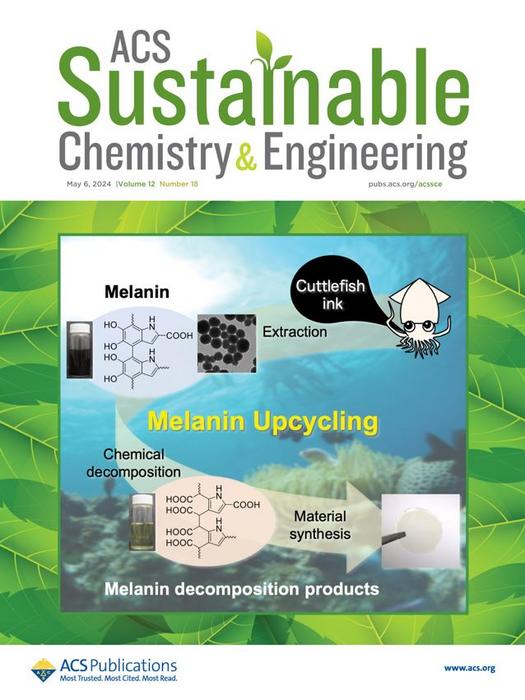
Credit: ACS Sustainable Chemistry & Engineering
Every year, the negative effects of human activities on the environment become increasingly clear. From climate change and microplastics to the endangerment and extinction of countless species, it is evident that we need to find new ways to achieve sustainability. Fortunately, many research groups in prominent fields like chemistry and materials science are tirelessly working to develop solutions to get us closer to circular and sustainable economies.
One area that has attracted much attention in this regard is biomass upcycling. It refers to the transformation of naturally available organic materials into valuable products, such as biofuels and bioplastics. While many scientific studies have focused on plant-derived biomass, such as cellulose fibers, the potential of melanin as a biomass resource remains understudied. One of the main reasons for this is that the decomposition of melanin—a complex yet ubiquitous biopolymer—needs to be further explored.
In a recent study published in ACS Sustainable Chemistry & Engineering, a research team led by Associate Professor Michinari Kohri from the Graduate School of Engineering at Chiba University, Japan, set out to address this knowledge gap. Using both artificially and naturally sourced melanin, they performed a detailed analysis of the decomposition of melanin and showcased its upcycling potential. Their paper, which was made available online on April 19, 2024, and published in Volume 12, Issue 18 of the journal on May 6, 2024, was co-authored by Mr. Takumi Morita and Prof. Keiki Kishikawa from the Graduate School of Engineering at Chiba University, Prof. Toshihiko Matsuura from the Laboratory of Biotechnology and Bioengineering at Hokkaido University of Education, and Prof. Hironori Izawa from the Faculty of Engineering at University of Miyazaki.
First, the researchers synthesized artificial melanin from polydopamine, obtaining a polymer that is structurally very similar to natural melanin. Using powdered samples as a model substance, they ran a series of decomposition tests under various conditions, followed by a series of analytical experiments on the resulting decomposition products.
Afterward, they repeated many of these tests on natural melanin, which they extracted from the ink sacs of cuttlefish. “From a resource perspective, the melanin concentrated in the ink sacs of cuttlefish and squid is easily recoverable natural melanin. The catch of squid and octopus has been increasing yearly and hovering around three million tons for the past few years,” explains Dr. Kohri. Interestingly, the researchers found that both artificial and natural melanin were decomposed into pyrrole derivatives containing carboxylic acids. This result suggests that melanin derived from other renewable and easily accessible sources, such as insect exoskeletons, animal hair, or melanin-producing microorganisms, could be equally useful as a chemical precursor.
Finally, using the decomposition products obtained from artificial and natural melanin as raw materials, the researchers prepared various polymer films and particles. These experiments serve as a demonstration of the untapped potential of melanin in biomass upcycling. “Since melanin is naturally abundant biomass and eventually gets degraded by microorganisms, polymeric materials produced using melanin decomposition products are probably also biodegradable,” highlights Dr. Kohri. “Biodegradable polymers can be disposed of without harming the environment, and thus, the proposed approach for making polymers from melanin decomposition products could lead to the development of sustainable materials.”
Overall, the findings of this study could pave the way to the widespread adoption of melanin upcycling, which could ultimately help us protect the environment. “Just as research on cellulose biomass has advanced because cellulose can be extracted from a variety of underutilized plants, we hope our efforts bolster the use of melanin as a biomass resource,” concludes Dr. Kohri, with eyes on the future.
We echo the team’s wishes for more environmentally friendly practices and look forward to what’s on the horizon for melanin upcycling.
About Associate Professor Michinari Kohri
Michinari Kohri obtained a PhD in Engineering from Tohoku University in 2007. He currently holds the title of Associate Professor at the Department of Applied Chemistry and Biotechnology, Graduate School of Engineering, Chiba University. His research is centered around polymer chemistry, colloid chemistry, and functional materials, with a particular focus on structural colors, biomass upcycling, and soft magnetic materials. He has published over a hundred papers on these topics and is a member of various scientific societies, including The Chemical Society of Japan, The Society of Polymer Science (Japan), and The Japanese Liquid Crystal Society.
Journal
ACS Sustainable Chemistry & Engineering
Method of Research
Experimental study
Subject of Research
Not applicable
Article Title
Melanin Upcycling: Creation of Polymeric Materials from Melanin Decomposition Products
Article Publication Date
6-May-2024
COI Statement
The authors declare no competing financial interest.
Cite Scienmag News
Bethany Barker. (July 1, 2024). Melanin from cuttlefish ink as a sustainable biomass resource. Scienmag. https://scienmag.com/melanin-from-cuttlefish-ink-as-a-sustainable-biomass-resource/
Bethany Barker. "Melanin from cuttlefish ink as a sustainable biomass resource." Scienmag, 1 July 2024, https://scienmag.com/melanin-from-cuttlefish-ink-as-a-sustainable-biomass-resource/. Accessed 4 September 2026.
Bethany Barker. "Melanin from cuttlefish ink as a sustainable biomass resource." Scienmag. July 1, 2024. https://scienmag.com/melanin-from-cuttlefish-ink-as-a-sustainable-biomass-resource/

