


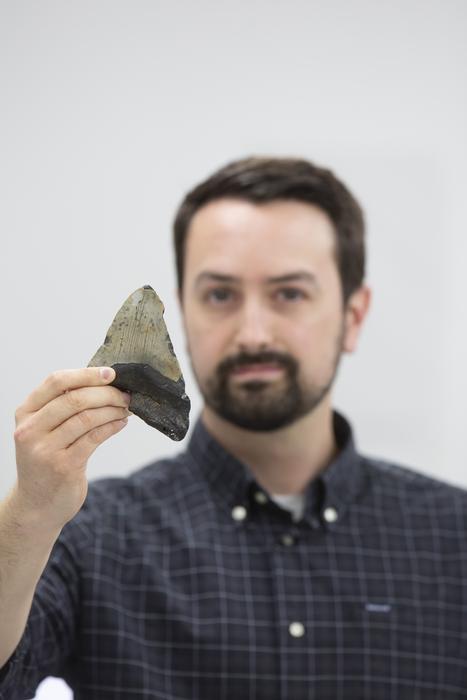
FRANKFURT — The prehistoric oceans once housed a colossal predator whose sheer size and power remain unrivaled in Earth’s aquatic history. Otodus megalodon, commonly known simply as megalodon, stood as the apex predator of its time, measuring over 20 meters in length—surpassing even the combined length of a semi-truck and its trailer. Weighing nearly twice as much, this giant shark brandished immense, triangular teeth the size of a human hand, delivering a bite force comparable to the pressure exerted by an industrial hydraulic press. It roamed the Earth’s oceans between approximately 20 and 3 million years ago, hunting relentlessly to fulfill its staggering caloric needs estimated at 100,000 kilocalories daily. While long assumed to have focused predominantly on large prey like whales, groundbreaking research led by Dr. Jeremy McCormack from Goethe University Frankfurt and an international team of scientists now argues for a far more diverse and opportunistic dietary strategy.
This reinterpretation stems from novel isotopic analyses of fossilized megalodon teeth—among the few remaining relics of this prehistoric giant, which had a skeleton primarily composed of cartilage. The study employed advanced zinc isotope ratio measurements to reconstruct the trophic dynamics of Miocene marine ecosystems. Zinc exists as several isotopes, with zinc-66 and zinc-64 being of particular interest due to their biological fractionation through the food web. Animals preferentially assimilate lighter zinc isotopes, resulting in characteristic shifts in the ratios of zinc-66 to zinc-64 within their tissues, which can be preserved in dental structures over millions of years. Predators residing at the apex of the food chain, like megalodon and its close cousin Otodus chubutensis, exhibit notably low zinc-66 to zinc-64 ratios, reflecting their position atop a complex marine food web.
By comparing these isotopic signatures across multiple shark species—prehistoric and extant—as well as other aquatic vertebrates, McCormack and colleagues illuminated predator-prey relationships dating back 18 million years. The teeth sampled were primarily recovered from fossil deposits near Sigmaringen and Passau in Germany, where an ancient estuarine environment once flourished at depths less than 200 meters along the ancient Alpine foreland. This habitat supported a diverse community of marine life, including various shark species that coexist with megalodon, providing a unique window into Miocene marine ecosystems.
Interestingly, the research delineates a nuanced trophic hierarchy. At the base were organisms such as sea bream, which specialized in feeding on benthic invertebrates like mussels and crustaceans. Above them were smaller sharks, including relatives of modern requiem sharks, and early cetaceans—precursors to today’s dolphins and whales. Mid-level predation was represented by larger shark genera such as sand tiger sharks, while the apex consisted of massive predators like Araloselachus cuspidatus and the Otodus lineage, including megalodon. However, the boundary between the highest and intermediate trophic levels was not sharply defined. Evidence points to megalodon’s dietary flexibility; it preyed across multiple trophic levels, shifting between marine mammals and large fish depending upon availability.
Dr. McCormack underscores this ecological versatility: “Megalodon was not strictly a marine mammal specialist but a highly opportunistic supercarnivore adapting to the ecosystem’s fluctuations.” This insight challenges the long-held paradigm that megalodon’s feeding ecology was narrowly focused on large cetaceans and suggests instead a broad-based predation strategy that could exploit whatever prey was accessible. Moreover, comparative analyses of specimens from different fossil sites highlight regional variability in prey consumption, possibly driven by temporal shifts in prey populations or habitat characteristics. For instance, Passau specimens showed a proclivity toward consumption of lower trophic level prey compared to their Sigmaringen counterparts, hinting at spatial and temporal dietary plasticity.
A notable novelty in this study is the utilization of zinc isotope analysis as a paleoecological tool. This methodology, still in its infancy, has unexpectedly robust applications in reconstructing ancient food webs with fine resolution. Aside from sharks, the technique yielded coherent insights into the diets of extinct herbivorous megafauna such as prehistoric rhinoceroses and has even validated existing knowledge concerning contemporary shark species. McCormack expressed enthusiasm about the potential of these isotopic investigations, noting that the approach adds a valuable dimension to understanding prehistoric ecosystems.
The implications of these findings extend beyond mere dietary reconstructions. By revealing ecological traits and interactions that may have contributed to resilience or vulnerability among Miocene marine megafauna, the research informs broader questions about species extinction and ecosystem dynamics. Paleobiologist Kenshu Shimada of DePaul University, a co-author, emphasizes that “even supercarnivores like megalodon were susceptible to extinction pressures, underscoring the delicate balance within marine communities across geologic time.” Earlier studies, including some involving McCormack’s team, have implicated ecological competition from emerging predators such as the modern great white shark in the eventual disappearance of megalodon.
Taken together, these advances not only enrich our understanding of an iconic yet enigmatic marine titan but also exemplify the power of interdisciplinary approaches—combining paleontology, chemistry, and ecology—to decipher Earth’s deep past. Such integrative studies are critical as they refine models of ancient food webs that underpin evolutionary and extinction patterns, offering analogies that may bear relevance to contemporary marine ecosystems under stress. Megalodon’s story is thus reframed from that of a specialized predator rigidly confined to a narrow niche, to that of an adaptable generalist supercarnivore deftly navigating a complex and fluctuating Miocene seascape.
The ability to infer trophic levels from zinc isotopes opens promising avenues for investigating other extinct taxa and their ecological roles. As geochemical techniques continue to evolve, they may provide unprecedented granularity in reconstructing life’s ancient interactions. Megalodon, long celebrated as the “big tooth,” now emerges as a symbol of ecological ingenuity and evolutionary plasticity—a reminder of nature’s capacity for adaptation, as well as its ultimate vulnerabilities.
Cite Scienmag News
Daisy Hatcher. (May 27, 2025). Megalodon’s Diverse Diet Revealed: Insights into the Feeding Habits of the Giant Shark. Scienmag. https://scienmag.com/megalodons-diverse-diet-revealed-insights-into-the-feeding-habits-of-the-giant-shark/
Daisy Hatcher. "Megalodon’s Diverse Diet Revealed: Insights into the Feeding Habits of the Giant Shark." Scienmag, 27 May 2025, https://scienmag.com/megalodons-diverse-diet-revealed-insights-into-the-feeding-habits-of-the-giant-shark/. Accessed 5 September 2026.
Daisy Hatcher. "Megalodon’s Diverse Diet Revealed: Insights into the Feeding Habits of the Giant Shark." Scienmag. May 27, 2025. https://scienmag.com/megalodons-diverse-diet-revealed-insights-into-the-feeding-habits-of-the-giant-shark/


