


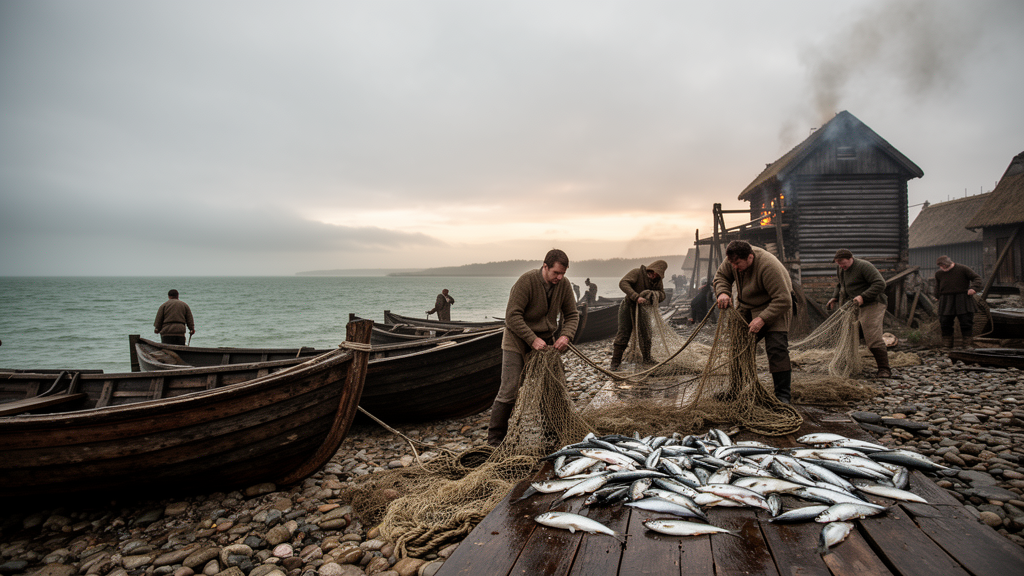
More than four centuries before modern fishing quotas and satellite vessel tracking, a small stretch of water between Denmark and Sweden produced one of Europe’s most valuable commodities. The Sound fishery, harvesting autumn-spawning herring each year between mid-August and early October, supplied salted herring from the British Isles to northern Italy and underpinned the wealth and political power of the Hanseatic world. Then, around the year 1570, it vanished. A new study published in Nature Sustainability reconstructs 450 years of herring catches, from 1200 to 1650, and shows that this historic collapse was not simply the death of a fish stock. It was the product of climate change, overfishing and a web of social and economic pressures interacting in ways that will feel uncomfortably familiar to anyone watching fisheries today.
The research team, led by Rudi Voss of Kiel University and the German Centre for Integrative Biodiversity Research, together with colleagues from institutions in Germany, the United States, Denmark and Italy, faced a formidable data problem. Direct records of medieval catches are sparse, scattered across toll books, customs registers and royal pre-emption accounts known as kongekøb. To fill the gaps, the team combined these fragments with indirect indicators, most importantly the availability and price of salt from the Lüneburg saline, the essential production factor for preserving herring. Demographic trends and general economic conditions served only as consistency checks rather than quantitative inputs, a deliberate design choice that prevents circular reasoning when those same social variables are later tested as drivers of the system. The result is not a precise year-by-year dataset but a smoothed trend curve that captures the major dynamics of the fishery with confidence that varies across centuries.
The reconstructed time series divides naturally into four phases that eerily mirror the trajectory of modern fishery collapses, including the famous Atlantic northwest cod fishery. During the expansion phase from 1200 to 1315, catches in the Sound alone reached a first maximum of roughly 23,000 tonnes around the year 1300, driven by rising demand and the growing availability of high-quality Lüneburg salt. A long stagnation followed from 1315 to 1520, as cooling temperatures depressed agriculture, famines struck between 1315 and 1322, and the Bubonic plague killed an estimated 25 to 35 percent of Europe’s population around 1350, decimating the fishing workforce. Deflation caused by a shortage of gold and silver drained money from the economy, and a series of Baltic wars disrupted trade. Output nevertheless held steady at 19,000 to 23,000 tonnes.
Then came the boom. As the crisis of the Late Middle Ages receded, populations recovered, precious metals flowed back into the economy and the herring market expanded. After Danish wars had initially blocked its growth, the fishery flourished under King Frederic I from 1523 onward. Average output of the Scanian fishery soared to about 55,000 tonnes between 1524 and 1570, with some years exceeding 75,000 tonnes. Contemporaries noticed the strain: the average weight of an individual herring had fallen from about 154 grams in the Viking Age to 82 grams around 1400, and dropped temporarily to 67 grams in 1485, meaning fish were being caught three to four years younger. Pelagic trawl nets were banned as early as 1371, and mesh-size regulations followed in 1386, suggesting that medieval society recognized overfishing long before the word existed.
To test whether this pressure actually destroyed the stock, the team applied a recently developed bioeconomic stock assessment method, or BESA, which exploits the interplay between catch and price data in an unregulated, open-access fishery. Under open access, fishers enter and exit until profits are driven to zero, so price fluctuations reveal how effort responded to changing incentives. The method, built on a state-space model with an extended Kalman filter and Bayesian estimation, allowed the researchers to estimate maximum sustainable yield, stock biomass relative to carrying capacity and the influence of temperature on the stock’s natural growth rate. Four decadal price series from herring markets in England, Hamburg, Brabant and Utrecht provided independent estimates of the same underlying stock.
The verdict was nuanced and surprising. During the boom phase, catches clearly exceeded sustainable limits, and the stock shrank to between 41 and 51 percent of its maximum observed biomass. Yet there was no biological collapse. The herring population declined but remained viable, a conclusion independently supported by ancient DNA and genomic analyses showing that population dynamics over the period were consistent with environmental change rather than pure overexploitation. After the fishery’s breakdown, catches fell far below estimated sustainable levels, eventually averaging perhaps 1,000 tonnes per year in the seventeenth and eighteenth centuries, inferred from tax records of fishers in Kronborg Len. Medieval yields were not matched again until the 1950s.
If the fish did not disappear, why did the fishery? To answer this, the team turned to loop analysis, a qualitative modelling technique that represents the socioecological system as a signed, directed network of nine variables spanning ecology, economy and society, including herring stock, harvest, workforce, demand, population size, economy, agriculture, climate cooling and war. Loop analysis requires only the signs of interactions, not their precise strengths, making it ideal for data-poor historical systems. By applying sustained press perturbations, such as a shift toward cooling, and tracing effects through all direct and indirect pathways, the method predicts the direction of change for every variable. The researchers validated the model against the catch time series across the four historical phases.
The predictions reproduced the observed dynamics with striking fidelity: likely harvest increases during expansion, a slight decline during stagnation, a strong rise during the boom and an unambiguous, severe decrease signaling collapse after 1570. Crucially, climate cooling alone could not explain the outcome. Colder conditions directly reduced herring productivity, since autumn-spawning herring are sensitive to harsh winters, but indirect effects, such as cooling’s damage to agriculture and the resulting demographic decline, transmitted mixed signals through the network. The collapse emerged only from the interplay of local factors like the workforce, regional factors like the economy and demand, and large-scale forces like climate and war. After the 1570s, shifting dunes buried the fair towns of Skanor and Falsterbo, herring shoals fluctuated unpredictably, fishermen emigrated to the booming Bohuslän fishery on Sweden’s west coast, cheap and larger North Sea herring captured demand, and enforced serfdom barred peasants from leaving their landlords’ fields to fish in autumn.
The study also reveals a subtle economic mechanism: because harvesting costs in the BESA framework are stock-dependent, a smaller herring stock raised the cost of every tonne caught. Meanwhile, North Sea fisheries, with a season three times longer and seaworthy boats that outperformed Baltic vessels by a factor of twenty, were flooding the market. The Baltic fishery likely became economically uncompetitive before the fish were ever gone, a divergence between economic viability and ecological sustainability that bioeconomic theory predicts but historical data rarely document so clearly. For centuries, pressures had partly offset one another, keeping catches moderate; in the early sixteenth century they aligned to boost the fishery, and by mid-century they reversed to destroy it.
The lessons reach directly into the present. The western Baltic spring-spawning herring stock, though a different population from the medieval autumn spawners, is now outside safe biological limits and subject to zero-catch advice, its decline driven by overfishing and compounded by climate-driven recruitment failure and food-web interactions. The authors argue that recovery remains possible if fishing mortality ceases, but that management must also address socioeconomic pressures, as now discussed in high-level political groups in Denmark and Germany and reflected in the recent report of the German Commission on the Future of Baltic Sea Fisheries, which recommends improving infrastructure and diversifying coastal economies. History’s message is stark: a fishery is a coupled human-natural system, and no amount of biological stock assessment alone can prevent its collapse. Understanding the people, prices, wars and weather that surround the fish is not a luxury of interdisciplinary scholarship but a requirement for keeping the sea’s silver flowing.
Subject of Research: Socioeconomic and environmental drivers of the medieval western Baltic herring fishery collapse
Article Title: An historic fishery collapse driven by socioeconomic and environmental factors
Article References: Voss, R., Schmidt, J. O., Lehmann, O., Okamoto, D., Polte, P., Lancker, K., Grunwald, A., & Scotti, M. (2026). An historic fishery collapse driven by socioeconomic and environmental factors. Nature Sustainability. https://doi.org/10.1038/s41893-026-01937-1
Image Credits: AI Generated
DOI: 10.1038/s41893-026-01937-1
Keywords: Baltic Sea, herring fishery, fishery collapse, overfishing, climate change, Little Ice Age, loop analysis, bioeconomic stock assessment, socioecological systems, medieval trade, fisheries management, Nature Sustainability
Cite Scienmag News
Sloane Callahan. (October 8, 2026). Medieval Baltic herring collapse reveals the hidden social roots of fishery disasters. Scienmag. https://scienmag.com/medieval-baltic-herring-collapse-reveals-the-hidden-social-roots-of-fishery-disasters/
Sloane Callahan. "Medieval Baltic herring collapse reveals the hidden social roots of fishery disasters." Scienmag, 8 October 2026, https://scienmag.com/medieval-baltic-herring-collapse-reveals-the-hidden-social-roots-of-fishery-disasters/. Accessed 8 October 2026.
Sloane Callahan. "Medieval Baltic herring collapse reveals the hidden social roots of fishery disasters." Scienmag. October 8, 2026. https://scienmag.com/medieval-baltic-herring-collapse-reveals-the-hidden-social-roots-of-fishery-disasters/


