


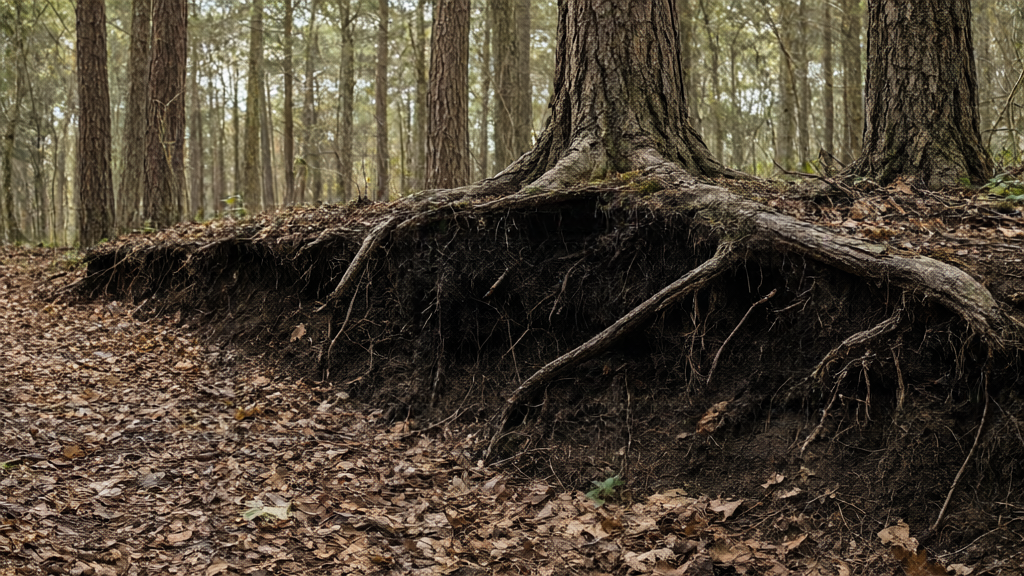
Forests are widely valued for their role in capturing atmospheric carbon, yet their long-term climate benefit depends on more than the total amount of carbon entering the soil. It also hinges on where that carbon is stored and how long it remains protected from decomposition. A new study published in Forest Ecosystems suggests that as forests mature, they do not simply accumulate more soil carbon uniformly. Instead, they redistribute existing carbon between different soil pools, creating contrasting patterns near the surface and deeper underground.
The research team examined temperate forests in Northeast China that represent four distinct stages of a 300-year ecological succession. The study sites ranged from young birch stands to mature mixed broad-leaved and Korean pine forests. By analyzing soils at depths of up to 30 centimeters, the researchers focused on two major pools of soil organic carbon: particulate organic carbon (POC) and mineral-associated organic carbon (MAOC). These two pools behave differently over time, with POC derived from incompletely decomposed plant and microbial material remaining relatively vulnerable to further breakdown, while MAOC forms when processed organic compounds bind to mineral surfaces, where they can remain protected for much longer periods.
The findings revealed that forest maturation does not lead to a simple increase in total soil carbon across all depths. Across the succession, POC declined at every sampled depth, indicating a consistent loss of this more labile carbon fraction as the forest aged. However, the behavior of MAOC varied significantly depending on soil depth. In the upper 10 centimeters of soil, MAOC increased by approximately 55 percent. This increase meant that MAOC accounted for a growing share of total soil carbon in the surface layer, shifting the soil profile toward a more persistent form of carbon storage.
In contrast, below this surface layer, both POC and MAOC declined as the forest matured. This means that while mature forests contained a more stable form of carbon near the surface, they did not accumulate carbon uniformly throughout the entire soil profile. The study highlights that forest age alone is not a reliable predictor of carbon storage capacity. Instead, soil depth and the specific microbial mechanisms driving carbon transformation are critical factors in determining how carbon is retained or lost.
To understand the drivers behind these depth-dependent patterns, the researchers applied microbial carbon pump theory. This framework describes how microorganisms transform plant-derived carbon into soil organic matter through two primary routes. The first route is ex vivo modification, where extracellular enzymes transform organic matter outside of microbial cells. The second route is in vivo turnover, where microbes incorporate carbon into their own biomass, which later enters the soil as dead microbial material, or necromass. The study suggests that both routes play important roles, but their relative contributions vary with forest succession and soil depth.
Microbial life-history strategies influence which of these routes dominates. The resource-acquisition (A) strategy involves investing in extracellular enzymes and is linked to ex vivo modification. As the forests matured, the study found reduced investment in this strategy. This shift may have slowed the rate of decomposition and favored the binding of organic compounds to mineral surfaces, thereby supporting the accumulation of MAOC in the surface soils. This mechanism explains why the topsoil became richer in stable carbon as the forest aged.
The high growth yield (Y) strategy, on the other hand, channels carbon into microbial biomass and is linked to in vivo turnover. The study found that declining necromass was closely associated with the loss of POC. In deeper, resource-poor soils, limited carbon availability restricted microbial biomass and necromass formation. Consequently, even though stronger Y-strategy traits were present, they did not result in greater carbon storage in these deeper layers. This indicates that in resource-scarce environments, microbial growth does not necessarily translate into long-term carbon sequestration.
The research extends microbial carbon pump theory by demonstrating that the interplay between ex vivo modification and in vivo turnover is not static. Instead, these processes shift in response to changing resource availability and microbial community strategies as the forest develops. The study provides a nuanced view of how forest succession affects soil carbon dynamics, moving beyond simple metrics of total carbon storage to examine the quality and stability of that carbon.
These findings have implications for how carbon models are constructed and how forest restoration efforts are designed. By incorporating depth-specific microbial mechanisms into carbon models, scientists could improve predictions of forest carbon storage. Furthermore, understanding that surface soils become more carbon-stable while deeper soils may lose carbon suggests that restoration strategies aimed at building persistent soil carbon reserves need to account for these vertical differences. The study underscores that managing forests for carbon sequestration requires a detailed understanding of the microbial processes operating at different soil depths.
The study, titled “Microbial life-history strategies regulate soil organic carbon formation and stability across soil depths during 300 years of the temperate forest succession,” was published in Forest Ecosystems. The work highlights the complexity of forest carbon dynamics and emphasizes the need for a more mechanistic understanding of how microbial strategies drive carbon stability in changing forest ecosystems.
Subject of Research: Ecology
Article Title: Maturing forests redistribute soil carbon rather than simply storing more
Article References: Maturing forests redistribute soil carbon rather than simply storing more. (n.d.). Original publication
Image Credits: AI Generated
DOI: Not provided
Keywords: soil carbon, forest succession, microbial ecology, carbon sequestration, temperate forests, Maturing, forests, redistribute, soil, carbon, rather, than
Cite Scienmag News
Morgan Morrow. (October 2, 2026). Maturing forests redistribute soil carbon rather than simply storing more. Scienmag. https://scienmag.com/maturing-forests-redistribute-soil-carbon-rather-than-simply-storing-more/
Morgan Morrow. "Maturing forests redistribute soil carbon rather than simply storing more." Scienmag, 2 October 2026, https://scienmag.com/maturing-forests-redistribute-soil-carbon-rather-than-simply-storing-more/. Accessed 4 October 2026.
Morgan Morrow. "Maturing forests redistribute soil carbon rather than simply storing more." Scienmag. October 2, 2026. https://scienmag.com/maturing-forests-redistribute-soil-carbon-rather-than-simply-storing-more/


