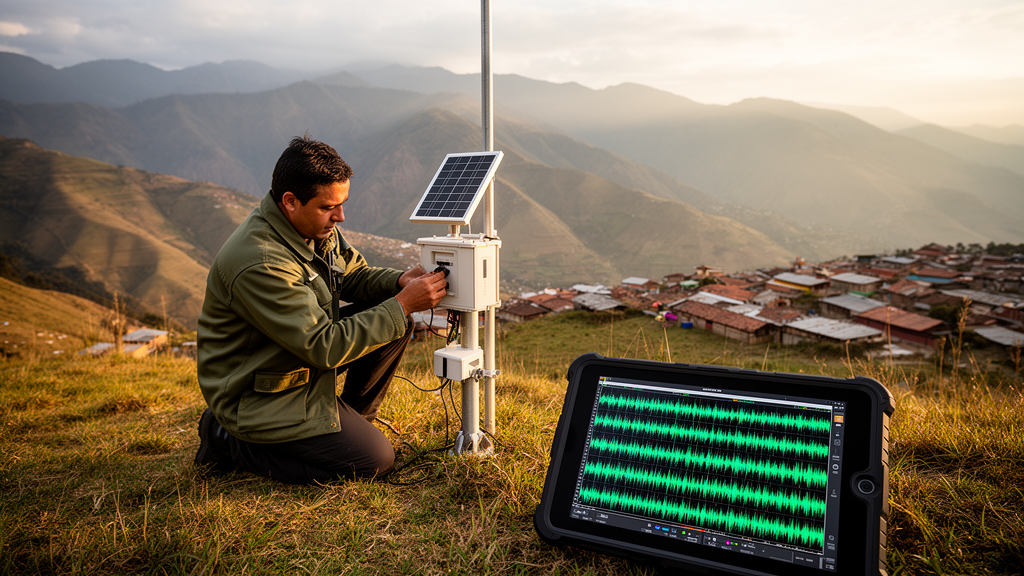
Colombia sits at one of the most complicated tectonic crossroads on Earth. Beneath its northwestern corner, the Nazca and Caribbean plates grind beneath the South American continent, while the Panamá-Chocó block pushes in from the northwest, producing a tangled mixture of subduction megathrusts, deep intraslab ruptures, and shallow crustal faults that slice through the Andes themselves. This collision zone has repeatedly unleashed devastating earthquakes, from the catastrophic magnitude 8.8 Colombia-Ecuador event of 1906, one of the largest ever recorded worldwide, to the 1999 Eje Cafetero earthquake that killed more than 2000 people. Yet despite this well-documented seismic menace, the country has never had a comprehensive, uniformly processed catalogue of the actual ground motions its earthquakes generate. A new study published in Earth System Science Data changes that, presenting an open-access dataset of 7550 three-component acceleration recordings from 667 shallow earthquakes, compiled and processed to the same rigorous standards as the flagship ground-motion databases of North America, Europe, and Japan.
The work was led by Daniel Martinez-Jaramillo, a doctoral researcher at the Universidad Nacional Autónoma de México, together with Sreeram-Reddy Kotha of ISTerre in Grenoble, F. Ramón Zúñiga, and Pierre Lacan. Their starting point was the national seismic network of the Colombian Geological Survey, known by its FDSN code CM, which has operated since 1993 and currently comprises 506 seismological and accelerometric stations distributed across the country. Local networks monitoring volcanoes, mining districts, and oil and gas fields contributed additional stations. Upon request, the survey supplied more than 10,000 quality-checked acceleration time series. The team applied strict selection criteria: events between 0 and 14 degrees north latitude and 69 to 82 degrees west longitude, at depths shallower than 50 kilometres, with magnitudes above 4 and stations within 400 kilometres of the epicentre. After discarding volcanic signals and spurious spikes, 667 earthquakes and 7550 records survived the cut, forming what seismologists call a flatfile: a single table describing every earthquake, every recording site, and every measured level of shaking.
The technical care invested in processing these waveforms is what elevates the dataset from a raw archive to a scientific instrument. Each acceleration time series underwent the same sequence of corrections, following protocols established for the Italian strong-motion databases: baseline correction, cosine tapering, a second-order acausal bandpass Butterworth filter, double integration to obtain displacement, linear detrending of that displacement, and double differentiation back to corrected acceleration. The high-pass corner of the filter was made magnitude-dependent, ranging from 0.15 hertz for the smallest events down to 0.05 hertz for the largest, while the low-pass corner was fixed at a median value of 32.26 hertz. A sensitivity analysis showed that this fixed low-pass choice barely affects most records, shifting the orientation-independent RotD50 peak ground acceleration by an average of just 2.31 percent, though 6.4 percent of recordings, concentrated around magnitude 4.5 at distances beyond 250 kilometres, showed variations above 10 percent, likely reflecting high-frequency noise near the filter corner.
The intensity measures extracted from the corrected records are comprehensive. The dataset provides peak ground acceleration, velocity, and displacement for all three components, along with 5 percent-damped spectral accelerations at 31 oscillator periods spanning 0.01 to 8 seconds, computed as RotD50 values, the median over all non-redundant horizontal orientations, a measure now standard in modern ground-motion modelling. Fourier amplitude spectra for each component cover frequencies from 0.04 to 50 hertz, smoothed with the Konno-Ohmachi function, and the effective amplitude spectrum, a geometric combination of the two horizontal components, is also included. Crucially, the authors report the lowest and highest usable frequencies for every record, bounded by a safety factor of 1.25 around the filter corners so that users know exactly which spectral values are trustworthy. This usable-bandwidth information, often omitted from older compilations, allows engineers and seismologists to weight each record appropriately in downstream analyses.
Perhaps the most technically inventive element concerns magnitudes. Moment magnitude is the preferred scale for hazard analysis, but reliable agency-reported values were not available for every event. Where they were missing, the team estimated magnitudes from the recordings themselves by fitting a single-corner Brune omega-squared source model to each corrected spectrum, using a coarse grid search followed by non-linear least-squares refinement in log-log space. From the resulting corner frequency, the source radius was computed assuming a shear-wave velocity of 3.5 kilometres per second, and the seismic moment followed from the Eshelby circular-crack relation under an assumed constant stress drop. Testing stress drops of 1, 3, and 5 megapascals against independently reported moment magnitudes from the Global CMT catalogue and other agencies, the authors found that 5 megapascals reproduced catalogued values best. This procedure homogenised the entire catalogue, ultimately widening the magnitude range to 3.5 through 7.2, with 24 percent of events falling below magnitude 4 once recalculated.
Site characterisation received equal attention. The 227 recording stations are described by their time-averaged shear-wave velocity in the upper 30 metres, the widely used Vs30 parameter, together with horizontal-to-vertical spectral ratios and predominant site periods derived from seismograms. For 154 sites, these parameters come from a recent northwestern South America database, and 28 of them have in-situ, microtremor-based Vs30 measurements. The remaining stations rely on Vs30 values inferred from a topographic-slope-based map of Colombia, a pragmatic but imperfect proxy. The authors are candid about this limitation, noting that proxy-based site parameters introduce additional epistemic uncertainty that may inflate the site-to-site variability observed in their validation, and pointing to H/V spectral ratio classification schemes as a promising complement for future work. Distance metrics are equally thorough: epicentral and hypocentral distances are reported for all events, while finite-fault measures such as Joyner-Boore distance are computed for the 42 earthquakes larger than magnitude 5.5, with rupture dimensions scaled from published empirical relations.
Validation came through residual analysis, the standard test of whether a new dataset behaves consistently with established ground-motion prediction models. The team compared observed peak ground acceleration, spectral accelerations, and effective amplitude spectra against the global NGA-West2 model of Abrahamson and colleagues from 2014, its regional adaptation for northern South America published by Arteta and colleagues in 2023, and the Bayless-Abrahamson 2019 Fourier-spectrum model. The residuals, decomposed into between-event, between-site, and leftover components, showed no significant biases and followed Gaussian-like distributions confirmed by Shapiro-Wilk tests. As expected, the regional model produced lower overall variability than the global one, and the between-event trends support the internal consistency of the compilation. One instructive exception emerged: within the magnitude range of roughly 4.2 to 4.7, the regional model showed a negative trend in between-event residuals, suggesting that magnitude calibration at these moderate levels could benefit from future refinement.
The statistical footprint of the dataset reveals both its strengths and its character. About 85 percent of records lie beyond 100 kilometres from the epicentre, while only 5.3 percent come from within 50 kilometres, meaning near-source shaking remains comparatively sparse. Roughly 65 percent of the records originate from events shallower than 20 kilometres, confirming the dataset’s focus on shallow crustal seismogenic sources, with the remainder spanning depths down to about 55 kilometres. Strong events are well represented: 716 records, or 9.5 percent of the total, come from earthquakes above magnitude 5.5, including the magnitude 7.2 Pizarro earthquake of 2004 on the Pacific coast and the magnitude 6.1 San Juanito earthquake of 2023 in eastern Colombia. Epicentres of 488 events fall on continental territory and 179 offshore, and the authors deliberately leave tectonic classification, whether subduction interface, intraslab, or crustal, to users, since appropriate assignments depend on the slab models each analyst chooses.
The practical payoff could be substantial. Ground-motion datasets of this kind are the raw material for probabilistic seismic hazard assessment, the framework that underlies building codes, and for the emerging generation of partially non-ergodic ground-motion models, which replace globally averaged predictions with region-specific ones by exploiting dense, well-characterised observations. Colombian engineers designing buildings, and officials updating national hazard maps, will gain a resource calibrated to the actual faults and soils beneath their feet rather than to California or Japan. The Fourier spectra additionally open a window onto source physics, allowing researchers to constrain corner frequencies, seismic moments, and stress drops for Colombian earthquakes directly. Released openly under a Creative Commons Attribution 4.0 licence on Zenodo, with the underlying time series available through the Colombian Geological Survey’s acceleration catalogue and the FDSN network CM, the dataset invites reuse far beyond Colombia’s borders, offering a template for other seismically active but data-poor regions of the world where the next damaging earthquake is only a matter of time.
Subject of Research: A uniformly processed open dataset of ground-motion recordings from shallow earthquakes in Colombia for seismic hazard analysis
Article Title: Ground-motion dataset for shallow earthquakes in Colombia
Article References: Martinez-Jaramillo, D., Kotha, S.-R., Zúñiga, F. R., & Lacan, P. (2026). Ground-motion dataset for shallow earthquakes in Colombia. Earth System Science Data, 18(10), 7403-7415. https://doi.org/10.5194/essd-18-7403-2026
Image Credits: AI Generated
DOI: 10.5194/essd-18-7403-2026
Keywords: Colombia, ground-motion dataset, seismic hazard, earthquake engineering, strong-motion records, moment magnitude, spectral acceleration, Fourier amplitude spectrum, subduction, Vs30, flatfile, open data
Cite Scienmag News
Violet Maxwell. (October 9, 2026). Massive Open Dataset Captures Shaking from 667 Colombian Earthquakes. Scienmag. https://scienmag.com/massive-open-dataset-captures-shaking-from-667-colombian-earthquakes/
Violet Maxwell. "Massive Open Dataset Captures Shaking from 667 Colombian Earthquakes." Scienmag, 9 October 2026, https://scienmag.com/massive-open-dataset-captures-shaking-from-667-colombian-earthquakes/. Accessed 4 November 2026.
Violet Maxwell. "Massive Open Dataset Captures Shaking from 667 Colombian Earthquakes." Scienmag. October 9, 2026. https://scienmag.com/massive-open-dataset-captures-shaking-from-667-colombian-earthquakes/