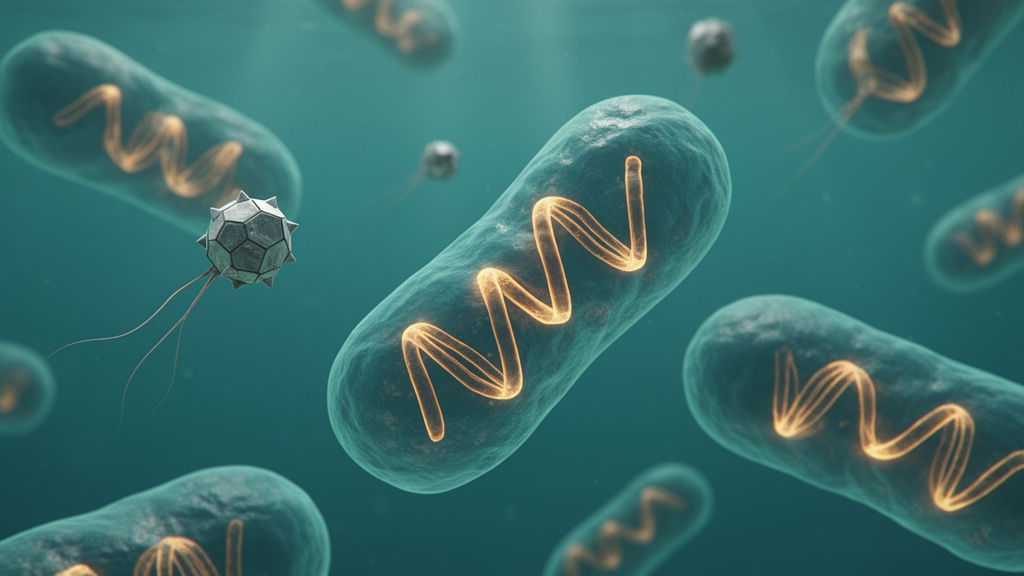
Freshwater ecosystems owe much of their productivity to filamentous, heterocyst-forming cyanobacteria, multicellular microbes that convert atmospheric dinitrogen gas into biologically usable nitrogen while simultaneously harvesting light through photosynthesis. When these organisms bloom, viruses that infect them, the cyanophages, can abruptly end the bloom, lysing the cells and releasing the accumulated nutrients back into the water. Despite this pivotal role in biogeochemical cycling, only a handful of cyanophages capable of infecting nitrogen-fixing cyanobacteria have had their genomes sequenced, and almost nothing has been known about how infection unfolds across the individual cells within a filament. A new study published in the journal Microbiome by Yue Shi, Marcus Ziemann, and colleagues at the Qingdao Institute of Bioenergy and Bioprocess Technology and the University of Freiburg now fills part of that gap with a detailed genomic and microscopic portrait of three newly isolated viruses.
The team isolated and characterized three Caudoviricetes cyanophages, named A-Lf14, A-Alj1, and A-Hlh1, each of which specifically infects the model nitrogen-fixing cyanobacterium Anabaena sp. PCC 7120. This filamentous strain has long served as a laboratory workhorse for studying cyanobacterial cell differentiation, because it forms specialized nitrogen-fixing cells called heterocysts along its chains of photosynthetic vegetative cells. Choosing such a multicellular host meant the researchers could ask questions that cannot be addressed in single-celled systems: does a phage sweep uniformly along a filament, or do neighboring cells progress through infection at different rates? The answer, obtained through super-resolution microscopy, turned out to be strikingly heterogeneous.
Using advanced imaging to localize phage DNA inside Anabaena filaments, the researchers observed that adjacent cells within the same filament displayed markedly different infection outcomes. Some cells harbored abundant viral DNA and progressed toward lysis, while their immediate neighbors remained largely unaffected or showed only early signs of infection. Cryo-scanning electron microscopy captured successive stages of phage-induced cell destruction, from surface alterations to complete collapse of cellular architecture. Together, these observations demonstrate that infection by these cyanophages proceeds asynchronously at the single-cell level, a finding with implications for how viral lysis propagates through the multicellular filaments that form the structural backbone of freshwater and wetland microbial communities.
The genomic analysis uncovered an equally surprising structural feature. Comparative genomics revealed a conserved invertible region of roughly 30 kilobases in the phage genomes, flanked by inverted repeats. Such invertible segments, which can flip their orientation through site-specific recombination, create two distinct genomic isomers within a single viral population. Although genomic inversion is well documented in some bacteriophages, precedent among cyanophages was limited. The team validated the coexistence of the two isomeric configurations using three independent approaches: diagnostic polymerase chain reaction, Sanger sequencing, and mapping of high-throughput sequencing reads onto the reference genomes. Both orientations were stably maintained in the phage populations, indicating that genomic isomerism represents a genuine and recurring source of structural plasticity in freshwater cyanophages rather than a sequencing artifact.
Beyond genome architecture, the study highlighted how auxiliary genes can tie phage infection strategies to the nutritional conditions of the environment. Unlike the previously characterized cyanophage A-1(L), which also infects Anabaena sp. PCC 7120, the three new isolates encode a non-cyanobacterial alkaline phosphatase of the PhoD family. Alkaline phosphatases liberate inorganic phosphate from organic phosphorus compounds, and the gene in question most likely arrived in the phage genome through horizontal transfer from an unrelated organism. During infection, expression of phoD was strongly upregulated, suggesting that the virus actively boosts the host cell’s capacity to scavenge phosphorus, a frequently limiting nutrient in freshwater systems. In effect, the phage appears to reprogram its host’s nutrient acquisition machinery to support viral replication, a mechanism that could also accelerate phosphorus turnover in natural microbial communities.
The comparison with A-1(L) also revealed what the new phages lack. A-1(L) carries an early-expressed tnpB endonuclease gene, whereas the three novel isolates do not. Instead, infection by the new phages modestly induced the transcription of five identical tnpB copies encoded in the host genome. In A-1(L) infection, by contrast, transcription of the phage-encoded tnpB was strongly upregulated from both strands of the gene, designated tnpB_fwd and tnpB_rev. TnpB is of particular interest to the broader life sciences because it is a miniature relative of Cas12, the effector protein of CRISPR-Cas12 systems, and has become a foundation for emerging genome-editing tools. Understanding how tnpB behaves during phage infection therefore carries relevance well beyond cyanobacterial ecology.
Perhaps the most unusual discovery concerns the architecture of that tnpB locus. In a highly atypical genetic arrangement, both strands of the A-1(L) tnpB gene are protein-coding over their entire length. The reverse strand, tnpB_rev, encodes a protein of 347 amino acid residues. Overlapping genes on opposite strands are known in compact viral genomes, but complete bidirectional coding across the full length of a gene of this size is rare. The finding demonstrates that a phage gene can be protein-coding on both strands simultaneously, expanding the known repertoire of genome organization strategies in viruses and raising questions about how such an arrangement evolved and is maintained without deleterious mutations accumulating on either reading frame.
The researchers also searched the phage genomes for anti-CRISPR genes, proteins that phages deploy to neutralize host immune defenses, with algorithmic support from collaborators, and compiled extensive catalogs of functional open reading frames, gene clusters, and CRISPR arrays detected across the cyanophages included in the analysis. Environmental sampling information and physicochemical parameters of the freshwater sites used for phage isolation were documented, anchoring the genomic findings in the ecological contexts from which the viruses were recovered. Phylogenetic placement of the new isolates among known cyanophages situates them within the diversity of Caudoviricetes, the broad class of tailed double-stranded DNA phages that dominates cultured bacteriophage diversity.
Methodologically, the study illustrates the value of combining complementary techniques. Super-resolution microscopy and electron microscopy provided spatial and ultrastructural evidence of asynchronous infection, while comparative genomics, targeted sequencing, and read-mapping converged on the reality of genomic isomerism. Transcriptomic measurements linked individual auxiliary genes to infection biology, showing not merely that phages carry metabolic genes but that those genes are actively and specifically expressed during the infection cycle. This integration of scales, from nucleotide-level genome structure to the behavior of entire multicellular filaments, offers a template for future work on phage-host interactions in other filamentous microbes.
Ecologically, the findings carry weight for understanding nutrient cycling in freshwater, wetland, and agricultural ecosystems, where nitrogen-fixing cyanobacteria serve as primary producers and their viral lysis releases fixed nitrogen and phosphorus back into the food web. The discovery that cyanophages can modulate phosphorus acquisition through phoD suggests that viruses may directly influence how limiting nutrients flow through these environments. The demonstration of stable genomic isomerism adds a layer of structural variability that could affect how phage genomes are annotated, compared, and tracked in metagenomic surveys, since a single viral population may harbor two sequence configurations. As more cyanophages infecting nitrogen-fixing cyanobacteria are characterized, the mechanisms uncovered here, from invertible DNA to dual-strand coding, are likely to prove part of a broader strategy by which these viruses diversify their genomes and adapt to the nutritional and defensive landscapes of their hosts.
Subject of Research: Comparative genomics and single-cell imaging of cyanophages infecting the nitrogen-fixing cyanobacterium Anabaena sp. PCC 7120
Article Title: Comparative genomics and super-resolution microscopy of novel cyanophages reveals genomic isomerism, auxiliary genes, and a non-synchronous infection process
Article References: Shi, Y., Ziemann, M., Zhao, Y., Reimann, V., Zhu, T., Hess, W. R., & Lu, X. (2026). Comparative genomics and super-resolution microscopy of novel cyanophages reveals genomic isomerism, auxiliary genes, and a non-synchronous infection process. Microbiome. https://doi.org/10.1186/s40168-026-02551-1
Image Credits: AI Generated
DOI: 10.1186/s40168-026-02551-1
Keywords: cyanophages, Anabaena sp. PCC 7120, genomic isomerism, phoD, tnpB, super-resolution microscopy, auxiliary metabolic genes, Caudoviricetes, nitrogen fixation, phosphorus acquisition, Microbiome, comparative genomics
Cite Scienmag News
Juliet Wilcox. (October 9, 2026). Freshwater Cyanophages Reveal Flip-Flopping Genomes and a Two-Way Gene. Scienmag. https://scienmag.com/freshwater-cyanophages-reveal-flip-flopping-genomes-and-a-two-way-gene/
Juliet Wilcox. "Freshwater Cyanophages Reveal Flip-Flopping Genomes and a Two-Way Gene." Scienmag, 9 October 2026, https://scienmag.com/freshwater-cyanophages-reveal-flip-flopping-genomes-and-a-two-way-gene/. Accessed 9 October 2026.
Juliet Wilcox. "Freshwater Cyanophages Reveal Flip-Flopping Genomes and a Two-Way Gene." Scienmag. October 9, 2026. https://scienmag.com/freshwater-cyanophages-reveal-flip-flopping-genomes-and-a-two-way-gene/