


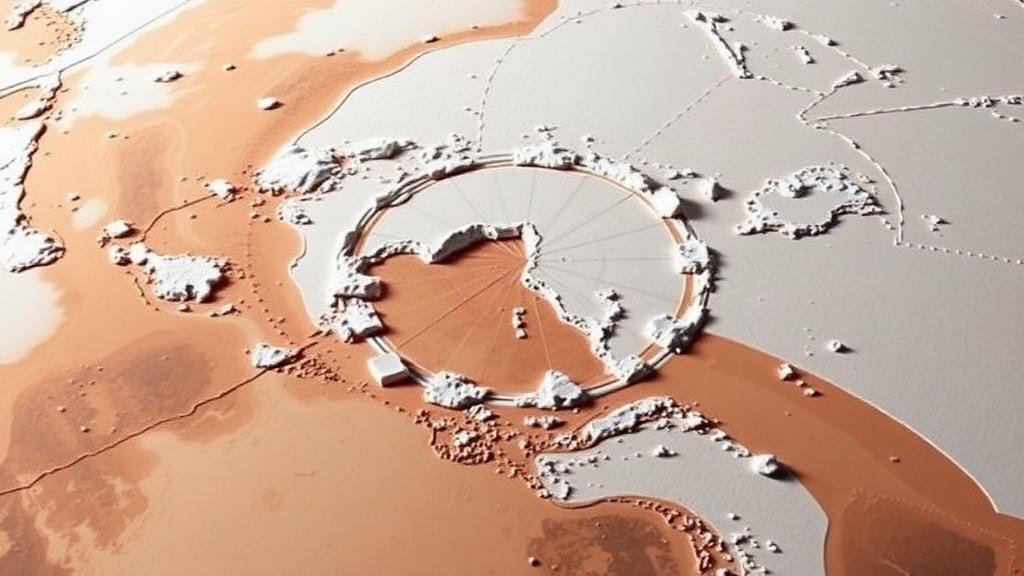
Mars is a cold, desolate world today, but buried within its polar ice caps lies a record of a very different planetary history. Just as scientists drill into Greenland and Antarctica to read Earth’s climate past, researchers hope to decode the layered ice at the Martian poles for clues about ancient snowfall, shifting seasons, and the tantalizing possibility that the planet once harbored life. Now, a new study from the University of Washington has upended a long-standing assumption about the composition of that ice, finding that the north polar cap of Mars contains dramatically less dust than previous analyses had suggested. The finding, published Sept. 8 in the journal npj Space Exploration, has implications that reach from the planet’s climate history to the search for habitable environments on the red planet.
The research team, led by Aditya Khuller, a senior research scientist at the University of Washington’s Applied Physics Laboratory, set out to resolve a stubborn disagreement in the planetary science community. “We know there is water ice in the area surrounding the north pole of Mars, but there has been widespread disagreement as to how dusty that ice is,” Khuller said. The stakes of that disagreement are higher than they might first appear. Dust content determines how dark the ice is, and darkness determines temperature. “If it is dustier, the ice will be darker. Just like a dark T-shirt in the sun makes you warmer, dusty ice gets warmer and vaporizes faster on Mars,” Khuller explained. In the thin Martian atmosphere, where water vapor sublimates directly from ice to gas, even small differences in dust concentration can meaningfully change how quickly polar ice is lost to the atmosphere.
The methodological heart of the study lies in a cross-planetary detective story. For years, the leading technique for estimating the physical properties of Martian ice was an analytical approach originally developed for studying soil on the Moon. Several years ago, Khuller noticed something troubling: when he tested the accuracy of that lunar-derived method against measurements on Earth, the results seemed off. The discrepancy suggested that decades of estimates about Martian ice composition might rest on a shaky foundation. Rather than simply flagging the problem, Khuller and Pari Mohan, who recently graduated from the University of Washington with a degree in geoscience, decided to redo the calculations entirely using a different framework.
That framework came from an unexpected corner of the university. Steve Warren, professor emeritus of Earth and space sciences at the University of Washington, has spent decades perfecting methods for analyzing snow and ice on our own planet. His radiative transfer techniques, refined through years of studying how light interacts with snow crystals and embedded impurities, had been used successfully to study terrestrial snow and ice for decades. “His methods had been used successfully to study snow and ice on Earth for decades. So I thought it would be interesting to adapt these Earth-tested methods to Mars,” Khuller said. The adaptation required accounting for the very different conditions on Mars, including its lower atmospheric pressure, different illumination geometry, and the peculiar way dust grains scatter light within ice matrices.
The data underpinning the new analysis came from a combination of sources spanning half a century of Mars exploration. NASA celebrated its first successful mission to Mars 50 years ago with the Viking program, and in 2008 the Mars Phoenix lander achieved a major milestone by successfully sampling ice near the north pole. That triumph carried particular weight because it followed the loss of the Mars Polar Lander, which went missing near the south pole in 1999. The University of Washington researchers combined the Phoenix mission’s ground-truth measurements with observations from orbiting satellites, allowing them to connect what the lander touched on the surface with what spacecraft see from above. This pairing of surface and orbital data is essential, because orbiters can survey vast swaths of the polar terrain but need calibration against direct measurements.
The results paint a strikingly different picture of the north polar cap. Rather than a uniformly dirty slab of ice, the polar layered deposits are structured, in Khuller’s words, “like an ice-cream sandwich,” with layers of dustier ice interleaved between slabs of much cleaner ice. The team traced the origin of this layering to an annual cycle. A dusty layer of frost forms over the ice cap every Martian winter, and when summer arrives, that seasonal frost sublimates away, exposing the older, cleaner ice beneath. “By looking at how the brightness changed over time, we figured out that there is a frost that forms in the winter and it’s more dusty. In the Martian summer it goes away, exposing cleaner, older ice,” Khuller said. The brightness changes observed from orbit over successive seasons provided the key signature distinguishing seasonal frost from the permanent ice below.
The quantitative correction is substantial. Previous estimates had suggested that the top layer of the polar ice contained as much as 25 percent dust by mass, a figure that would make the ice dark and thermally aggressive under the Martian sun. The new study finds the true value is closer to 3 percent, a nearly tenfold reduction. That difference transforms scientific understanding of the ice cap’s radiative properties: cleaner ice reflects far more sunlight, stays colder, and sublimates more slowly. It also changes how researchers should interpret the layered deposits as climate archives, since the amount of dust locked into each layer is one of the primary proxies for the conditions under which that ice formed.
Those layers contain key details about the climate of Mars thousands of years ago, when the ice is thought to have formed from snowfall. Mars experiences massive ice ages that have deposited shallow ice across roughly one-third of the planet’s surface, and the driver of this dramatic variability lies in planetary mechanics. Earth’s axial tilt is stabilized by the gravitational influence of its relatively large moon, which keeps our seasons within a narrow, predictable range over tens of thousands of years. Mars, possessing only two small moons, lacks that stabilizing hand. Its axial tilt, or obliquity, “oscillates wildly,” Khuller said, swinging through large excursions over geological timescales. Those oscillations redistribute sunlight across the planet’s latitudes, driving the advance and retreat of ice ages and leaving their signature in the alternating layers of the polar caps.
The cleaner ice also reshapes thinking about habitability. In a previous study, Khuller and colleagues proposed that layers of dust and ice could create conditions suitable for life on Mars. Dark, dusty layers absorb sunlight and could warm the surrounding ice enough to form pockets of meltwater within otherwise frozen deposits. These pockets, enriched with nutrients supplied by the dust grains, could potentially host bacteria and other primitive life forms. The analogy comes from Earth, where similar pockets of shallow, dusty meltwater within ice are often teeming with microbial life during summer. In winter, the liquid water freezes and the microbes go dormant, reviving when the next summer thaws their icy refuge. “The fact that Mars and Earth both have these similar layers of water ice and dust is interesting,” Khuller said. “Why does one planet have life and the other doesn’t?”
Answering that question may take years, but the new dust measurements sharpen the picture of where to look and what to expect. Cleaner ice absorbs less sunlight than previously assumed, which alters calculations of where and whether meltwater pockets could form within the polar layered deposits, and it refines models of how the ice cap responds to seasonal and long-term climate cycles. Khuller hopes to build on the work by applying these improved, Earth-tested analytical methods to other regions of the red planet, extending the corrected picture of ice composition beyond the north pole. As missions continue to probe the Martian surface and orbiters keep watch over the polar caps, the layered ice of Mars stands as one of the most promising archives of the planet’s climatic memory, and one that now appears considerably cleaner, and perhaps more revealing, than scientists had believed.
Subject of Research: Dust content of exposed water ice at the north polar cap of Mars
Article Title: The north pole of Mars is less dusty than scientists thought
Article References: The north pole of Mars is less dusty than scientists thought. (n.d.). Original publication
Image Credits: AI Generated
DOI: Not provided
Keywords: Mars, north polar cap, water ice, dust content, Mars Phoenix, climate record, polar layered deposits, radiative transfer, ice ages, axial tilt, astrobiology, University of Washington
Cite Scienmag News
Grant Pearson. (October 2, 2026). Mars’ North Polar Ice Is Far Cleaner Than Scientists Believed, Study Finds. Scienmag. https://scienmag.com/mars-north-polar-ice-is-far-cleaner-than-scientists-believed-study-finds/
Grant Pearson. "Mars’ North Polar Ice Is Far Cleaner Than Scientists Believed, Study Finds." Scienmag, 2 October 2026, https://scienmag.com/mars-north-polar-ice-is-far-cleaner-than-scientists-believed-study-finds/. Accessed 4 October 2026.
Grant Pearson. "Mars’ North Polar Ice Is Far Cleaner Than Scientists Believed, Study Finds." Scienmag. October 2, 2026. https://scienmag.com/mars-north-polar-ice-is-far-cleaner-than-scientists-believed-study-finds/


