


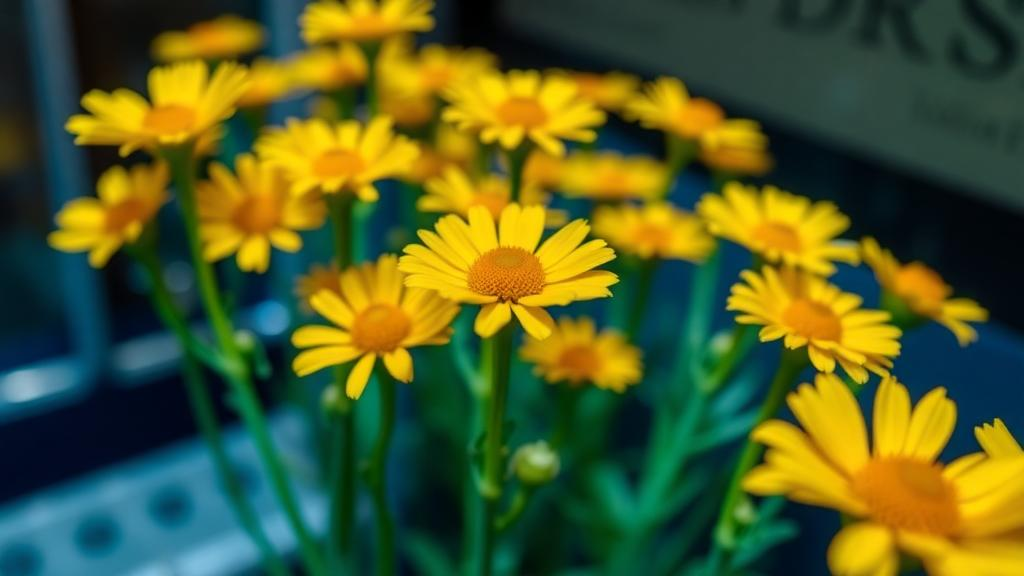
For more than fifty years, a single tobacco cell line has dominated the world of plant biotechnology. Now, researchers at the Fraunhofer Institute for Molecular Biology and Applied Ecology in Aachen, Germany, have turned to an unexpected candidate to challenge that monopoly: the marigold. In a study published in Plant Cell Reports, Matthias Buntru, Alexander Croon, Jürgen Müller, Marika Hanke and Helga Schinkel describe the establishment of a new suspension cell culture derived from the roots of Calendula officinalis, the common pot marigold, and demonstrate that it can produce recombinant proteins at levels that rival or exceed the industry workhorse tobacco Bright Yellow 2, better known as BY2.
The new cell line, named Calendula Root 1, or CR1, was born from a deceptively simple procedure. Seeds of Calendula officinalis were surface-sterilized and germinated on agar plates, and the emerging rootlets were sliced into small fragments and placed on callus induction medium containing the auxin 2,4-dichlorophenoxyacetic acid. Within days, a soft white callus appeared on the root pieces, and just thirty-five days after callus formation was first observed, the researchers transferred the tissue into liquid medium to start a suspension culture. The resulting cells, mostly round and measuring between fifty and three hundred micrometers, grew quickly and homogeneously, reaching packed cell volumes of fifty to sixty percent within a week when passaged weekly, figures very similar to those of BY2 cultures grown under comparable conditions.
One of the most consequential findings of the study came from an analysis of what the cells leave behind in their growth medium. When recombinant proteins are secreted into the culture supernatant, purification becomes dramatically simpler, but secreted proteins are vulnerable to the proteases that plant cells release into the medium. In BY2 cultures, these extracellular proteases have long been a thorn in the side of protein producers. Using gelatin zymography, a technique in which gelatin is embedded in a polyacrylamide gel so that proteolytic activity appears as clear bands of degraded substrate, the team found that the CR1 supernatant showed only minimal degradation at a single position of roughly eighty kilodaltons. The BY2 supernatant analyzed in the same experiment, by contrast, displayed five distinct degradation bands between fifty and sixty-eight kilodaltons plus a weaker signal at one hundred kilodaltons. This stark difference positions CR1 as a potentially far friendlier host for secreted products.
To test the production capacity of the new line, the researchers engineered a transformation construct carrying two independent expression cassettes, both driven by the cauliflower mosaic virus 35S promoter. The first encoded DsRed, the tetrameric red fluorescent protein from the coral Discosoma, targeted to the endoplasmic reticulum. The second encoded brazzein, a small, intensely sweet protein of just 6.5 kilodaltons from the West African plant Pentadiplandra brazzeana, directed to the apoplast, the space between the cell membrane and the cell wall from which proteins can reach the culture medium. DsRed served as a visible marker, allowing the team to pick fluorescent calli with a simple cold light source and filters, while brazzein represented a genuine industrial target with no commercial antibody available for detection.
Transformation was carried out using Agrobacterium tumefaciens strain GV3101, with cocultivation performed in the dark on solid medium. Ten days after plating on selection medium containing kanamycin, the first seventy-two fluorescent calli were picked, followed by another eighty-four five days later. Notably, the researchers chose not to optimize the codon sequences of either gene, reasoning that the available codon usage data for Calendula officinalis was sparse and that analysis of the closely related sunflower revealed no truly rare codons. Some calli turned visibly pink to the naked eye, indicating very high DsRed accumulation, and these were used to initiate suspension cultures that grew homogeneously within two weeks, although growth rates varied considerably between transformation events.
Quantifying brazzein posed a methodological challenge that the team solved with an elegant two-step approach. First, they purified brazzein from the supernatant of transformation event 74 using cation exchange chromatography and ultrafiltration, creating an in-house reference standard. Top-down liquid chromatography with tandem mass spectrometry confirmed the integrity of this standard, detecting the sevenfold-charged ion at a mass-to-charge ratio of 925.69 and deconvoluting the signals to a molecular weight of 6473 daltons, exactly the correct average mass of brazzein. The standard was then quantified by tryptic digest and comparison with a commercial isotope-labeled peptide, yielding a concentration of 0.21 milligrams per milliliter. Armed with this reference, the team used top-down LC-MS/MS with external calibration to measure brazzein in the supernatants of seven transformation events.
The results were striking. Brazzein concentrations in the culture supernatants ranged from 4.1 to 24.5 micrograms per milliliter, with an average of 10.5 micrograms per milliliter. Expressed per gram of fresh cell weight, the best line produced 259 micrograms of brazzein after fifteen days, roughly two hundred times more than the 1.2 micrograms per gram previously reported for brazzein production in transgenic carrot cells. Crucially, the brazzein produced in CR1 was untagged and secreted into the medium, an important distinction because attachments to either terminus of the molecule can alter or even completely abolish its sweetness. While yeast fermentation still holds the record for brazzein titers, with reports exceeding 300 milligrams per liter, the authors emphasize that the purpose of their work was to showcase the platform rather than to maximize this particular product.
The DsRed figures were even more dramatic. The best transformation event, line 155, accumulated 1322 micrograms of DsRed per gram of fresh weight, equivalent to 34.9 percent of total soluble protein, a figure the authors note clearly exceeds production rates reported for other recombinant proteins in the literature. Even the average across the seven analyzed lines, 533 micrograms per gram, was more than twice the roughly 200 milligrams per kilogram of biomass achieved with cytosol-targeted DsRed in transiently transformed BY2 plant cell packs. Because stable transformants are generally assumed to produce less recombinant protein than transiently transformed cells, the true capacity of CR1 may be even greater than these numbers suggest. Only small amounts of DsRed, between zero and 19.9 percent, were found in the supernatants, indicating that the cultures consisted largely of intact cells at harvest.
The study also revealed intriguing biology that will require further investigation. Transformation events that produced the most DsRed tended to grow more slowly, with line 155 being the most prominent example, though the authors did not explore the causal relationship in this dataset. Moreover, the molar production ratio of DsRed to brazzein varied widely between lines, from 1:2 in event 74 to 1:0.24 in event 16, showing that high DsRed output is not a reliable predictor of output from the second cassette in the tandem construct. The researchers attribute this asymmetry to position effects and to the multiple or partial T-DNA insertions that commonly occur during Agrobacterium-mediated transformation. Encouragingly, thirty-three months after transformation, all analyzed calli and dozens of others were still alive and expressing DsRed, suggesting robust transgene stability.
The authors acknowledge one cosmetic quirk: like BY2 cultures, which accumulate the pigment phytomelanin, aging CR1 cultures turn brownish-black, a trait known in marigold and other members of the Asteraceae family. Timely subculturing kept the browning from interfering with the work. Taken together, the findings establish CR1 as a rapidly growing, easily transformed cell culture with remarkably low protease activity in its medium and exceptional recombinant protein productivity in both the cytosolic-to-ER and secretory routes. Beyond the raw numbers, the choice of marigold carries strategic weight: as a well-known therapeutic herb with a positive public image, Calendula may sidestep the customer acceptance concerns that can complicate the use of tobacco-derived lines for food-related products, while its rich secondary metabolism offers untapped possibilities for producing high-value plant natural products in bioreactors.
Subject of Research: Establishment of a marigold (Calendula officinalis) suspension cell culture for recombinant protein production
Article Title: Marigold suspension cell culture as production system for recombinant DsRed and brazzein
Article References: Buntru, M., Croon, A., Müller, J., Hanke, M., & Schinkel, H. (2026). Marigold suspension cell culture as production system for recombinant DsRed and brazzein. Plant Cell Reports, 45(10), Article 317. https://doi.org/10.1007/s00299-026-03982-8
Image Credits: AI Generated
DOI: 10.1007/s00299-026-03982-8
Keywords: plant cell culture, Calendula officinalis, recombinant proteins, DsRed, brazzein, BY2 cells, Agrobacterium tumefaciens, LC-MS/MS, protease activity, suspension culture, plant biotechnology, Fraunhofer IME
Cite Scienmag News
Alan Morgan. (September 30, 2026). Marigold Cells Emerge as a Powerful New Factory for Recombinant Proteins. Scienmag. https://scienmag.com/marigold-cells-emerge-as-a-powerful-new-factory-for-recombinant-proteins/
Alan Morgan. "Marigold Cells Emerge as a Powerful New Factory for Recombinant Proteins." Scienmag, 30 September 2026, https://scienmag.com/marigold-cells-emerge-as-a-powerful-new-factory-for-recombinant-proteins/. Accessed 4 October 2026.
Alan Morgan. "Marigold Cells Emerge as a Powerful New Factory for Recombinant Proteins." Scienmag. September 30, 2026. https://scienmag.com/marigold-cells-emerge-as-a-powerful-new-factory-for-recombinant-proteins/


