


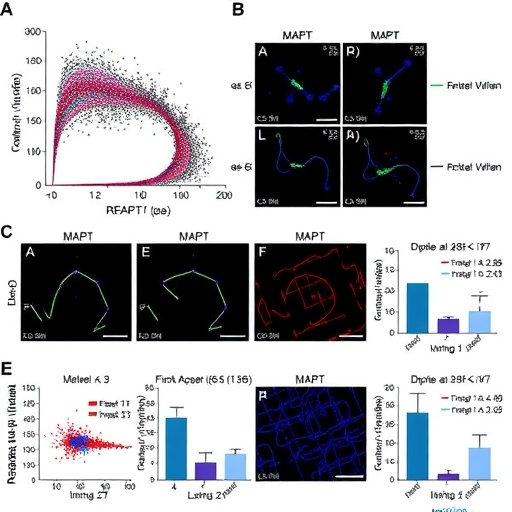
In a groundbreaking study published in Nature Neuroscience, scientists have unveiled pivotal insights into the pathological mechanisms driving neurodegenerative diseases linked to tau protein abnormalities. This research elucidates how mutations in the microtubule-associated protein tau (MAPT) gene give rise to early disruptions in axonal transport, a critical process for neuronal function and survival. Remarkably, the study identifies the inhibition of the p38α kinase as a promising therapeutic intervention capable of rescuing these early pathological defects.
Tau proteins play an essential role in stabilizing microtubules, the structural components that ensure proper axonal transport of organelles and molecular cargo within neurons. Mutations in the MAPT gene are known to cause various forms of tauopathies, including frontotemporal dementia and related disorders. However, the precise cellular deficits that occur early in disease progression have remained elusive. The current investigation offers a detailed mechanistic account of how aberrant tau accumulation impairs intracellular transport well before widespread neurodegeneration manifests.
Using advanced imaging and molecular techniques, the researchers demonstrated that mutant forms of tau exhibit a heightened propensity to aggregate within axons. These aggregates disrupt microtubule dynamics and interfere with motor proteins responsible for ferrying cargoes between neuronal soma and synapses. As a consequence, axonal transport stalls, leading to the accumulation of defective mitochondria and synaptic vesicles, which critically undermine neuronal health and signaling.
Importantly, the study reveals that the pathological tau species induce activation of the stress kinase p38α, a signaling molecule implicated in neuronal stress responses and inflammation. Elevated p38α activity exacerbates transport defects and promotes further tau pathology, establishing a detrimental feedback loop that accelerates neuronal dysfunction. This connection between tau accumulation and p38α signaling sheds new light on the pathological cascade underlying tau-related neurodegeneration.
Therapeutic experiments carried out in neuronal cell models and animal systems showed that pharmacological inhibition of p38α effectively reverses the aberrations in axonal transport caused by mutant tau. Treatment with selective p38α inhibitors restored mitochondrial trafficking, normalized synaptic vesicle movement, and ultimately improved neuronal survival metrics. These findings underscore the potential of targeting p38α as a disease-modifying strategy for tauopathies.
The researchers employed quantitative live-cell imaging to monitor the transport of mitochondria and synaptic components in neurons expressing mutant tau. They observed marked decreases in both velocity and frequency of cargo movement along axons, well before overt signs of cell death appeared. Intervention with p38α inhibitors rapidly rescued these transport parameters to near-normal levels, emphasizing the early and reversible nature of the pathological phenotype.
Further molecular analysis identified that p38α activation leads to the phosphorylation of key motor proteins and microtubule-associated factors, thereby disrupting their functional capacity. By mitigating this phosphorylation through kinase inhibition, the stability and efficiency of axonal transport are maintained despite the presence of mutant tau. This mechanistic insight provides a rational basis for the development of targeted therapies aiming to preserve neuronal function.
The study also highlights the importance of early intervention in tauopathies. Detecting and correcting transport defects at initial disease stages may prevent irreversible neuronal damage and cognitive decline. Given the complex interplay between tau pathology, kinase signaling, and transport machinery, combinatorial therapeutic approaches could offer superior clinical outcomes, combining p38α inhibition with strategies to reduce tau aggregation.
Moreover, these findings have broader implications beyond classical tauopathies. Since axonal transport deficits are common features in multiple neurodegenerative diseases, including Alzheimer’s and Parkinson’s, modulating p38α or related signaling cascades might provide a generalizable avenue to halt or slow neurodegeneration. Future studies are needed to explore this potential and to optimize inhibitor compounds for safe and effective human use.
The translational prospects of this research are further bolstered by the availability of selective p38α inhibitors already in clinical development for other inflammatory conditions. Repurposing or modifying these agents to target neuronal p38α activity might accelerate the path to therapeutic application. However, careful evaluation of blood-brain barrier penetration, off-target effects, and long-term safety will be critical to realizing their potential.
In conclusion, the study represents a major advance in our understanding of how MAPT mutations disrupt neuronal homeostasis at the molecular and cellular levels. By pinpointing the central role of p38α kinase in mediating these early pathological changes, the research paves the way for novel interventions tailored to halt disease progression before irreversible neurodegeneration ensues. The concept that a single kinase inhibitor can restore complex intracellular transport dynamics is a testament to the power of mechanism-based drug discovery.
Going forward, integrating these insights with biomarker development and patient stratification will be essential for successful clinical translation. Identifying individuals harboring MAPT mutations early and monitoring axonal transport function may guide personalized therapeutic regimens. Ultimately, such mechanistic-focused approaches hold promise to transform the management of devastating neurodegenerative diseases, improving quality of life for countless patients.
This study not only deepens the scientific community’s grasp of tau biology in neurodegeneration but also highlights the burgeoning potential of targeted kinase modulation as a therapeutic paradigm. The findings ignite hope that effective treatments for tauopathies are within reach if intervention can be aligned precisely with early cellular dysfunction. Continued exploration of tau-p38α signaling interplay will undoubtedly enrich our arsenal against neurodegenerative disorders.
Cite Scienmag News
Cassandra Pierce. (June 4, 2026). MAPT Mutations Disrupt Axonal Transport, p38α Inhibition Restores. Scienmag. https://scienmag.com/mapt-mutations-disrupt-axonal-transport-p38%ce%b1-inhibition-restores/
Cassandra Pierce. "MAPT Mutations Disrupt Axonal Transport, p38α Inhibition Restores." Scienmag, 4 June 2026, https://scienmag.com/mapt-mutations-disrupt-axonal-transport-p38%ce%b1-inhibition-restores/. Accessed 3 September 2026.
Cassandra Pierce. "MAPT Mutations Disrupt Axonal Transport, p38α Inhibition Restores." Scienmag. June 4, 2026. https://scienmag.com/mapt-mutations-disrupt-axonal-transport-p38%ce%b1-inhibition-restores/


