


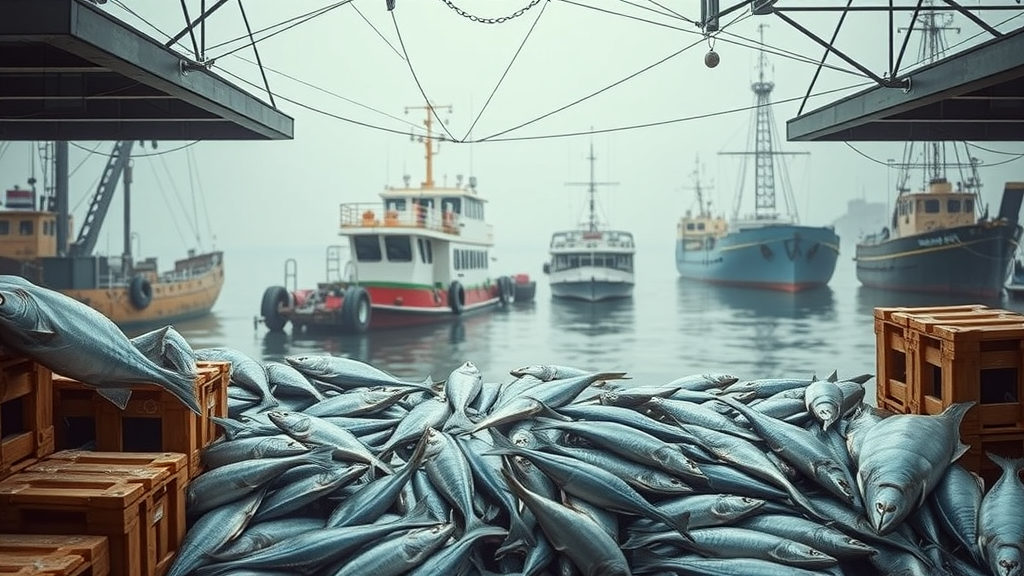
Boulogne-sur-Mer, on the southern shore of the Strait of Dover, is far more than a picturesque French fishing port. It is the beating heart of Europe’s seafood industry: France’s largest fishing harbor, selling nearly 33,000 tons of seafood at its local fish market in 2024, and the continent’s leading seafood processing hub, importing roughly 300,000 tons of seafood each year, mainly salmon from Norway and Scotland and shrimp from Madagascar, Ecuador, and Peru. In an industrial district called Capecure, 150 organizations employing 5,000 workers fillet, can, salt, freeze, store, trade, package, and ship seafood products destined primarily for France, Italy, and Spain. Now, a team of French researchers has done something no one had attempted before at this scale: they have mapped the entire social-ecological system of this hub as a single network, revealing with striking clarity how deeply production dominates the way the whole sector is organized.
The study, published in the journal Ambio, was led by Etienne Quillet of the Université du Littoral Côte d’Opale together with Rhoda Fofack-Garcia, Laureline Poisson, and Frida Ben Rais Lasram. Their goal was not simply to describe the seafood industry but to capture its structural complexity, the dense web of interactions linking fish stocks, fishing vessels, processing plants, regulators, markets, technologies, and social norms. To do this, they combined two analytical frameworks that are rarely brought together: the social-ecological network approach, which translates social and ecological elements into nodes and links, and Actor-Network Theory, a sociological perspective that insists non-human entities such as fishing gear, processing technologies, climate change, and even abstract concepts like the market can act as full participants in shaping a system.
The theoretical foundation matters because conventional approaches to social-ecological systems often treat the non-human world passively, as a backdrop against which human actors make decisions. Actor-Network Theory, developed by sociologists Michel Callon and Bruno Latour, flips that assumption. In this view, components are defined by their relationships to other components rather than by their intrinsic characteristics, and material and immaterial objects alike can stabilize or destabilize the network. For a sector as technically saturated as seafood processing, where social and ecological components interact through fishing gear, filleting lines, cold-storage facilities, and regulatory institutions, this perspective offered the researchers a way to include everything stakeholders considered relevant, without imposing rigid predefined boundaries on the system.
Building the network required extensive fieldwork. Between May and July 2024, the researchers conducted semi-structured interviews, direct observations, and participatory workshops with a deliberately diverse set of participants drawn from the membership of the regional competitiveness cluster supporting sustainable seafood development: fishing companies and shipowners, primary and secondary processing firms, storage and packaging businesses, traders, maritime colleges, local authorities, non-governmental organizations, certification bodies, unions, and researchers specializing in biology, marine ecosystems, engineering, and logistics. This methodological triangulation, combining multiple data sources, was designed to mitigate the biases inherent in any single method. Interviews capture individual narratives shaped by personal experience; observations and collective workshops add the researchers’ interpretations and the nuances that emerge when participants compare perspectives. The findings were later presented back to stakeholders in a restitution workshop in November 2025 to discuss how the results could inform governance.
The data were analyzed qualitatively using thematic coding in NVivo14, guided by a deceptively simple question: who is responsible for what in relation to seafood products in Boulogne-sur-Mer? The ‘who’ became the nodes of the network, and the ‘what’ became directed links between them. Through iterative, open coding rooted in grounded theory, the team identified a staggering 227 nodes and 595 directed links spanning 49 distinct types of relationship, grouped into nine broad categories: contain, development, influence, integration, production, repercussion, supervision, support, and use. Each category forms a distinct layer of interaction built on the same shared set of nodes, producing what network scientists call a multi-layer network, a structure far richer than the simple social-versus-ecological dichotomy used in most previous studies.
The nodes themselves span four major categories: economic, environmental, productive, and social. They range from aquatic species such as pollock, mackerel, herring, scallop, and the recently abundant squids landed by the local fleet, to the social norms governing seafood consumption, from processing technologies to the regulatory frameworks that govern productive activities. When the researchers visualized the full network, the result was an intricate web almost too dense to interpret directly. But by adjusting the visualization to highlight concentrations of nodes and links, four functional clusters emerged. Cluster 1 represents fishery and aquaculture resources within their ecosystem, connected almost exclusively through ‘contain’ relationships. Cluster 2 corresponds to the operational production of seafood products, bound together by production and use links. Clusters 3 and 4 serve regulatory and organizational functions: the former acts primarily as an influencing force over other components, while the latter channels support toward operational production.
The most consequential finding is structural: operational production entities constitute the core of the network, shaping how environmental resources, economic support, and social regulations are organized around them. Environmental nodes are understood primarily as exploited resources, with their broader systemic dimension, ecosystems, habitats, and unmarketed ecosystem services, remaining marginal. Economic components focus mainly on industrial development support and product promotion, while social components are embedded within the regulatory and normative frameworks governing production. In other words, the entire system reads as production-centric. The researchers argue this reflects a capacity of a limited set of highly connected actors to impose specific interpretive frameworks of sustainability, prioritizing efficiency gains, monitoring tools, and production optimization while marginalizing alternative framings centered on social equity, food sovereignty, and the well-being of coastal communities.
This production-centric structure also raises questions about power dynamics and who gets left out. The network was built from stakeholders recruited through the competitiveness cluster, which facilitated participation but biased it toward well-organized, formal actors, potentially under-representing precarious workers, small-scale fishers outside the cluster, and critical NGOs. Consumers, laborers, and local communities appear weakly connected, suggesting their knowledge, interests, and values are poorly integrated into current governance. The authors propose concrete remedies: creating new nodes, such as organizations representing labor or consumer interests, strengthening their connectivity, reinforcing collaboration between scientific institutions and resource users, and developing participatory interfaces between regulators and local stakeholders. They also recommend expanding the environmental dimension of the network to include habitats, ecosystem services, and biodiversity dynamics, which would support ecosystem-based management in the face of climate change and mounting anthropogenic pressures.
The study is candid about its limits. Generic boundary-interface nodes such as ‘market’ or ‘import’ inevitably conceal a diversity of underlying mechanisms, actors, and geographic contexts, simplifying the complexity of global seafood systems that connect Boulogne-sur-Mer to Norwegian salmon farms, Malagasy shrimp fisheries, Brexit, and resurgent US protectionism. The network is also a snapshot of 2024, though it incorporates drivers of change that give it a dynamic dimension. Future work, the authors suggest, could apply quantitative social network analysis, including centrality metrics and community detection algorithms, information-spreading analyses to trace how disturbances propagate, loop analysis of stabilizing and destabilizing feedbacks, and temporal comparisons to reveal how the network evolves. For now, the map stands as a diagnostic tool: by making visible the underlying structure of interactions and power relations in Europe’s seafood capital, it gives decision-makers an evidence-based foundation for sustainability strategies grounded in the sector’s systemic reality, and identifies the levers, connecting the marginalized, reconfiguring key relationships, and broadening how the environment itself is represented, through which genuine transformation might begin.
Subject of Research: Social-ecological network analysis of the seafood processing sector in Boulogne-sur-Mer using actor-network theory
Article Title: Highlighting the structural complexity of Europe’s leading seafood processing hub: Building a social-ecological network with actor-network theory
Article References: Quillet, E., Fofack-Garcia, R., Poisson, L., & Ben Rais Lasram, F. (2026). Highlighting the structural complexity of Europe’s leading seafood processing hub: Building a social-ecological network with actor-network theory. Ambio. https://doi.org/10.1007/s13280-026-02485-w
Image Credits: AI Generated
DOI: 10.1007/s13280-026-02485-w
Keywords: seafood sector, social-ecological network, actor-network theory, Boulogne-sur-Mer, fisheries, aquaculture, governance, sustainability, supply chain, complex networks, stakeholder participation, marine ecosystems
Cite Scienmag News
Violet Maxwell. (September 22, 2026). Mapping the Hidden Web Behind Europe’s Largest Seafood Processing Hub. Scienmag. https://scienmag.com/mapping-the-hidden-web-behind-europes-largest-seafood-processing-hub/
Violet Maxwell. "Mapping the Hidden Web Behind Europe’s Largest Seafood Processing Hub." Scienmag, 22 September 2026, https://scienmag.com/mapping-the-hidden-web-behind-europes-largest-seafood-processing-hub/. Accessed 5 October 2026.
Violet Maxwell. "Mapping the Hidden Web Behind Europe’s Largest Seafood Processing Hub." Scienmag. September 22, 2026. https://scienmag.com/mapping-the-hidden-web-behind-europes-largest-seafood-processing-hub/


