


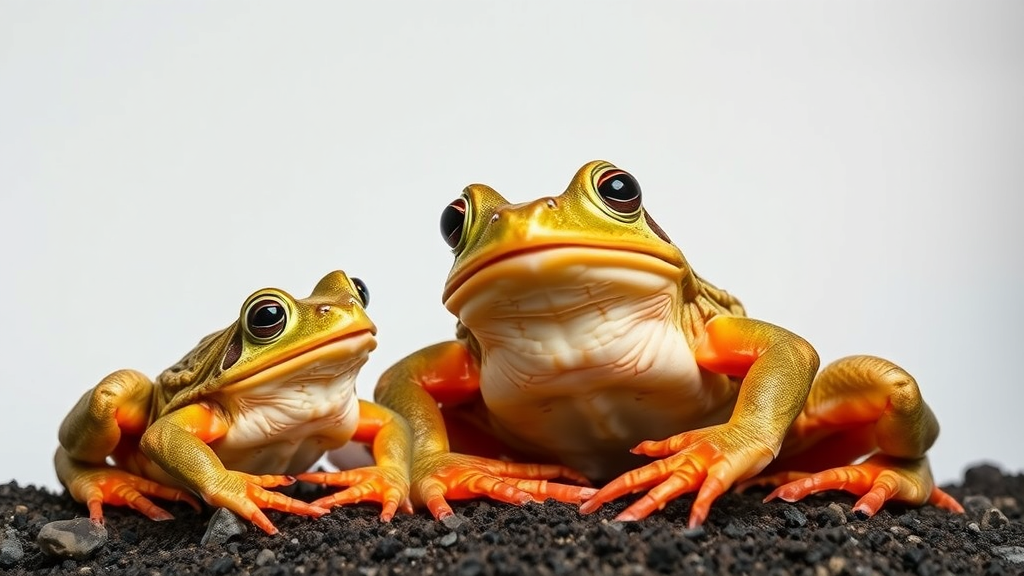
In 1950, the herpetologist Hobart Smith declared the Crawfish Frog the most secretive ranid in North America, and for the next half century the species lived up to that reputation in the most frustrating way possible. Nearly everything scientists thought they knew about Rana areolata was wrong, contradictory, or based on fragments of observation. Early authorities could not agree on when the frogs bred, whether they were nocturnal or crepuscular, or even which burrows they inhabited. Now, after more than a decade of intensive fieldwork in Indiana and a sweeping synthesis of evidence from across the species’ thirteen-state range, a team led by Nathan Engbrecht, Rochelle Stiles, Michael Lannoo, and Lilly Hein Shults has published a comprehensive review in Discover Ecology that transforms one of North America’s least-known frogs into one of its best-understood, and lays out a concrete roadmap for returning the species to landscapes from which it has vanished.
The story begins in 2008, when non-game biologists at the Indiana Department of Natural Resources asked researchers to determine why the state’s Crawfish Frogs were declining and to recommend management actions to prevent statewide extirpation. The resulting study ran eight years, from 2009 to 2016, and processed more than 1,100 breeding adults and 8,000 newly metamorphosed juveniles through drift fence-pitfall trap arrays that completely encircled study wetlands. The team added radiotelemetry to track movements, statewide call surveys to assess status, and, in a methodological first, wildlife cameras aimed at occupied crayfish burrows to observe the animals’ seasonal activity without ever disturbing them. The work produced forty-one peer-reviewed publications and, ultimately, the new synthesis.
What emerged was a portrait of a frog with unusually demanding habitat requirements. Crawfish Frogs breed in spring, typically March and April, in fishless seasonal and semipermanent wetlands alongside Spring Peepers, chorus frogs, and leopard frogs. Their breeding follows a boom-or-bust pattern driven by drought and the presence or absence of warm nocturnal rains. In boom years, thousands of juveniles flood the landscape; in bust years, populations fail to recruit entirely. The researchers documented a striking inverse relationship between the number of breeding females and their body size at a study wetland: in 2012, only eight females bred, averaging 101.5 millimeters in snout-vent length, while in 2013 fifty-two females bred, averaging just 88.2 millimeters. Because larger females produce substantially more eggs, a census alone can mislead; twelve large females can be reproductively equivalent to eighteen small ones.
Drought, the team found, acts on these frogs in unexpected ways. Drought conditions did not reduce adult survivorship, but they did reduce body mass in both sexes, likely because invertebrate prey became scarce while the frogs, which remain active year-round without aestivation or torpor, kept foraging. The consequence was a roughly thirty percent reduction in clutch size, translating to an estimated loss of more than 130 adults recruited into the population in a single drought year. Yet drought also carried a hidden benefit: in the dry year of 2011, infection intensity of the deadly chytrid fungus Batrachochytrium dendrobatidis dropped two-hundred-fold among adult frogs, and no Bd-related deaths occurred, compared with five deaths in the wet year of 2010. Sustained heat and dryness, it turns out, can moderate chytridiomycosis even as it undermines fecundity, a nuance that complicates simple narratives about climate change and amphibian decline.
The heart of the review, however, lies underground. Crawfish Frogs are obligately dependent on the vacated burrows of terrestrial crayfish, which they do not dig themselves. Telemetry revealed that adults occupy a single crayfish burrow as a home, return to it after breeding migrations that can exceed a kilometer, and reuse the same burrow for up to five consecutive years. Once fitted to a burrow, a frog spends ten to eleven months a year there, venturing only onto a small worn patch of ground at the entrance called a feeding platform. The burrow is not merely shelter; it is the centerpiece of an extraordinary predator defense. When threatened, a Crawfish Frog dives into its burrow, turns to face the entrance, inflates its body, and wedges itself against the burrow walls, lowering its head so that a snake, the primary predator, cannot gain purchase on its jaw.
That behavior works only because of a remarkable morphological adaptation. Comparing skeletal growth across the subgenus Nenirana, the researchers found that while Pickerel Frogs develop pointed snouts and Gopher Frogs develop rounder but proportionally narrower heads, Crawfish Frog heads become both relatively shorter and wider as the animals grow, producing a nearly orbiculate skull. A round head seals a cylindrical burrow, minimizing gaps through which a snake could seize the jaw. The fit must be precise: a burrow too small cannot be entered, and one too large cannot be sealed by body distention. This likely explains the frogs’ extraordinary fidelity to a single burrow across years. The stakes are high, as frogs outside burrows face twelve times greater risk of predation, and the authors argue that destroying burrows through plowing may be as lethal to Crawfish Frogs as the plow blades themselves, leaving surviving frogs exposed and defenseless in open fields.
Perhaps the most provocative section of the review concerns cognition. The authors argue that Crawfish Frog behavior cannot be explained by simple reflex arcs. Post-breeding frogs navigate back to burrows located over a kilometer from breeding wetlands, likely using remembered sequences of landmarks or a cognitive map of the landscape, since rain-triggered migrations under cloudy skies rule out celestial navigation. The team proposes that the species possesses declarative memory, temperament along a shy-bold continuum, and even a sense of self. To respond appropriately to an approaching gartersnake, a frog must assess the snake’s size relative to its own, a judgment that requires continuously recalibrated self-perception as the animal grows. Field observations support individual temperament differences: of three telemetered males, one responded to human approach with bold territorial calling, one dove shyly into its burrow, and one remained indifferent.
Activity patterns add another layer of flexibility. Depending on season, Crawfish Frogs can be strictly diurnal, strictly nocturnal, or active around the clock: diurnal in cold early spring and late fall, circumdiel in moderate conditions, and nocturnal during hot, dry summers. Remarkably, this variable pattern is synchronized across solitary individuals throughout the population, a behavioral plasticity the authors suggest provides resilience to climate change. The frogs even appear to respond cognitively to habitat alteration: after a prescribed burn removed vegetative cover, frogs in burned areas spent far more daylight hours hidden in burrows or peering out with only their heads exposed, an aversion to exposure the authors interpret as either an innate reaction or learned inhibition from prior predator encounters.
The distributional picture is sobering. Crawfish Frogs once occupied 246 counties across their range; they have been extirpated from sixty of them, a 24 percent loss, with eastern populations suffering a 40 percent county-level decline compared with 15 percent west of the Mississippi. The pattern points to row crop agriculture, rather than ranching, as the primary driver, consistent with historical accounts of frogs being plowed out of fields in numbers. The species is now categorized as near threatened globally, and it has disappeared entirely from Iowa and Louisiana.
Yet the review closes on a note of cautious optimism grounded in action. Crawfish Frogs have proven remarkably capable of colonizing restored habitats, including reclaimed coal mines and a former military proving ground that now host Indiana’s largest populations, and they readily breed in constructed wetlands. Working with the Detroit Zoological Society, the team developed the first head-starting protocols for the species, boosting survival of captive-reared tadpoles nearly a hundred-fold over wild rates. In 2024, the Indiana DNR translocated eight egg masses to Angel Mounds State Historic Site, where tadpoles metamorphosed successfully, marking the first Crawfish Frogs on that landscape in nearly four decades. In 2025, the team released 917 head-started juveniles at recovery sites, placing them directly into crayfish burrows during cool evening hours to minimize exposure. Five new wetlands were excavated at Hillenbrand Fish and Wildlife Area, and five more at Sugar Ridge, a site lacking breeding habitat since the 1960s. The authors stress that success will be measured across four generations of verification, from hatching through reproduction of the offspring of reintroduced adults, and they argue that captive-rearing programs must challenge developing amphibian brains rather than raise larvae in semi-sterile conditions, lest released animals lack the neural wiring to survive in the wild. For a frog that survived the Dust Bowl and the eruption of Mount St. Helens, the ingredients of recovery now exist; what remains is the will to assemble them across a fragmented mid-continental landscape.
Subject of Research: The ecology, behavior, cognitive capabilities, and population restoration of the Crawfish Frog (Rana areolata)
Article Title: A review of the ecology, behavior, and cognitive capabilities of crawfish frogs (Rana areolata) with the goal of restoring extirpated populations
Article References: Engbrecht, N. J., Stiles, R. M., Lannoo, M. J., & Shults, L. H. (2026). A review of the ecology, behavior, and cognitive capabilities of crawfish frogs (Rana areolata) with the goal of restoring extirpated populations. Discover Ecology, 2(1), Article 10. https://doi.org/10.1007/s44396-026-00028-x
Image Credits: AI Generated
DOI: 10.1007/s44396-026-00028-x
Keywords: Crawfish Frog, Rana areolata, amphibian conservation, crayfish burrows, chytridiomycosis, head-starting, wetland restoration, prairie grasslands, animal cognition, predator defense, population reintroduction, Indiana DNR
Cite Scienmag News
Sloane Callahan. (September 22, 2026). Secretive Crawfish Frogs Reveal Memory, Temperament, and a Blueprint for Resurrection. Scienmag. https://scienmag.com/secretive-crawfish-frogs-reveal-memory-temperament-and-a-blueprint-for-resurrection/
Sloane Callahan. "Secretive Crawfish Frogs Reveal Memory, Temperament, and a Blueprint for Resurrection." Scienmag, 22 September 2026, https://scienmag.com/secretive-crawfish-frogs-reveal-memory-temperament-and-a-blueprint-for-resurrection/. Accessed 4 October 2026.
Sloane Callahan. "Secretive Crawfish Frogs Reveal Memory, Temperament, and a Blueprint for Resurrection." Scienmag. September 22, 2026. https://scienmag.com/secretive-crawfish-frogs-reveal-memory-temperament-and-a-blueprint-for-resurrection/


