

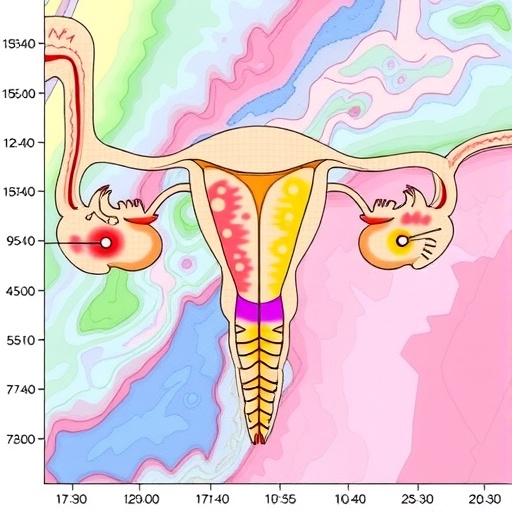
In a groundbreaking exploration into human reproductive biology, scientists have unveiled the intricate spatial and temporal dynamics underpinning the development of the fallopian tubes and epididymis during fetal growth. By deploying cutting-edge genomic techniques, the research charts the emergence of regional gene expression patterns within the epithelia of these organs between 10 and 21 weeks post-conception, revealing how early differentiation shapes adult function.
The fallopian tube and epididymis, essential to reproductive capacity, harbor non-ciliated epithelial cells that perform specialized functions critical for fertilization and sperm maturation respectively. Prior research had identified gene expression gradients that establish this functional regionalization in adults, but the timing and molecular basis of these differences during fetal development remained obscure. By meticulously examining the rostrocaudal axes of these epithelia, the current study fills this major knowledge gap through comprehensive transcriptomic mapping.
Focusing first on the fallopian tube, the authors detected distinct groups of genes exhibiting clear rostrocaudal expression gradients in the fetal epithelium. Genes such as PNOC, APOA1, CLDN6, ERP27, and ZBED2 showed decreasing expression moving from the fimbria at the rostral end toward the isthmus at the caudal region. Meanwhile, a separate cluster including LYPD1, S100A1, and CRTAC1 peaked centrally along the tube. Intriguingly, PNOC and LYPD1 were already restricted to rostral zones during the initial stages of Müllerian duct development, suggesting regional patterning begins remarkably early.
Further reinforcing the functional specialization emerging in utero, genes like MUC6, WDR72, and KCNN4 were selectively upregulated in the isthmus region of the developing fallopian tube. Comparative studies demonstrate that orthologues of these genes participate in isthmus-specific secretory functions in other species, implying conserved roles in reproductive physiology. These findings indicate that the spatial genetic blueprint laid down during fetal development sets the stage for adult function.
The persistence of these gradients, established prenatally, into adult life was confirmed through spatial transcriptomic analyses of human fallopian tube tissue samples from adults. Sequencing data from discrete regions – fimbria, ampulla, and isthmus – maintained the fetal expression patterns, indicating that the developmental transcriptional gradients not only emerge early but are stably maintained. This molecular continuity underscores the importance of early embryonic patterning in reproductive tract function.
Turning to the epididymis, the research identified rostrally biased gene expression in fetal non-ciliated epithelial cells featuring genes such as ESR1, SALL1, VIL1, SPAG11A, PDZK1, and FXYD2. These genes are crucial regulators of fluid reabsorption and sperm maturation in the adult organ, highlighting that these processes are transcriptionally encoded well before birth. The study also observed enrichment of cell-adhesion molecules including claudins (CLDN2, CLDN10) and cadherins (CDH2, CDH6) in the rostral epididymis, coherent with their known roles in maintaining tissue integrity.
Conversely, gene expression increased caudally for a distinct cohort including GATA3, WNT9B, TFAP2A, CPXM2, and BLNK, associated with immune functions in adult epididymal tissue. This partitioning likely reflects the organ’s role in balancing immune tolerance with sperm protection. The data reveal a sophisticated molecular landscape developing in a polarized fashion within the epididymal epithelium, foundational for its multifaceted adult roles.
By leveraging a sophisticated Müllerian and Wolffian duct axis framework for transcriptomic analyses, this study brings unprecedented clarity to the timing and nature of spatial differentiation within the reproductive tract epithelia. The revelation that transcriptional patterning begins during duct emergence and evolves into stable adult gradients suggests an intrinsic developmental program governing reproductive organ function.
Taken together, these insights advance understanding beyond descriptive anatomy to a genetic blueprint mapping how distinct epithelial regions specialize functionally over developmental time. This establishes a vital link between embryogenesis and adult physiology, with significant implications for fertility research and potential congenital reproductive disorders.
Future investigations building upon these findings might explore how disruptions in these early transcriptional gradients contribute to pathologies such as ectopic pregnancies or epididymal dysfunction. Moreover, the molecular signatures identified offer targets for therapeutic intervention and biomarker development, expanding clinical possibilities.
The integration of spatial transcriptomics with developmental biology as demonstrated here sets a precedent for deciphering complex organogenesis in humans. This approach undoubtedly opens avenues for similar investigations across diverse tissues, aiming to unravel the molecular choreography underpinning human development with high resolution.
Conclusively, this landmark study charts a detailed spatiotemporal cellular atlas of the developing human reproductive tract epithelia. The revelation that regional gene expression gradients form early and endure into adulthood revolutionizes the conceptual framework for studying reproductive function and development, laying the groundwork for novel clinical and biological pathways.
Subject of Research: Developmental spatiotemporal gene expression patterns in human fallopian tube and epididymis epithelia
Article Title: Spatiotemporal cellular map of the developing human reproductive tract
Article References:
Lorenzi, V., Icoresi-Mazzeo, C., Cassie, C. et al. Spatiotemporal cellular map of the developing human reproductive tract. Nature (2025). https://doi.org/10.1038/s41586-025-09875-2
Image Credits: AI Generated


