


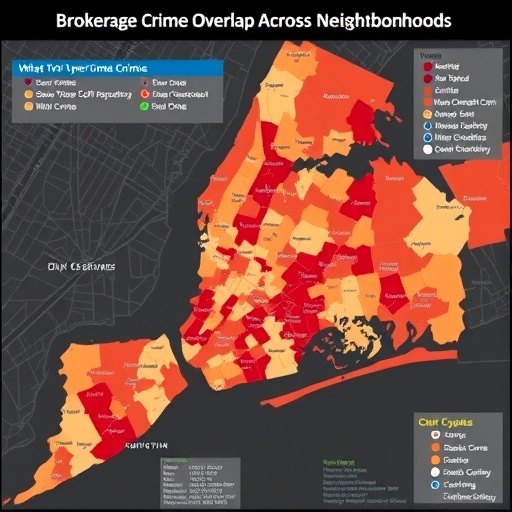
Crime in New York City is famously uneven. A small fraction of streets and neighborhoods absorbs a wildly disproportionate share of the city’s offenses, a pattern so consistent across places and years that criminologists have elevated it to a “law.” A new study argues, however, that the deepest secret of the urban crime map lies not simply in where offenses pile up, but in which offenses pile up together. In research published in the American Journal of Criminal Justice, criminologist Young-An Kim of Florida State University’s College of Criminology and Criminal Justice and Keungoui Kim of Yonsei University reconstructed more than a decade of New York City crime, spanning 2008 to 2018, as a network in which offense types are nodes and persistent spatial co-occurrence within census block groups forms the links. Running classic network algorithms over that structure, the researchers identified a small set of “brokerage” crimes—led by prostitution, drug offenses, and robbery—that bridge otherwise separate clusters of offending. These bridging offenses are comparatively rare, yet the block groups where they occur show markedly higher levels of both violent and property crime.
The analysis builds on one of the most replicated findings in modern criminology: the law of crime concentration. Formalized by David Weisburd in 2015 from decades of hot-spot research, the law holds that in city after city, roughly half of all crime concentrates at a tiny fraction of micro-places, typically around five percent of street segments. Complementary research traditions reinforced the same message. Studies of repeat victimization show that the same addresses are struck again and again, while “near-repeat” analyses of burglaries and shootings reveal contagion-like ripples spreading to adjacent properties within days or weeks. The practical stakes are high: if crime concentrates, policing can concentrate with it, and hot-spot strategies have become among the most widely adopted tactics in law enforcement. Yet the authors argue that the field has overwhelmingly treated each crime type in isolation—mapping robberies in one study, burglaries in another, and drug markets in a third—without systematically asking which offenses share the same ground and what that togetherness implies.
The omission matters because several influential theories predict that different offenses should not merely coexist but actively enable one another. The disorder–crime relationship, popularized by the 1982 “broken windows” essay by James Q. Wilson and George Kelling and elaborated by scholars such as Wesley Skogan, holds that visible low-level offending and physical decay signal that a neighborhood’s informal social control has eroded, inviting more serious offenders to operate there. Repeat victimization research suggests that once a location proves vulnerable, offenders return to it and may transmit that knowledge to associates. Crime pattern theory, developed by Paul and Patricia Brantingham, adds that “crime generators” and “crime attractors”—transit hubs, markets, entertainment strips—pull offenders along predictable routine-activity paths, so particular offense types should cluster around the same nodes of opportunity. If those mechanisms operate as theorized, some offenses should function as connective tissue between distinct criminal ecosystems, and the study set out to find them empirically.
To do so quantitatively, the team aggregated recorded offenses by type across New York City’s block groups—small census units that typically encompass a few hundred to a few thousand residents—and measured, for every pair of crime types, how strongly the two co-occurred from place to place over the 2008-to-2018 period. Those pairwise co-occurrence scores were then filtered through a cutoff threshold: only crime-type pairs whose spatial overlap exceeded the threshold were joined by an edge, producing what the authors describe as a crime network for the city. The choice of threshold is consequential, because a cutoff set too low would connect nearly everything and one set too high would fragment the map, so the researchers repeated the analysis at alternative cutoffs of 0.4 and 0.6 as a robustness check and found no substantial differences in the estimated model results. The approach deliberately imports methods from network science—a toolkit the authors have previously applied to patent citations, technology convergence, and research collaboration—and repurposes it for the geography of offending.
The analytic centerpiece is betweenness centrality, a measure introduced by sociologist Linton Freeman in 1977. For every node in a network, the algorithm computes the fraction of shortest paths—between all possible pairs of other nodes—that pass through it. High-betweenness nodes need not be the largest or the most densely connected; they are the indispensable intermediaries, the brokers whose removal would fragment the network into disconnected islands. In social network analysis the measure has long been used to spot gatekeepers who bridge otherwise separate communities and control the flow of information, money, and influence. The metric rewards position rather than volume, which is precisely why it can expose offense types that conventional frequency counts render invisible. Here the same mathematics was aimed at offenses: a crime type earns high betweenness when the shortest conceptual route between, say, a cluster of predominantly property offenses and a cluster of predominantly violent offenses runs directly through it, marking that offense as structurally responsible for binding different kinds of criminal activity together in space.
Three offense types rose decisively to the top of that measure: prostitution, drug offenses, and robbery. None of them ranks among the city’s most common crimes—the authors characterize the brokerage offenses as relatively infrequent—but their positions within the network gave them outsized structural importance. Statistical models of block-group crime levels showed that the presence of these bridging offenses was strongly associated with elevated levels of violent and property crime, despite their lower prevalence, and the association held across the researchers’ estimated models. The analysis explored both faces of co-occurrence, confirming that similar offenses cluster together in the same places while revealing that connections between crimes of differing severity are what give the network its long-range reach. In network terms, the low-level markets and the serious predation that share the same block groups are not parallel phenomena but linked ones, joined through a small set of intermediary offenses that punch far above their weight.
The pattern fits the theoretical scaffolding the authors assembled. Street-level prostitution and drug markets are classic manifestations of the disorder–crime relationship: they both reflect weakened collective efficacy—the shared willingness of residents to intervene on their block’s behalf, famously measured by Robert Sampson and colleagues in Chicago—and reproduce it, broadcasting the message that surveillance and sanction are unlikely there. That signal, disorder theory predicts, lowers the perceived risk for predatory offenders, drawing robbery and worse into the same terrain. Robbery’s bridging role is equally legible through repeat and near-repeat victimization research, which has documented how street robberies and shootings cluster along the routine-activity paths that offenders patrol, from Philadelphia’s near-repeat shootings to Britain’s “infectious burglaries.” A block group hosting a brokerage offense, on this reading, is not simply experiencing two unrelated problems; it is hosting a junction through which opportunity, offender knowledge, and weakened informal control flow between different species of crime.
The policy implications follow directly, and the authors frame them in the language of problem-oriented policing, the strategy articulated by Herman Goldstein that calls for analyzing the underlying conditions that generate recurring offending rather than responding incident by incident. If a small set of brokerage offenses structurally connects a city’s crime clusters, then interventions aimed squarely at those offenses—focused deterrence, situational prevention, targeted social services, environmental redesign—could yield disproportionate returns by severing links that diffuse, citywide enforcement would leave intact. The findings argue for proactive rather than reactive strategies: instead of waiting for serious violence to erupt and saturating a hot spot afterward, agencies could treat persistent low-level markets as early-warning infrastructure marking the places where broader crime patterns are stitched together. The authors are careful to position this as precision rather than saturation, an approach that also engages long-standing concerns about crime displacement, which major reviews suggest is far from inevitable when interventions are tailored to specific problem patterns.
Like all observational research, the study establishes association rather than causation. Brokerage offenses may genuinely enable neighboring crimes, or they may simply be joint symptoms of deeper structural disadvantage that block-group-level models only partly absorb. Aggregation to census geographies smooths over variation within blocks, and a decade-long window captures the stable geography of offending rather than its fast-moving short-term dynamics. Even so, the robustness checks give the central result unusual resilience for a network-based finding: whether the co-occurrence threshold was held at its original value or moved to the alternatives of 0.4 and 0.6, the same offense types emerged as brokers and the reported model results held firm. The framework also travels easily: any city with geocoded offense data and census geography can now ask whether its own crime map contains similar bridging offenses, making the brokerage concept a portable diagnostic rather than a one-off portrait of New York.
The broader significance may lie in the reframing. For four decades, hot-spot policing has asked where crime concentrates; this study asks which crimes hold the map together. Treating a city’s offenses as a network converts an old intuition—that some crimes open the door to others—into a measurable quantity that can be computed, validated, and tracked over time. If future longitudinal research confirms that weakening a brokerage offense precedes the fraying of the clusters it connects, the lowly street market long dismissed by residents and police alike as a nuisance may be revealed as a linchpin of the entire local crime ecology. For a city that has spent generations fighting crime block by block, the suggestion that a handful of bridging offenses quietly stitches its criminal landscape together is a finding with the power to redraw the map—and to change where the next decade of enforcement, and prevention, begins.
Cite Scienmag News
Courtney Benton. (August 29, 2026). Mapping How Crime Types and Brokerage Crime Overlap Across NYC Neighborhoods. Scienmag. https://scienmag.com/mapping-how-crime-types-and-brokerage-crime-overlap-across-nyc-neighborhoods/
Courtney Benton. "Mapping How Crime Types and Brokerage Crime Overlap Across NYC Neighborhoods." Scienmag, 29 August 2026, https://scienmag.com/mapping-how-crime-types-and-brokerage-crime-overlap-across-nyc-neighborhoods/. Accessed 3 September 2026.
Courtney Benton. "Mapping How Crime Types and Brokerage Crime Overlap Across NYC Neighborhoods." Scienmag. August 29, 2026. https://scienmag.com/mapping-how-crime-types-and-brokerage-crime-overlap-across-nyc-neighborhoods/


