

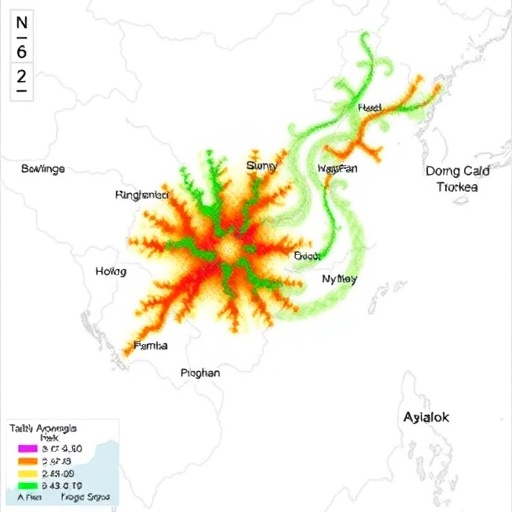
In recent years, environmental research has underscored the critical importance of understanding ecological connectivity, especially in dynamic ecosystems like the Dongting Lake Basin in China. A compelling new study by Su, Yang, and Chen has utilized innovative approaches, combining circuit theory with the InVEST modeling framework to map and analyze ecological resilience in this vital region. Their findings mark a significant advancement in ecological research, aiming to facilitate better management and conservation strategies in areas prone to ecological fragmentation.
The Dongting Lake Basin serves as a key ecological zone, renowned for its biodiversity and rich ecosystem services. However, like many other natural habitats, it faces increasing threats from urbanization, agriculture, and climate change. The study vividly illustrates the challenges posed by ecological disconnections within the basin, which hamper the ability of various species to adapt and thrive in a rapidly changing environment. Understanding these disconnections is vital for the preservation of both the ecosystem and the services it provides to surrounding communities.
To analyze the connectivity within the Dongting Lake Basin, the researchers applied circuit theory, which effectively translates ecological processes into electrical circuit analogies. This innovative technique allows for complex interactions and pathways to be modeled, providing valuable insights into how species move throughout the landscape. By treating landscape features as ‘resistors’ and connectivity as ‘current flow,’ the researchers can identify critical areas that facilitate or hinder movement across ecosystems.
Moreover, the InVEST (Integrated Valuation of Ecosystem Services and Tradeoffs) modeling framework complements circuit theory by quantifying the ecological services provided by various landscapes within the basin. This dual approach has offered a richer understanding of ecological dynamics and has revealed how alterations in land use can significantly impact both connectivity and ecosystem service delivery. By integrating these two methodologies, the researchers have laid the groundwork for a comprehensive analysis of ecological resilience in the face of anthropogenic pressures.
One of the most striking findings of this study is the identification of key “crossroads” in the Dongting Lake Basin where ecological connectivity is most critical. These crossroads serve as vital hubs that not only support biodiversity but also enhance the overall resilience of the ecosystem. The loss or degradation of these areas could lead to significant adverse effects on species survival, highlighting the urgent need for targeted conservation efforts in these zones.
The implications of mapping ecological connectivity extend far beyond local biodiversity. The study signifies a critical intersection between biodiversity conservation and human livelihoods, particularly for communities that rely on the ecosystem services provided by the Dongting Lake Basin. By ensuring that wildlife can traverse these landscapes, the health of fisheries, water quality, and natural flood defenses will be maintained, benefiting both the environment and human populations alike.
Another crucial aspect explored in the research is the impact of climate change on ecological connectivity within the basin. As environmental conditions shift, species may require new routes to adapt to changing climates. Understanding potential future scenarios of connectivity will be vital for implementing proactive conservation strategies. The researchers emphasize the importance of keeping these corridors intact, particularly in light of expected climatic changes that will heighten the vulnerability of various species.
The research can also guide policymakers and environmental managers in assessing land use changes. Utilizing the findings, local governments can make informed decisions regarding development and conservation zoning. By aligning human activities with ecological needs, the strategies foster a sustainable balance where both people and nature can thrive.
Moreover, the potential for public engagement through the findings is immense. The research equips local communities with a better understanding of the importance of ecological connectivity in sustaining their livelihoods. Raising awareness among residents could lead to stronger advocacy for conservation initiatives, ensuring that local voices contribute to the management of the Dongting Lake Basin.
By emphasizing the interconnectedness of ecological systems, the study advocates a paradigm shift towards more holistic environmental management. Acknowledging that ecosystems do not exist in isolation encourages collaborative approaches that bring various stakeholders together, including environmentalists, policymakers, and local communities. Such concerted efforts will be imperative as we navigate the complexities of managing and preserving vital habitats.
In conclusion, the study by Su, Yang, and Chen represents a groundbreaking contribution to ecological research, particularly in understanding how to map and enhance ecological resilience within the Dongting Lake Basin. By employing circuit theory alongside the InVEST framework, the researchers provide a multi-faceted analysis that informs conservation strategies and policymaking efforts. As we grapple with the challenges posed by climate change and habitat fragmentation, the insights gained from this research can serve as a vital resource for fostering sustainable practices and promoting biodiversity conservation in the years to come.
The urgency for such research is further underscored by the rapidly evolving environmental crises we face globally. The methodologies and findings from this study can inspire similar investigations in other regions, advancing the field of ecological connectivity while highlighting the necessity of preserving the linchpins of biodiversity. It opens up new avenues for interdisciplinary collaboration and technological application in environmental science, pushing the boundaries of what we understand about ecological systems today.
As we step into a future increasingly dominated by the impacts of human activity and changing climates, the work of Su, Yang, and Chen offers a hopeful pathway forward, shedding light on the resilience of nature and the vital importance of safeguarding ecological networks. Their research is both a cautionary tale about the fragility of our ecosystems and a beacon of potential—a call to action for us to thoughtfully engage with our environment and safeguard it for generations to come.
Subject of Research: Ecological connectivity and resilience mapping in the Dongting Lake Basin.
Article Title: Wiring resilience: mapping dynamic ecological connectivity in Dongting Lake Basin using circuit theory and InVEST.
Article References:
Su, Y., Yang, Z., Chen, W. et al. Wiring resilience: mapping dynamic ecological connectivity in Dongting Lake Basin using circuit theory and InVEST.
Environ Monit Assess 198, 53 (2026). https://doi.org/10.1007/s10661-025-14795-9
Image Credits: AI Generated
DOI: https://doi.org/10.1007/s10661-025-14795-9
Keywords: ecological connectivity, Dongting Lake Basin, circuit theory, InVEST, biodiversity conservation, environmental management, climate change, ecological resilience.


