


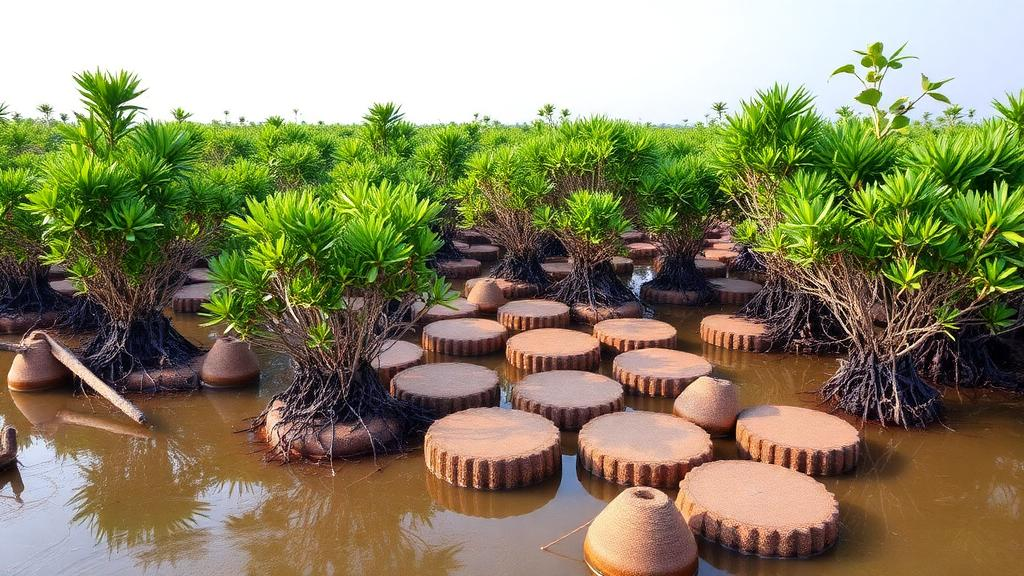
Along the muddy coastline of northern Vietnam, shrimp ponds sit shoulder to shoulder with mangrove forests, and a new study suggests the boundary between them is anything but inert. Researchers who pulled meter-long sediment cores from mangrove stands in the Red River Delta found that ammonium, nitrate, and phosphate concentrations in the mud decline steadily as you move away from aquaculture ponds toward the river estuary — a spatial fingerprint that points squarely at farm effluent as a driver of nutrient loading in one of Southeast Asia’s most heavily worked coastal landscapes.
The study, conducted in the coastal zone of Tien Hai district in Thai Binh province, targeted mangrove forests inside the Red River Delta Biosphere Reserve and the Tien Hai Nature Reserve. The Red River is the largest river system in northern Vietnam, and its delta hosts dense aquaculture, rice cultivation, and domestic wastewater discharge. Earlier water-quality research had flagged a potential risk of nutrient excess in the delta’s coastal waters, but the long-term storage of nutrients in mangrove sediments — where they can persist for decades — had remained poorly quantified.
To test whether aquaculture leaves a measurable imprint on the sediment record, the team collected six sediment cores from mangrove stands along two transects running from shrimp ponds to the river estuary. Sampling took place at low tide in September 2020, during the rainy season, using a Russian Peat Corer. Each core extended 100 centimeters deep and was sliced at 5-centimeter intervals from the surface to 50 centimeters, then at 10-centimeter intervals from 50 to 100 centimeters. At every site, the researchers also recorded mangrove species composition and counted dead trees within 5-meter circular plots, repeated three times alongside the core sampling.
Laboratory analysis combined classical geochemistry with automated colorimetry. Sediment samples were dried at 60 degrees Celsius, ground to powder, and assessed for organic matter using the loss-on-ignition method at 550 degrees Celsius for at least three hours. Grain size was measured by laser diffraction. Available phosphate was extracted with the Bray II method, while ammonium and nitrate were drawn out with a 2N potassium chloride solution. The extracts then ran through a Skalar SAN++ continuous flow analyzer, which quantified ammonium via the Berthelot reaction at 630 nanometers, nitrate through cadmium reduction and diazotization at 540 nanometers, and phosphate as a blue molybdate complex at 880 nanometers. Detection limits were 10 micrograms per liter for ammonium and nitrate and 2 micrograms per liter for phosphate, with standard samples repeated after every ten analyses to keep analytical drift below 5 percent.
The results revealed a sediment profile dominated by silt — 81.66 to 97.47 percent on average — with clay ranging from 2.31 to 15.27 percent and sand making up the remainder. Median grain size averaged 9.8 ± 1.8 micrometers, confirming the quiet, muddy depositional environment typical of mangrove forests. Organic matter content ranged from 4.88 to 9.79 percent, averaging 7.10 ± 0.94 percent, and declined significantly from the top to the bottom of the cores. The transect closer to the aquaculture ponds showed slightly higher organic matter than the transect nearer the estuary, hinting at a gradient of organic enrichment flowing outward from the ponds.
Nutrient concentrations told a more nuanced story. Ammonium ranged from 0.925 to 32.278 milligrams per kilogram, averaging 9.879 ± 4.485 milligrams per kilogram, and varied significantly by location, depth, and their interaction. Nitrate, ranging from 0.236 to 7.240 milligrams per kilogram, averaged just 0.823 ± 0.745 milligrams per kilogram and showed no statistically significant variation by location or depth. Phosphate, ranging from 0.047 to 9.124 milligrams per kilogram, averaged 1.134 ± 1.294 milligrams per kilogram and varied significantly by the location-by-depth interaction. Across all cores, nutrient levels were highest in the surface layer from 0 to 20 centimeters, declined between 20 and 50 centimeters, and changed minimally from 50 to 100 centimeters.
The spatial gradient was the study’s most striking finding. Ammonium averaged 11.281 ± 6.362 milligrams per kilogram near the aquaculture ponds, dropping to 9.206 ± 2.784 in the transition zone and 9.148 ± 3.231 near the main estuary. Phosphate followed a similar pattern, with the highest values near the ponds in one transect and in the transition area of the other. The researchers attribute this to tidal dynamics: nutrient-rich effluent from extensive shrimp ponds, which typically lack water-monitoring equipment, deposits organic matter into adjacent mangrove sediments, where microbial ammonification converts organic nitrogen into ammonium. The consistency of this pattern with earlier seawater-quality studies in the Red River estuary strengthens the case that aquaculture is the dominant nutrient source.
Depth profiles add a second layer of interpretation. The anaerobic conditions and abundant litterfall and root material in mangrove forests favor ammonification, concentrating ammonium in the upper sediment. Mangrove roots of the dominant species Kandelia obovata and Sonneratia caseolaris are most developed in the 0-to-50-centimeter layer, where they actively absorb nutrients and drive exchange between sediment and trees. Organic matter correlated positively with ammonium and phosphate at a medium level, consistent with mineralization and microbial activity releasing nitrogen and phosphorus from organic pools. Nitrate, by contrast, showed no such correlation, suggesting it is more tightly controlled by nitrification and denitrification processes than by organic matter availability.
The ecological consequences may already be visible. In sampling plots near the aquaculture ponds, the researchers counted more dead mangrove trees than in plots farther away, echoing fertilization experiments in the Indo-Pacific that showed nutrient enrichment increases tree mortality during droughts. Excess nutrients can alter detritus-based food webs, reduce the carbon-to-nitrogen ratio in sediments, and favor methanogenic bacteria — potentially accelerating greenhouse gas emissions such as carbon dioxide, methane, and nitrous oxide from mangrove soils. High nutrient loading also risks eutrophication in adjacent coastal waters, supporting algal blooms and degrading coral reefs and ecosystem resilience.
The study’s authors emphasize that ongoing monitoring is essential to determine the long-term impacts of aquaculture on mangrove forests and adjacent coastal ecosystems. Because mangroves act as natural filters and net sinks of nutrients, their capacity to absorb excess inputs is finite; when discharge exceeds uptake, the surplus spills into coastal waters and destabilizes the forest itself. Future research, the team suggests, should quantify methane emissions under different nutrient conditions and link nutrient dynamics with mangrove biomass and carbon storage, providing the evidence base for sustainable management strategies in tropical developing regions where aquaculture and mangrove conservation increasingly collide.
Subject of Research: Nutrient accumulation in mangrove sediments near aquaculture ponds in the Red River Delta, Vietnam
Article Title: Nitrate, ammonium, and phosphate patterns from mangrove sediment cores near extensive aquaculture areas in the Red River Delta, Vietnam
Article References: Toan, N., Ngoc, P., Dung, L., Tue, N., Quy, T., & Nhuan, M. (2025). Nitrate, ammonium, and phosphate patterns from mangrove sediment cores near extensive aquaculture areas in the Red River Delta, Vietnam. One Ecosystem, 10, Article e150217. https://doi.org/10.3897/oneeco.10.e150217
Image Credits: AI Generated
DOI: 10.3897/oneeco.10.e150217
Keywords: mangroves, aquaculture, Red River Delta, Vietnam, sediment cores, nutrients, ammonium, nitrate, phosphate, eutrophication, coastal ecosystems, tree mortality
Cite Scienmag News
Violet Maxwell. (October 18, 2026). Mangrove Sediment Cores Reveal Aquaculture’s Nutrient Footprint in Vietnam’s Red River Delta. Scienmag. https://scienmag.com/mangrove-sediment-cores-reveal-aquacultures-nutrient-footprint-in-vietnams-red-river-delta/
Violet Maxwell. "Mangrove Sediment Cores Reveal Aquaculture’s Nutrient Footprint in Vietnam’s Red River Delta." Scienmag, 18 October 2026, https://scienmag.com/mangrove-sediment-cores-reveal-aquacultures-nutrient-footprint-in-vietnams-red-river-delta/. Accessed 18 October 2026.
Violet Maxwell. "Mangrove Sediment Cores Reveal Aquaculture’s Nutrient Footprint in Vietnam’s Red River Delta." Scienmag. October 18, 2026. https://scienmag.com/mangrove-sediment-cores-reveal-aquacultures-nutrient-footprint-in-vietnams-red-river-delta/


