


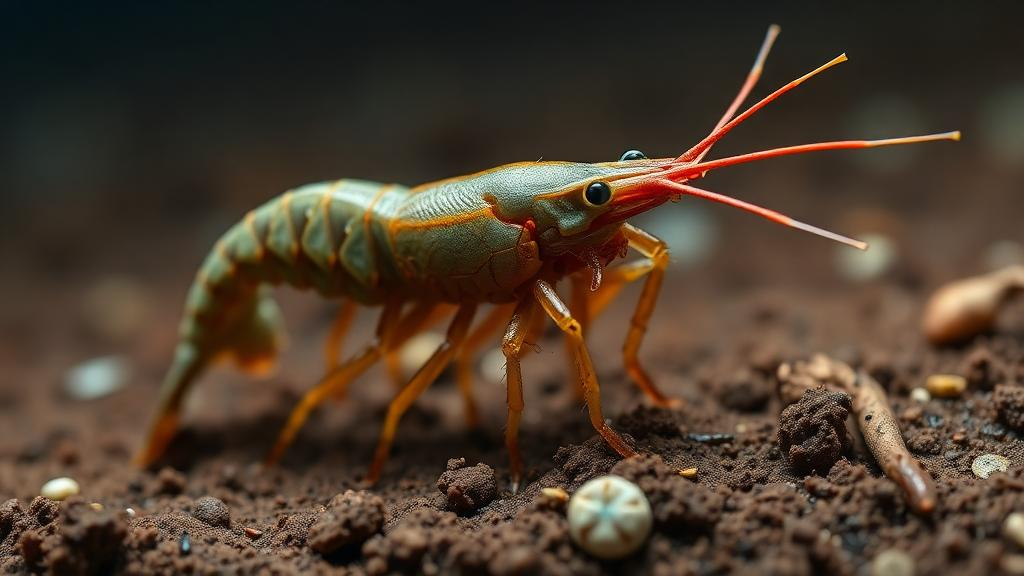
In the lower reaches of the River Rhine, a quiet arms race is playing out among tiny crustaceans most people have never heard of. Four species of Ponto-Caspian corophiid amphipods, often called mud shrimp, now share the same Dutch waterways, and a new study suggests that differences in their second antennae and body sizes may be what keeps them from crowding each other out. The research, published in the journal NeoBiota, offers a rare morphological window into how invasive species manage to coexist when they all seem to want the same thing.
The Ponto-Caspian region, which encompasses the Black, Azov, Caspian, and Aral Sea basins, is one of the most prolific sources of aquatic invasive species in Europe and North America. Among its exports are the corophiids, small tube-dwelling filter feeders that have been spreading across the continent since the early twentieth century. Chelicorophium curvispinum was the first to reach Western Europe, traveling from Poland through the central corridor. C. robustum and C. sowinskyi followed, their spread accelerated by the opening of the Main-Danube canal in the 1990s. Now a fourth species, C. maeoticum, has arrived in the Netherlands, likely carried directly by sea freighters rather than through the interconnected inland waterways.
What makes the arrival of C. maeoticum so surprising is that it was never considered a serious invasion risk. Within its native range it is apparently rare compared to the three already invasive species, and its distribution in the River Danube basin actually narrowed during the twentieth century. Yet since its discovery in the Netherlands in 2021, it has colonized all major stretches of the Rhine system, large lakes such as Ijsselmeer and Markermeer, and the inland canal network. Understanding how it manages to establish itself alongside three close relatives is central to predicting what happens next.
Corophiids are sedentary animals that live in self-constructed tubes in the sediment or among stones. They feed by filtering particles from the water, and the crucial trait determining what they can eat is the mesh size of their filtering screen, formed by bristled setae on their second gnathopods. The distance between the bristles sets the size of food particles each species can capture, and previous studies have shown that coexisting corophiids tend to divide the food particle size spectrum into three partitions. With four invasive species now sharing the Rhine, the question was whether there is enough room on this niche axis for all of them.
The research team measured filter mesh sizes in specimens collected from the estuarine section of the River Rhine and the Rhine Delta in April 2024, using a variety of sampling methods including box corers, Van Veen grabs, and even a handheld vacuum cleaner on littoral stones. For comparison, they also analyzed a historic sample from the River Tisza in Hungary, dating from September and October 1943, in which C. maeoticum co-occurred only with C. sowinskyi before apparently disappearing from the river. The museum specimens, stored in the Hungarian Natural History Museum, were carefully dissected to expose the filtering setae, which were photographed under a light microscope and measured in ImageJ2.
The results revealed a densely packed niche space. Mean filter mesh sizes in the Dutch material ranged from 1.71 to 5.45 micrometers across the four species. C. maeoticum showed an intermediate interval of 2.31 to 3.63 micrometers, partially overlapping with the range of C. sowinskyi, which measured between 1.71 and 3.01 micrometers. C. curvispinum and C. robustum had the largest mesh sizes, between 3.45 and 5.26 and between 3.58 and 5.45 micrometers respectively, largely overlapping with each other. Statistical modelling confirmed significant differences between all species pairs except C. curvispinum and C. robustum, whose filter mesh sizes were almost completely indistinguishable.
The strongest niche overlap was between C. maeoticum and C. sowinskyi. The estimated mean difference of 0.7 micrometers between the two species in the Rhine is considerably smaller than the 1.58 micrometers measured in the historic Tisza sample, where the two species showed no overlap at all. This is the first time an overlap has been reported for C. sowinskyi with any other species, suggesting that differentiation by food particle size alone may not guarantee stable coexistence between the newcomer and the earlier colonist. By contrast, the differences between C. maeoticum and C. curvispinum or C. robustum were comparable to the differentiation observed among the three invasive species in the Lower Danube.
Looking for additional mechanisms, the researchers turned to the second antennae, appendages known from related species to play roles in both aggressive encounters and deposit feeding. In the mudflat corophiid Corophium volutator, males fight each other over females using their enlarged second antennae, and the same appendages are used to scrape the sediment surface around burrow openings. The team measured the relative lengths and widths of the second antennae in adult specimens of all four invasive species, in both males and females, using log-log transformed data and linear models. The results showed marked interspecific differences, particularly in antenna width in females, where all species pairs differed significantly. C. maeoticum and C. robustum had considerably thicker second antennae than C. curvispinum and C. sowinskyi in both sexes.
These morphological differences hint at a competitive hierarchy. Because crevice size limits the body size of occupants in corophiid microhabitats, success in territorial combat may depend more on antenna properties than on overall body size. The researchers hypothesize that C. maeoticum and C. robustum, with their more robust appendages, are dominant in interference competition, while the gracile C. curvispinum and C. sowinskyi can invest more in somatic growth and reproduction. Remarkably, the latter two species have been more successful at colonizing new areas, while the thicker-antennaed species could establish themselves in habitats already occupied by their congeners. A similar pattern appears in Dikerogammarus amphipods, where the faster-spreading D. haemobaphes is often replaced by the more robust and competitively superior D. villosus.
Body size adds yet another dimension. The maximal body lengths in the studied material were 5, 6.4, 6.5, and 8.1 millimeters for C. maeoticum, C. sowinskyi, C. curvispinum, and C. robustum respectively, producing body length ratios remarkably close to 1.3. This figure echoes Hutchinson’s classic rule, which holds that a minimal size difference of about 1.3 is often necessary for coexistence among guild members. While the generality of this rule is debated, body size differences can contribute to niche differentiation through variations in life history, microhabitat use, or predation risk. Taken together, filter mesh size, body length, and the relative width of the second antennae appear to act as proxies of independent niche axes, with the species showing non-random associations that minimize overall niche overlap. The authors suggest that these combined differences are likely to allow the coexistence of all four species and portend the continued spread of C. maeoticum through the interconnected waterways of Western and Central Europe, in stark contrast with its mysterious decline in the Danube catchment. More studies are needed to reveal the full range of behaviors these peculiar appendages are involved in and how their morphological features determine their functionality, but the study provides a novel perspective on the ecological interactions of invasive species beyond simple food resource partitioning.
Subject of Research: Ecological niche differentiation among invasive Ponto-Caspian corophiid amphipods in the River Rhine
Article Title: Differences in antennal morphology and body size might offset increased overlap in food particle size among invasive Ponto-Caspian corophiids ( Crustacea , Amphipoda )
Article References: Borza, P., Achterkamp, B., & van Haaren, T. (2026). Differences in antennal morphology and body size might offset increased overlap in food particle size among invasive Ponto-Caspian corophiids (Crustacea, Amphipoda). NeoBiota, 107, 21-34. https://doi.org/10.3897/neobiota.107.181767
Image Credits: AI Generated
DOI: 10.3897/neobiota.107.181767
Keywords: invasive species, Ponto-Caspian, amphipods, corophiids, River Rhine, niche differentiation, filter feeding, antennal morphology, ecology, freshwater biology, Differences, antennal
Cite Scienmag News
Gavin Prescott. (October 18, 2026). Antennae and body size may save invasive mud shrimp from competing for the same food. Scienmag. https://scienmag.com/antennae-and-body-size-may-save-invasive-mud-shrimp-from-competing-for-the-same-food/
Gavin Prescott. "Antennae and body size may save invasive mud shrimp from competing for the same food." Scienmag, 18 October 2026, https://scienmag.com/antennae-and-body-size-may-save-invasive-mud-shrimp-from-competing-for-the-same-food/. Accessed 18 October 2026.
Gavin Prescott. "Antennae and body size may save invasive mud shrimp from competing for the same food." Scienmag. October 18, 2026. https://scienmag.com/antennae-and-body-size-may-save-invasive-mud-shrimp-from-competing-for-the-same-food/


