


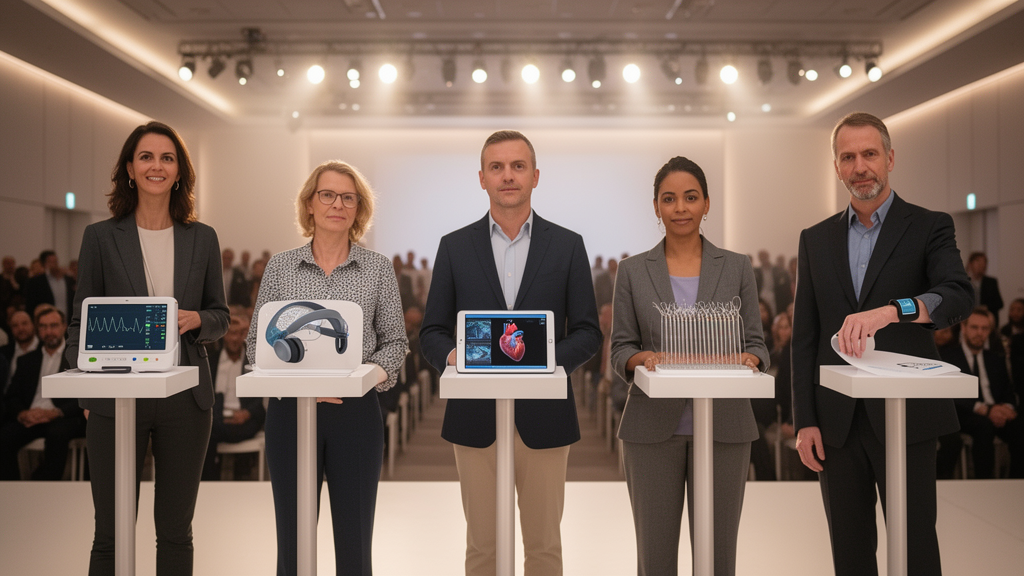
Some of the most promising ideas in medicine never make it out of the laboratory. The gap between a clever prototype and a technology that actually changes clinical practice is wide, paved with regulatory hurdles, reimbursement uncertainty and the sheer difficulty of persuading busy clinicians to change how they work. The American Heart Association has placed that problem at the center of its 2026 Health Tech Competition, a global program designed to accelerate innovations that could improve how cardiovascular and brain health conditions are prevented, diagnosed and treated. This month, the association announced the five companies that have advanced to the final round, each selected for its potential to move market-ready technology closer to the patients and clinicians who need it.
The competition, hosted by the American Heart Association’s Center for Technology & Innovation, drew a record number of submissions from health technology companies around the world. Volunteer experts spanning healthcare, science and industry carried out a rigorous multi-stage review before narrowing the field to five finalists. What unites them is a focus on two of the largest burdens in modern medicine: diseases of the heart and of the brain and nervous system. The finalists will present their solutions in the Health Innovation Pavilion during Scientific Sessions 2026, the association’s flagship global event for the latest research and clinical advancements in cardiovascular science, taking place November 6 through 9 at McCormick Place in Chicago. Competition pitches are scheduled for November 7 and 8, with winners announced on November 8.
The first finalist, HEARTio of Pittsburgh, Pennsylvania, is developing investigational artificial intelligence software that analyzes a standard electrocardiogram to estimate obstructive coronary artery disease, the leading cause of heart attacks. The significance of the approach lies in what it does not require: no dyes, no radiation, no incisions and no catheters. Coronary artery disease is typically evaluated with invasive angiography or imaging techniques that carry cost, access and safety considerations, so an algorithm capable of extracting diagnostic signal from the routine ECG, one of the cheapest and most widely available cardiac tests in existence, could dramatically widen the funnel of early detection if its performance holds up in clinical validation.
MEGI, based in Chicago, Illinois, takes aim at a different gap in cardiovascular care with an AI-powered digital health platform focused on women’s heart health, maternal care and hypertension management. High blood pressure remains one of the most consequential and undercontrolled risk factors worldwide, and cardiovascular conditions in women, particularly around pregnancy, have historically been under-recognized. A platform that combines artificial intelligence with continuous digital engagement could help patients and clinicians manage hypertension more proactively, especially in populations where traditional touchpoints with the health system are infrequent.
MedRhythms of Portland, Maine, brings a distinctly different modality to the finalist pool. The company operates at the intersection of digital health and neurotherapeutics, combining sensors, software and music to help people improve their walking and mobility after a neurological injury or disease. The idea builds on a long-observed phenomenon in rehabilitation science: rhythmic auditory stimulation, in which music provides a timing cue for movement, can help patients retrain gait patterns disrupted by stroke or other neurological conditions. By pairing that therapeutic approach with sensor-based measurement, MedRhythms aims to deliver and quantify rehabilitation in ways that were previously confined to the clinic.
Seerlinq, headquartered in Bratislava, Slovakia, addresses one of the most persistent problems in heart failure management: detecting deterioration early enough to intervene before a crisis. The company’s technology estimates cardiac filling pressure non-invasively from a short fingertip photoplethysmography measurement taken at home. Rising filling pressures are a hallmark of worsening heart failure, and today they are often assessed invasively or during hospital visits, by which point a patient may already be decompensating. By catching deterioration weeks before hospitalization, Seerlinq aims to give clinicians time to adjust therapy, potentially averting the costly and dangerous admissions that heart failure so frequently triggers.
The fifth finalist, Vascudyne of St. Paul, Minnesota, works at the frontier of bioengineering. The company has developed bioengineered blood vessels that regenerate into the patient’s own tissue. For coronary bypass patients, the technology could eliminate the need to harvest a vein from the leg, an invasive step that adds morbidity to an already major surgery. For children with congenital defects, the implications may be even more profound: an implant that grows with the patient could spare growing children the repeated surgeries that conventional grafts, which do not grow, currently necessitate.
The competition is deliberately structured for emerging companies whose technologies are clinically informed and validated, who can show early evidence of impact and who have a viable path to scale. Finalists were selected for solutions that may engage patients, support clinicians and demonstrate the potential to improve cardiovascular and brain health outcomes across diverse care settings. During the final presentations, a panel of expert volunteer judges will evaluate each company against three core criteria: the strength of the supporting clinical or pilot data, the innovativeness of the underlying science or technology, and how well the solution addresses a meaningful market need. The judging panels themselves draw from across the clinical and commercial spectrum, including cardiologists, digital health executives, academic leaders and investors from institutions such as Stanford University, Yale School of Medicine, Weill Cornell Medicine, Kaiser Permanente and the University of Texas Southwestern Medical Center.
Behind the competition lies a frustration that the American Heart Association’s leadership has articulated plainly. “Too many promising health technologies never reach the people who could benefit from them most,” said Lee A. Shapiro, J.D., volunteer chair of the American Heart Association and managing partner and co-founder at 7wireVentures, an investment firm headquartered in Chicago. “The American Heart Association’s Health Tech Competition highlights solutions that are grounded in science, informed by real-world needs and designed to improve care for people at risk for or living with cardiovascular and brain health conditions.” The statement captures the program’s central thesis: that scientific grounding and real-world relevance, not novelty alone, should determine which technologies earn attention and resources.
The association has also been careful to set expectations about what finalist status means. Selection as a finalist does not constitute an endorsement, certification or validation of a company, product, clinical claim or commercial offering by the American Heart Association. That distinction matters in a field where digital health claims often outpace evidence, and it signals that the competition is a platform for scrutiny rather than a seal of approval. Even so, the visibility that comes with presenting at Scientific Sessions, before an audience of clinicians and researchers from around the world, represents a meaningful accelerant for young companies navigating the long road from promising data to adopted practice.
Taken together, the five finalists sketch a portrait of where cardiovascular and neurological care may be heading. Artificial intelligence is being applied to the humble ECG and to the management of hypertension and maternal health. Sensors and music are being repurposed as rehabilitation tools. A fingertip measurement at home may soon flag heart failure weeks before the hospital does. And bioengineered vessels may grow alongside the children who receive them. None of these outcomes is guaranteed; each depends on the clinical evidence, scientific innovation and market fit that the judges will weigh in Chicago. But the competition’s premise is that the bottleneck in health technology is often not the science itself. It is the pathway between a validated idea and the clinic, and it is precisely that pathway the American Heart Association is trying to shorten.
Subject of Research: The American Heart Association's 2026 Health Tech Competition finalists developing cardiovascular and brain health technologies
Article Title: Health tech competition finalists advance solutions for heart and brain health
Article References: Health tech competition finalists advance solutions for heart and brain health. (n.d.). Original publication
Image Credits: AI Generated
DOI: Not provided
Keywords: American Heart Association, Health Tech Competition, cardiovascular disease, artificial intelligence, electrocardiogram, coronary artery disease, hypertension, heart failure, digital health, neurorehabilitation, bioengineered blood vessels, Scientific Sessions 2026
Cite Scienmag News
Ophelia Keating. (October 18, 2026). Five health tech finalists vie to transform heart and brain care in global competition. Scienmag. https://scienmag.com/five-health-tech-finalists-vie-to-transform-heart-and-brain-care-in-global-competition/
Ophelia Keating. "Five health tech finalists vie to transform heart and brain care in global competition." Scienmag, 18 October 2026, https://scienmag.com/five-health-tech-finalists-vie-to-transform-heart-and-brain-care-in-global-competition/. Accessed 18 October 2026.
Ophelia Keating. "Five health tech finalists vie to transform heart and brain care in global competition." Scienmag. October 18, 2026. https://scienmag.com/five-health-tech-finalists-vie-to-transform-heart-and-brain-care-in-global-competition/


