


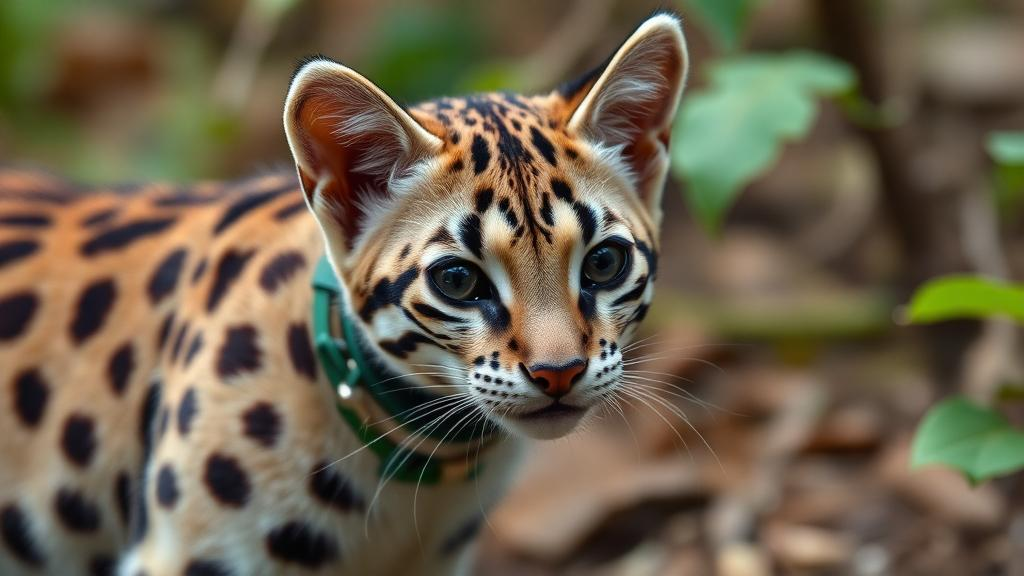
A young male ocelot struck by a car on a Costa Rican highway has become one of the most closely watched felids ever returned to the wild, and the six months of GPS data collected from his collar are rewriting assumptions about how rehabilitated cats re-enter human-dominated landscapes. The animal was hit near Hatillo, Quepos, in April 2022 and spent eight months at the Alturas Wildlife Sanctuary before being released on the Osa Peninsula in January 2023. A satellite and VHF-enabled collar then recorded 693 locations over 178 days, giving researchers a fine-scale record of an animal that would otherwise have vanished into dense rainforest. The results, published in Neotropical Biology and Conservation, show a striking two-act pattern: roughly 75 days of restless exploration followed by settlement in a restricted area, and, unexpectedly, a consistent preference for agricultural and disturbed habitats over the primary forest where he was released.
The study addresses a stubborn gap in conservation practice. Rehabilitation and release of injured wildlife is common, but assessing whether those releases actually succeed is difficult, particularly for nocturnal felids that are almost never seen after the transport box opens. Post-release monitoring data for rehabilitated Leopardus species fitted with GPS devices is scant, and past efforts have often ended early when the animal died or had to be recaptured. Costa Rica has the highest wildlife roadkill incidence in Central America, and ocelots are the most common feline victims of vehicle strikes, so the pipeline from collision to rescue center to release is a busy one. Without tracking, nobody could say what happened to the cats on the other end of it. This project was designed to change that, pairing a rescue case with satellite technology capable of documenting survival, movement, and habitat choice in near real time.
The setting matters as much as the technology. The Osa Peninsula, a 1,543-square-kilometer biodiversity hotspot on Costa Rica’s southern Pacific coast, holds a unique mosaic of oil palm plantations, cattle farms, and a stable network of protected primary and secondary lowland rainforest anchored by Corcovado National Park. Camera-trap surveys have documented mammal populations recovering from historical hunting and habitat loss, and the peninsula supports a singularly dense ocelot population, with estimates reaching up to 169 individuals per 100 square kilometers. That density is a double-edged sword for any release program: prey and habitat are abundant, but a young male dropped into the landscape must contend with resident adults already holding territories. The researchers chose a hard release site near Piro Biological Station, inside a private reserve in Corcovado’s buffer zone, citing stream access, ample prey, distance from human conflict areas, and ease of monitoring access.
The ocelot’s road to release was long and deliberately hands-off. Rescued with minor injuries plus central nervous system inflammation and vestibular symptoms from the strike, he was treated for seven days and then held under rehabilitation protocols for eight months. Four health checks were performed under anesthesia to minimize human contact, and the cat repeatedly demonstrated the behaviors that made him a release candidate: fear and aggression toward people, successful hunting of live prey and fish introduced into his enclosure, and minimal pacing distress. A final veterinary workup 24 days before release included a complete blood count, ELISA screens for seven pathogens, PCR testing for feline infectious anemia, and a coprological exam. Results came back positive for Chlamydophila and Toxoplasma gondii, both pathogens wild ocelots commonly carry, and the team correctly judged that treating them was pointless when reinfection in the wild was near-certain. At that final check he weighed nine kilograms.
The collar itself was engineered around the constraints of tracking a small cat. Weighing less than five percent of the ocelot’s body mass, the Telonics unit was programmed to collect a GPS fix every five hours, transmit data every five days, and emit a VHF beacon daily for real-time tracking when needed. Critically, during the final months of rehabilitation the cat wore a non-functional collar of identical size and weight, so the device was already familiar on release day. He was chemically immobilized, fitted with the working unit one day before release, and set free at 08:00 local time on January 4, 2023. The collar achieved an 81 percent fix success rate, averaging 3.9 locations per day, a dataset dense enough to reconstruct daily movement but frugal enough to stretch the battery across the monitoring window.
The movement data split cleanly into two phases. For the first 75 days the ocelot kept moving away from the release point, covering an average daily displacement of 1.05 kilometers, with single-day displacements ranging from five meters up to 5.4 kilometers and total daily movement reaching 7.5 kilometers. Then the track tightened. Average daily displacement fell by 46 percent, from 1.82 kilometers per day in the exploratory period to 0.99 kilometers per day once the animal settled, and the track began repeatedly revisiting the same locations, which the researchers defined as territory establishment. Two veterinarians visually confirmed the cat once, 43 days after release, noting he displayed fear of humans and ran off quickly, an encouraging sign that rehabilitation had not habituated him to people.
The habitat findings were the surprise. Although the release site sat in primary forest and high-quality forest was available nearby, the ocelot spent progressively more time in grassland, pasture, and other disturbed habitats as the months passed. A resource selection function, built with 100 pseudo-absences per location and weighted logistic regression, found strong statistical support for selection of grassland, palm plantations, open and urban areas, and secondary forest relative to primary forest, with only mangroves ranking lower than the baseline habitat. Camera traps deployed for 30 days around day 105 confirmed that known ocelot prey, including Central American agouti, white-nosed coati, and raccoon, were present in the settled area, and residents of two nearby properties reported seeing a collared ocelot passing through without distress, though no photograph was ever obtained.
Why would a wild cat released into pristine forest choose the farmland? The authors offer two non-exclusive explanations. First, competition: camera-trap surveys have documented high densities of resident ocelots around the release area, and this young male was likely pushed out of prime territory by established adults, relegated to grasslands until a vacancy opened. Second, familiarity: the area around his collision site is dominated by agriculture, so he may have carried a learned preference for disturbed habitats, or an acquired taste for domestic prey such as chickens, and sought out a landscape that felt like home. The pattern also fits natal habitat preference induction, the phenomenon in which animals settle in habitats resembling those they grew up in. Either way, the flexible habitat and diet requirements that make ocelots generalists appear to have carried this individual through a difficult transition.
The lessons for future releases are practical. Release-site assessments should weigh the existing density of conspecifics and sympatric carnivores, since intraspecific competition can shape long-term success, and generalist species like ocelots may actually be well suited to mixed-use matrices where varied prey and habitat compensate for competitive pressure. The study also exposes the trade-offs of collar-based monitoring: six months is likely an underestimate of true integration, given that subadult ocelot dispersal can take up to 18 months and post-translocation vulnerability up to four years, but longer tracking demands heavier batteries or sparser data for a nine-kilogram cat. Camera traps, despite their popularity, proved nearly useless for finding a single individual in dense forest. As a single-animal study, the work cannot settle whether competition or preference drove the habitat choice, but it demonstrates that rehabilitation centers and researchers, working together with satellite collars, can finally measure what happens after the release door opens, one of the first fine-scale GPS assessments of its kind for a rehabilitated Neotropical felid.
Subject of Research: Post-translocation GPS monitoring of a rehabilitated ocelot on the Osa Peninsula, Costa Rica
Article Title: Back to the wild: Post-translocation GPS monitoring of a rehabilitated ocelot ( Leopardus pardalis ) in a forest-agriculture matrix in the Osa Peninsula, Costa Rica
Article References: Wicks, S., Beirne, C., Azzopardi Schellmann, C., Flatt, E., Quirós Beita, S., Pereira Rocha, R., & Whitworth, A. (2024). Back to the wild: Post-translocation GPS monitoring of a rehabilitated ocelot (Leopardus pardalis) in a forest-agriculture matrix in the Osa Peninsula, Costa Rica. Neotropical Biology and Conservation, 19(3), 379-392. https://doi.org/10.3897/neotropical.19.e124324
Image Credits: AI Generated
DOI: 10.3897/neotropical.19.e124324
Keywords: ocelot, Leopardus pardalis, GPS tracking, wildlife rehabilitation, post-release monitoring, translocation, Osa Peninsula, Costa Rica, habitat selection, roadkill, Neotropical felids, resource selection
Cite Scienmag News
Margaret Porter. (October 18, 2026). GPS collar reveals how a rehabilitated ocelot reclaimed the wild. Scienmag. https://scienmag.com/gps-collar-reveals-how-a-rehabilitated-ocelot-reclaimed-the-wild/
Margaret Porter. "GPS collar reveals how a rehabilitated ocelot reclaimed the wild." Scienmag, 18 October 2026, https://scienmag.com/gps-collar-reveals-how-a-rehabilitated-ocelot-reclaimed-the-wild/. Accessed 18 October 2026.
Margaret Porter. "GPS collar reveals how a rehabilitated ocelot reclaimed the wild." Scienmag. October 18, 2026. https://scienmag.com/gps-collar-reveals-how-a-rehabilitated-ocelot-reclaimed-the-wild/


