


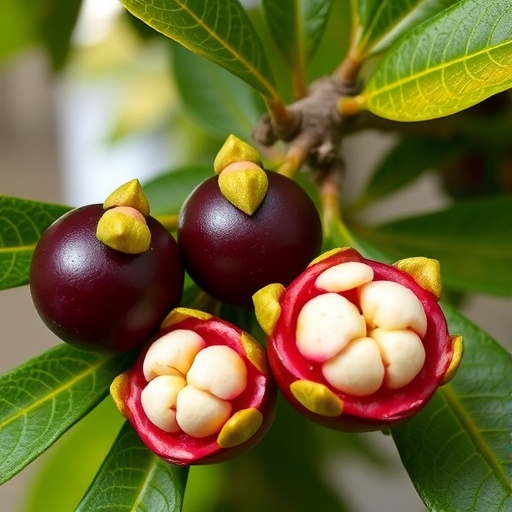
A waste product from the mangosteen fruit could help turn graphene oxide into a more effective carbon-capture material, according to a study that combines an advanced nanomaterial with the antioxidant-rich peel of Garcinia mangostana. The resulting composite captured up to 1.86 millimoles of carbon dioxide per gram of adsorbent—more than three times the capacity reported for the unmodified graphene oxide prepared under the same conditions. The strongest-performing material also survived three adsorption–desorption cycles with relatively stable performance, suggesting that a discarded agricultural material may have a useful role in reusable systems for removing CO₂ from gas streams.
The work addresses a central challenge in carbon capture: finding solid materials that can bind CO₂ efficiently without requiring the large energy inputs associated with regenerating liquid solvents. Adsorption systems work by allowing gas molecules to attach to a solid surface, either through relatively weak physical forces or stronger chemical interactions. Graphene oxide is attractive because its carbon sheets contain hydroxyl, epoxy, carbonyl and carboxyl groups that can interact with CO₂. Yet its performance depends heavily on how intensely the graphite is oxidized, how the sheets restack, and how many accessible pores and chemically active sites remain after synthesis. Excessive oxidation can create defects and collapse useful structure, while insufficient oxidation can leave too few polar sites to attract the quadrupolar CO₂ molecule.
The researchers prepared graphene oxide using a modified Hummers method, an established chemical route in which graphite is oxidized by potassium permanganate in concentrated sulfuric and phosphoric acids. They varied the later preparation temperature to 60, 80 and 100 °C, producing samples called GO 60, GO 80 and GO 100. The use of phosphoric acid and the omission of sodium nitrate follow greener modifications intended to reduce the toxic nitrogen oxides associated with the original Hummers process. The oxidized material was washed repeatedly to remove residual acids and minerals, then dried. In a second step, the team extracted compounds from powdered mangosteen peel using ethanol, evaporated the solvent and mixed the dried extract with graphene oxide in water at 60 °C. The resulting composites were designated GO 60+MP, GO 80+MP and GO 100+MP.
Mangosteen peel is more than a source of biomass: it contains phenolic compounds, flavonoids, tannins, anthocyanins and xanthones, including mangostin derivatives. Many of these molecules carry hydroxyl groups and aromatic rings. Those chemical features could alter graphene oxide in two important ways. First, they can increase the polarity of the surface, strengthening interactions with CO₂. Second, the bulky organic molecules can prevent graphene sheets from packing too tightly, creating or exposing pathways through which gas molecules can diffuse. Microscopy images indicated that the extract adhered to the graphene oxide, producing more folds, wrinkles and visibly heterogeneous regions. The researchers interpret these features as evidence that mangosteen-derived compounds changed the texture and accessibility of the carbon sheets, although the study does not establish the precise molecular bonding arrangement of every extract component.
Several characterization techniques supported the chemical changes. Infrared spectra of the untreated graphene oxide showed signals associated with carbonyl and carboxyl groups, aromatic carbon–carbon bonds, epoxy bridges and alkoxy or alcohol groups. After mangosteen impregnation, the broad hydroxyl signal became more pronounced, consistent with the addition of phenolic compounds and an increase in surface polarity. Raman spectroscopy showed that the disorder-to-graphite ratio, known as the ID/IG ratio, rose from 1.45 to 1.55 as the graphene oxide preparation temperature increased from 60 to 100 °C. After adding the peel extract, the ratio increased further to 1.75, 1.76 and 1.86 for the three temperatures. In graphene-based materials, a higher ID/IG ratio generally indicates more structural disorder or a greater number of defect sites. Such defects are not automatically beneficial, but they can expose reactive edges and create additional locations where gas molecules can bind.
The temperature itself had a pronounced effect on the material’s composition and structure. Energy-dispersive X-ray analysis found that the oxygen content of pristine graphene oxide fell from 31.77 atomic percent in GO 60 to 24.53 percent in GO 80 and 14.03 percent in GO 100, according to the study’s discussion. X-ray diffraction measurements likewise indicated shrinking interlayer distances at higher preparation temperatures, consistent with the loss of oxygen-containing groups between carbon layers. GO 60 had a specific surface area of 52.64 square metres per gram, compared with 12.03 and 14.62 square metres per gram for GO 80 and GO 100. The researchers suggest that 60 °C created a balance: enough oxidation to expand and functionalize the layers, but not so much thermal damage that the structure became less accessible. Adding mangosteen extract raised the measured surface area of all three materials, with GO 60+MP reaching 71.27 square metres per gram.
Nitrogen adsorption measurements revealed why the GO 60 composite performed particularly well. GO 60+MP displayed a type IV adsorption isotherm with a pronounced H2 hysteresis loop, a pattern commonly associated with mesopores and complex pore networks. Mesopores range from 2 to 50 nanometres across and can provide a compromise between high surface area and rapid gas transport. The composite also contained larger voids and slit-like spaces created by partially restacked graphene oxide sheets. Its average pore diameter was 1.37 nanometres, smaller than the 1.97-nanometre average measured for GO 60, suggesting that the extract narrowed some openings while increasing the overall accessible surface. At higher synthesis temperatures, the composites exhibited weaker type III isotherms and lower surface areas—32.98 square metres per gram for GO 80+MP and 27.04 square metres per gram for GO 100+MP.
The most direct test used a fixed-bed reactor packed with 3 grams of adsorbent between layers of quartz wool. Before each experiment, the material was heated under nitrogen, cooled to 30 °C and exposed to a simulated gas stream containing nitrogen and carbon dioxide. The reported testing conditions include a gas flow of 80 millilitres per minute and CO₂ concentrations of either 20 percent in the experimental setup or 15 percent in the capacity comparison and cycling tests. Breakthrough curves track the ratio of outlet to inlet CO₂ concentration: when the ratio is low, the bed is retaining most of the gas; when it approaches one, the material is becoming saturated. Pure graphene oxide reached equilibrium after roughly 5 to 7 minutes, depending on preparation temperature. With mangosteen extract, the corresponding times extended to about 19 to 30 minutes, with GO 60+MP producing the broadest breakthrough curve. Its measured capacity was 1.86 millimoles per gram, compared with 0.51 millimoles per gram for GO 60.
The proposed explanation combines pore structure with surface chemistry rather than attributing the improvement to a single mechanism. CO₂ is a linear molecule with a substantial quadrupole moment, meaning its charge distribution allows it to interact with localized electric fields. Oxygen-containing groups on graphene oxide create surface dipoles that can attract CO₂, while hydroxyl and phenolic groups may support hydrogen-bond-like interactions. Aromatic regions in both graphene oxide and the mangosteen compounds can also interact with CO₂ through its quadrupole and the electron clouds of the rings. At the same time, mesoporous channels can speed diffusion toward internal sites. Kinetic modelling supports a mixed mechanism. Untreated graphene oxide was best described by the Avrami fractional-order model, with correlation coefficients of 0.97 to 0.99, consistent with heterogeneous sites and multiple adsorption pathways. After impregnation, pseudo-first- and pseudo-second-order models both fitted the data well, with coefficients near 0.99, suggesting that the surface treatment changed the apparent distribution and behaviour of adsorption sites rather than converting the process into purely physical or purely chemical capture.
For a carbon-capture material to be useful beyond the laboratory, it must release the stored gas without losing capacity. The researchers regenerated the composites by heating them to 200 °C under pure nitrogen and repeated adsorption and desorption three times. GO 60+MP showed complete regeneration by the third cycle, while the measured capacities remained relatively consistent across the tested cycles. That result is encouraging, but it is not yet evidence of industrial readiness. The experiments used a small fixed bed, a synthetic CO₂–nitrogen mixture and only three cycles; real flue gas contains water vapour, oxygen, sulfur compounds and other contaminants that can compete for active sites or degrade the biomass-derived coating. The chemical oxidation route also uses strong acids and oxidants, so the environmental advantages of recycling mangosteen peel will ultimately depend on reagent recovery, waste treatment, scale-up and the durability of the composite over hundreds or thousands of cycles. Even with those limitations, the study demonstrates a compelling design principle: agricultural waste can supply functional molecules that tune a graphene-based surface, while a moderate synthesis temperature preserves the porous architecture needed to capture CO₂ efficiently.
Cite Scienmag News
Neil Sanderson. (August 27, 2026). Mangosteen Peel Extract Boosts Graphene Oxide CO2 Adsorption Across Synthesis Temperatures. Scienmag. https://scienmag.com/mangosteen-peel-extract-boosts-graphene-oxide-co2-adsorption-across-synthesis-temperatures/
Neil Sanderson. "Mangosteen Peel Extract Boosts Graphene Oxide CO2 Adsorption Across Synthesis Temperatures." Scienmag, 27 August 2026, https://scienmag.com/mangosteen-peel-extract-boosts-graphene-oxide-co2-adsorption-across-synthesis-temperatures/. Accessed 3 September 2026.
Neil Sanderson. "Mangosteen Peel Extract Boosts Graphene Oxide CO2 Adsorption Across Synthesis Temperatures." Scienmag. August 27, 2026. https://scienmag.com/mangosteen-peel-extract-boosts-graphene-oxide-co2-adsorption-across-synthesis-temperatures/


