


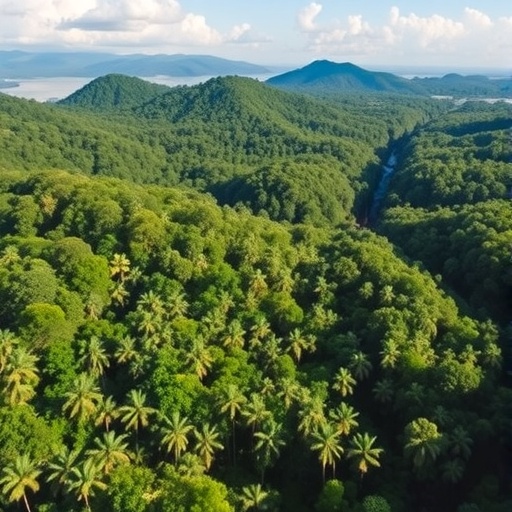
In the intricate tapestry of the Congo Basin’s vast rainforests, a groundbreaking study has illuminated the profound impact of forest management on carbon dynamics, fundamentally transforming our understanding of tropical ecosystem conservation and climate mitigation strategies. The research, spearheaded by Sagang, Dalagnol, White, and colleagues, presents compelling evidence that forests under managed stewardship exhibit significantly higher carbon density and enhanced carbon sequestration capacities compared to their unmanaged counterparts. This pioneering insight challenges conventional perspectives and positions managed rainforests as pivotal players in the global carbon cycle, offering new hopeful avenues for combating climate change.
The Congo Basin, spanning across several Central African nations, harbors the world’s second-largest tropical rainforest, a critical carbon sink whose health directly influences atmospheric carbon dioxide levels. Traditionally, efforts to mitigate climate change through forest conservation have predominantly focused on preserving pristine, untouched rainforests. However, this research introduces a paradigm shift: active forest management – a strategy that involves sustainable logging, controlled undergrowth clearing, and selective species enrichment – can paradoxically bolster the forest’s capacity to absorb and store carbon. Such findings are transformative, considering the pressure these forests face from deforestation, illegal logging, and agricultural expansion.
Central to the study is a meticulous comparative analysis of carbon stocks between managed and unmanaged forest areas within the Congo Basin, employing state-of-the-art remote sensing technologies, field biomass inventories, and sophisticated carbon modeling techniques. By integrating satellite data with ground-truth measurements, the team quantified aboveground carbon stocks with unprecedented accuracy. Remarkably, managed rainforests demonstrated up to a 20% increase in carbon density, suggesting that targeted human intervention, when scientifically guided, optimizes forest structure and function to accelerate carbon capture.
The implications of these findings extend beyond carbon accounting. Managed forests displayed altered species compositions favoring fast-growing, high wood-density trees, which not only sequester carbon more efficiently but also contribute to increased ecosystem resilience against drought and pest outbreaks. The selective removal of certain tree species appears to stimulate regeneration cycles, promoting a dynamic balance between growth and decay processes. This nuanced understanding of forest ecology underlines the potential of adaptive management practices to harmonize biodiversity conservation with climate goals.
To comprehend the mechanisms underpinning the enhanced carbon sequestration, the study delves into the physiological and biochemical responses of trees within managed regimes. Carbon assimilation rates were significantly elevated, as demonstrated by leaf photosynthetic activity measurements. Moreover, soil carbon pools benefited from improved organic matter inputs due to litterfall patterns influenced by management activities. These multifaceted carbon reservoirs collectively contribute to the forest’s net carbon gain, underscoring the importance of integrating aboveground and belowground processes in carbon budget assessments.
From a biogeochemical perspective, the managed forests exhibited modulated nutrient cycling, particularly nitrogen and phosphorus availability, which are critical for sustaining primary productivity. Forest interventions appeared to mitigate nutrient limitations by enhancing soil microbial communities responsible for nutrient mineralization and organic matter decomposition. This facilitation of nutrient turnover promotes a positive feedback loop, whereby managed forests sustain higher biomass productivity and carbon storage capacity over time, even in nutrient-poor tropical soils.
Moreover, the research examines the socio-economic dimensions embedded in forest management strategies. The managed areas typically coincide with community-managed forests or concessions governed by regulatory frameworks promoting sustainable resource utilization. These governance structures have not only curtailed destructive exploitation but have also fostered local stewardship, incentivizing practices that align ecological integrity with livelihood security. This intersection of ecological science and socio-political governance presents a replicable model for forest conservation that transcends mere preservation.
The study also raises critical discussions about the scalability and replicability of managed rainforest models across other tropical regions. While the Congo Basin offers unique ecological and cultural contexts, the principles underpinning successful management – adaptive silviculture, community involvement, and continuous monitoring – hold universal applicability. The researchers caution, however, that mismanagement or unsupervised exploitation could reverse gains, emphasizing the necessity of robust legal frameworks and scientific oversight in conservation planning.
Environmental policy implications emerging from these findings are profound. The enhanced carbon sequestration capacity of managed rainforests directly informs mechanisms such as REDD+ (Reducing Emissions from Deforestation and Forest Degradation), providing empirical data that can refine carbon credit valuations and promote investment in sustainable forest management projects. Integrating managed forests into national greenhouse gas inventories could amplify countries’ commitments under the Paris Agreement by recognizing forest stewardship as an active climate mitigation measure.
Furthermore, the study underscores the importance of long-term monitoring to capture temporal dynamics in carbon fluxes. Both satellite remote sensing time series and repeated forest inventories are essential to detect variations driven by climate anomalies, pest outbreaks, or anthropogenic disturbances. This temporal lens ensures that carbon sequestration gains are not only achieved but maintained, providing resilient carbon sinks that buffer against future environmental uncertainty.
At the intersection of climate science and forest ecology, the research advances methodological frontiers by combining cutting-edge LiDAR (Light Detection and Ranging) technologies with molecular biology tools. For instance, DNA barcoding of tree species in managed plots validated species composition data with high fidelity, while isotope analysis enabled tracing of carbon assimilation pathways, revealing alterations in carbon use efficiency under different management regimes. These technical innovations mark a new era of integrated forest carbon science.
Equally important is the potential co-benefits for biodiversity emerging from managed rainforests. Although selective logging inevitably alters habitat structure, the study found no significant declines in key faunal groups such as primates, birds, or insects in well-managed areas. On the contrary, patchy disturbances created microhabitats supporting diverse species assemblages. This suggests that sustainable forest management can reconcile carbon goals with biodiversity conservation, a dual imperative in tropical forest stewardship.
The findings spotlight the critical role of partnerships among scientists, policymakers, local communities, and international organizations in scaling managed rainforest approaches. Capacity-building initiatives that train local stakeholders in forest monitoring and management practices amplify social empowerment while ensuring ecological accountability. Such collaborative frameworks are indispensable to translating scientific insights into tangible conservation outcomes on the ground.
In conclusion, the study by Sagang et al. redefines the narrative surrounding tropical rainforests, transforming managed forests from perceived carbon liabilities to vital assets in the global fight against climate change. Through rigorous, multidisciplinary research, it reveals that sustainable management not only supports higher carbon density but also fosters resilient, productive ecosystems that benefit biodiversity and human societies alike. This work heralds a future where scientifically informed stewardship of tropical forests emerges as a cornerstone of planetary health and sustainability.
As the world confronts escalating climate crises, these new revelations offer a beacon of hope, suggesting that human intervention, when harmonized with ecological principles, can amplify nature’s intrinsic ability to regulate the atmosphere. Managed rainforests in the Congo Basin stand as living proof that innovation, respect for nature, and inclusive governance can converge to secure a greener, more sustainable future for generations to come.
Cite Scienmag News
Sloane Callahan. (April 30, 2026). Managed Rainforests Boost Carbon Storage in Congo Basin. Scienmag. https://scienmag.com/managed-rainforests-boost-carbon-storage-in-congo-basin/
Sloane Callahan. "Managed Rainforests Boost Carbon Storage in Congo Basin." Scienmag, 30 April 2026, https://scienmag.com/managed-rainforests-boost-carbon-storage-in-congo-basin/. Accessed 3 September 2026.
Sloane Callahan. "Managed Rainforests Boost Carbon Storage in Congo Basin." Scienmag. April 30, 2026. https://scienmag.com/managed-rainforests-boost-carbon-storage-in-congo-basin/


