


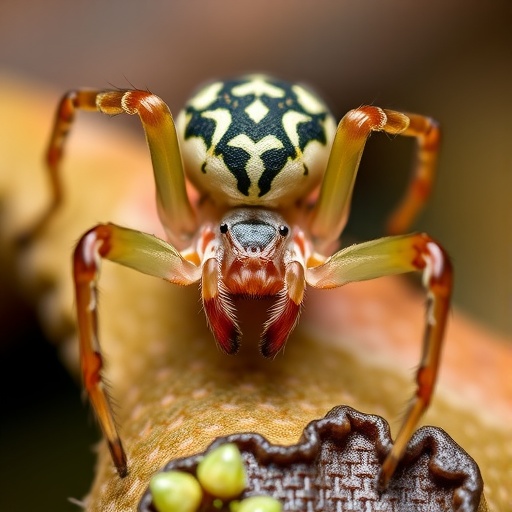
In the obscure yet fascinating realm of arachnids, a recent study has opened a window into understanding the complexities of same-sex sexual behavior in a male-dimorphic species. This arachnid exhibits a striking phenomenon characterized by resource-defense polygyny, where males compete not only for female attention but also for the control of essential resources. A team of researchers led by D. Solano-Brenes has shed light on this intriguing behavior, revealing evidence of female mimicry among male arachnids as part of their mating strategies.
The male-dimorphic characteristic of this arachnid species plays a crucial role in the dynamics of their sexual behavior. Males can display two distinct phenotypes, presumably adapted to different reproductive strategies. One phenotype appears more formidable, likely developed for direct competition over territories and mates. In contrast, the other phenotype could be less imposing but possesses unique advantages that allow it to leverage alternative mating tactics, such as female mimicry, to circumvent aggressive interactions with other males.
The emergence of same-sex sexual behavior within this context is particularly noteworthy. Previous studies in various taxa have documented instances of same-sex interactions, often framed within the context of social bonding or dominance displays. However, the findings from this arachnid study indicate that same-sex behavior can also be a strategic maneuver within the complexities of a polygynous breeding system. Male-male interactions might arise not only from competition but as part of an elaborate system of deceit and mimicry intertwined with the evolutionary pressures of reproduction.
Researchers utilized detailed observations and analyses in natural settings to monitor the interactions between male arachnids. They documented instances where males exhibited behaviors typically associated with mating attempts towards other males, prompting an exploration of the underlying motivations. One particularly captivating observation involved males mimicking female traits to lure other males, exploiting their courtship behaviors to gain advantages in mating without direct confrontation.
The ecological implications of such behaviors reflect a sophisticated understanding of sexual dynamics within these species. By engaging in mimicry, males not only enhance their reproductive potential but also create a more complex social structure within their populations. This mimicry can lead to an intricate web of interactions where the boundaries between competition and cooperation blur.
The hypothesis of female mimicry raises essential questions about the evolutionary advantages it may confer. In a scenario where the resource availability is critical, males that can divert the attention of others—either through mimicry or strategic interactions—might ensure their survival and reproductive success. Such behavior can skew population dynamics and influence the evolution of traits within the species over generations, making it an intriguing subject for future studies in behavioral ecology.
Furthermore, these observations challenge traditional views of sexual behavior in the animal kingdom. While many assume that mating strategies are strictly binary and straightforward, this arachnid’s case suggests a more nuanced approach. The coexistence of various mating strategies highlights the adaptability and complexity of sexual behavior in response to environmental pressures.
The study’s findings also underline the importance of continued research into the behavioral ecology of arachnids and other invertebrates. As the scientific community strives to comprehend the myriad behaviors exhibited across species, cases like this serve as vital evidence that mimicry and same-sex interactions have significant roles in shaping mating systems. This knowledge expands our understanding of the evolutionary mechanisms driving biodiversity and could have wider implications within the field of behavioral science.
In line with these discoveries, the researchers urge further exploration of similar patterns in other species exhibiting dimorphic traits. The intricate interplay of mating strategies, resource competition, and social interactions suggests that seemingly simple animal behaviors can, in reality, be rich with evolutionary significance. Future studies can benefit from a multi-disciplinary approach, incorporating genetics, ecology, and ethology to paint a fuller picture of these compelling behaviors.
This groundbreaking research emphasizes that every new discovery contributes to a greater understanding of the natural world. It beckons scientists to gaze deeper into the behaviors of creatures often overlooked, revealing the hidden complexities of their lives. Researchers are eager to see how this specific arachnid and others like it will continue to surprise us with their evolutionary adaptations, enriching our comprehension of life’s diversity.
As scholars sift through the wealth of data presented, they anticipate future work will unravel even more astonishing revelations about the interconnectedness of sexual behavior, environmental pressures, and the diverse strategies creatures employ to thrive in the natural world. The delicate balance of competition and cooperation illustrated by these arachnids presents not just a fascinating scientific mystery but a compelling narrative about survival, adaptation, and the intricate web of life on Earth.
Solano-Brenes, D., Furlan, C.M., da Silva, R.C. et al. Same-sex sexual behavior in a male-dimorphic arachnid with a resource-defense polygyny: evidence for female mimicry?. Sci Nat 113, 8 (2026). https://doi.org/10.1007/s00114-025-02058-z
Cite Scienmag News
Drew Townsend. (January 5, 2026). Male Arachnids Show Same-Sex Behavior, Questioning Mimicry. Scienmag. https://scienmag.com/male-arachnids-show-same-sex-behavior-questioning-mimicry/
Drew Townsend. "Male Arachnids Show Same-Sex Behavior, Questioning Mimicry." Scienmag, 5 January 2026, https://scienmag.com/male-arachnids-show-same-sex-behavior-questioning-mimicry/. Accessed 3 September 2026.
Drew Townsend. "Male Arachnids Show Same-Sex Behavior, Questioning Mimicry." Scienmag. January 5, 2026. https://scienmag.com/male-arachnids-show-same-sex-behavior-questioning-mimicry/


