A composite hydrocolloid dressing that pairs carboxymethyl cellulose with magnesium-doped bioactive glass has shown promise for acute wound management, according to a study published in Frontiers in Materials. The research, led by Wang Chen of the Wenzhou Institute, University of Chinese Academy of Sciences, together with colleagues at Wenzhou Medical University, evaluated the material’s physicochemical properties and its healing performance across several laboratory and animal models.
The dressing, referred to as MgBG/CMC, was designed to combine two functions that are often treated separately in wound care: managing wound exudate and actively regulating cell behaviour. By incorporating the bioactive glass into the CMC matrix, the team created a single material intended to absorb fluid while also supporting the repair process.
Physicochemical testing showed that adding the magnesium-doped bioactive glass enhanced the fluid absorption capacity of the CMC matrix.
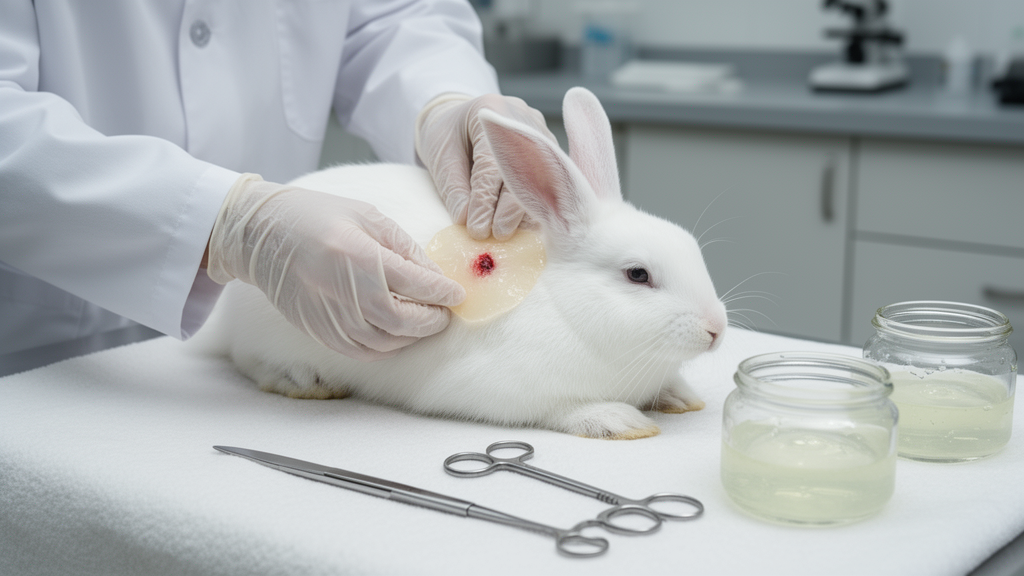
The most striking result came from an acute wound model in New Zealand white rabbits, where the MgBG/CMC dressing was associated with faster wound closure. This finding supports the study’s central conclusion that the formulation is best suited to acute wound management, where the combination of improved fluid handling and bioactive stimulation of keratinocytes may work together to accelerate repair.
However, the benefits were not uniform across all wound types examined. In a chronic wound model established in Sprague-Dawley rats, in which healing was impaired by glucocorticoid treatment, the additional benefit of MgBG/CMC over the CMC dressing alone was limited. The team also carried out an exploratory assessment of hypertrophic scar outcomes, and again the composite dressing did not show a clear advantage over the base material in that setting.
In vitro experiments helped clarify which cell types respond to the material. Extracts of the MgBG dressing selectively increased the viability of HaCaT keratinocytes. By contrast, the extracts showed minimal effects on dermal fibroblast viability and on endothelial tube formation.
The authors are careful to note that the mechanisms behind the observed effects remain to be fully elucidated. The relative contributions of ionic dissolution products from the bioactive glass, the intrinsic properties of the matrix, and other factors have not yet been separated experimentally. The hypertrophic-scar assessment was exploratory, and the study's conclusions about the formulation's application boundaries are correspondingly cautious.
Overall, the study presents a simple bioactive hydrocolloid dressing strategy for acute wound management and, importantly, maps the limits of the current formulation. Rather than claiming a universal solution for all wound types, the researchers identify the specific conditions under which MgBG/CMC appears advantageous and the conditions under which it does not, providing a realistic picture of where this dressing approach may fit in future wound care practice.
The work was carried out by researchers from the Wenzhou Institute, University of Chinese Academy of Sciences, and the Second Affiliated Hospital and Yuying Children’s Hospital of Wenzhou Medical University, and was published as an open-access original research article in the Biomaterials and Bio-Inspired Materials section of Frontiers in Materials.
Subject of Research: A magnesium-doped bioactive glass and carboxymethyl cellulose hydrocolloid dressing for skin wound repair
Article Title: Magnesium-doped bioactive Glass/CMC hydrocolloid dressings promote acute wound repair
Article References: Wang, C., Yu, J., Zhang, L., Ge, H., Chen, Y., Sun, Z., Chen, S., & Wang, L. (2026). Magnesium-doped bioactive Glass/CMC hydrocolloid dressings promote acute wound repair. Frontiers in Materials, 13, Article 1995518. https://doi.org/10.3389/fmats.2026.1995518
Image Credits: AI Generated
DOI: 10.3389/fmats.2026.1995518
Keywords: hydrocolloid dressing, magnesium-doped bioactive glass, carboxymethyl cellulose, acute wound healing, keratinocytes, wound closure, exudate management, biomaterials, rabbit ear wound model, chronic wounds, Frontiers in Materials, Magnesium-doped
Cite Scienmag News
Denise Maddox. (October 28, 2026). Magnesium-Doped Bioactive Glass Hydrocolloid Dressing Associated With Faster Acute Wound Closure in Rabbit Model. Scienmag. https://scienmag.com/magnesium-doped-bioactive-glass-hydrocolloid-dressing-associated-with-faster-acute-wound-closure-in-rabbit-model/
Denise Maddox. "Magnesium-Doped Bioactive Glass Hydrocolloid Dressing Associated With Faster Acute Wound Closure in Rabbit Model." Scienmag, 28 October 2026, https://scienmag.com/magnesium-doped-bioactive-glass-hydrocolloid-dressing-associated-with-faster-acute-wound-closure-in-rabbit-model/. Accessed 28 October 2026.
Denise Maddox. "Magnesium-Doped Bioactive Glass Hydrocolloid Dressing Associated With Faster Acute Wound Closure in Rabbit Model." Scienmag. October 28, 2026. https://scienmag.com/magnesium-doped-bioactive-glass-hydrocolloid-dressing-associated-with-faster-acute-wound-closure-in-rabbit-model/