


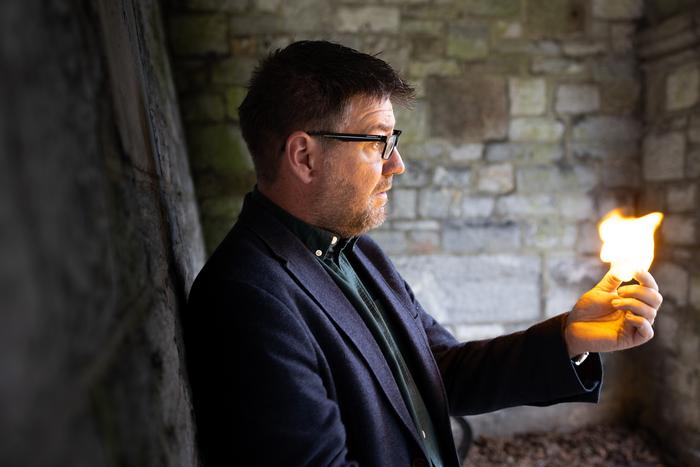
Magicians all over the world are being challenged to showcase their best possible trick that uses only the medium of sound.

Credit: University of Plymouth
Magicians all over the world are being challenged to showcase their best possible trick that uses only the medium of sound.
A significant number of magic tricks rely on sleight of hand or misdirection that deceives the eye, which prevents people who are blind or visually impaired from experiencing the illusions.
In fact, there are very few magic tricks that rely on other senses, and virtually none geared around auditory perception alone.
To address that, a new competition is challenging innovators and illusionists to craft mesmerizing tricks which evoke wonder and amazement purely through sound.
Dr Gustav Kuhn, Associate Professor of Psychology at the University of Plymouth, is coordinating the competition as part of a research project that aims to make magic more inclusive by allowing individuals with visual impairments to experience the art from.
He also believes that studying auditory magic tricks may also reveal intriguing insights into the nature of human perception and highlight important differences between vision and hearing.
Dr Kuhn, a member of the Magic Circle and the Science of Magic Association, said: “We believe the significance of this challenge extends far beyond entertainment. Individuals who live with blindness and visual impairments often face significant barriers to accessing, and participating in, artistic expression like magic. Recognising the importance of creating magic for these individuals is a profound act of inclusivity and compassion that can have a transformative impact on our society. By focusing on auditory perception alone, this challenge provides a unique opportunity for this audience to experience magic performances in a meaningful way.”
The competition is open for submissions until October, with the winner being announced at the Science of Magic Association conference in Las Vegas in November 2024.
Submitted tricks must include minimal to no verbal cues or instructions, with the essence of the challenge lying in crafting illusions that speak through sound alone, without the aid of language.
Participants are also required to abstain from integrating other sensory elements, so spectators will undergo the magical experience blindfolded thereby excluding any reliance on visual cues.
Additionally, the trick should not engage sensations of touch, pressure, pain, smell, taste, or the necessary movement of body parts, ensuring the audience’s immersion solely in the acoustic realm.
Entries can be detailed in writing, video or through sound files of live performances, and each of the submissions will be judged by a jury involving magicians, academics and members of the blind community.
For more details about the competition, visit https://www.magicresearchlab.com/auditorychallange.
Cite Scienmag News
Courtney Benton. (September 4, 2024). Magic for the blind – competition encourages magicians to create tricks that only use sound. Scienmag. https://scienmag.com/magic-for-the-blind-competition-encourages-magicians-to-create-tricks-that-only-use-sound/
Courtney Benton. "Magic for the blind – competition encourages magicians to create tricks that only use sound." Scienmag, 4 September 2024, https://scienmag.com/magic-for-the-blind-competition-encourages-magicians-to-create-tricks-that-only-use-sound/. Accessed 4 September 2026.
Courtney Benton. "Magic for the blind – competition encourages magicians to create tricks that only use sound." Scienmag. September 4, 2024. https://scienmag.com/magic-for-the-blind-competition-encourages-magicians-to-create-tricks-that-only-use-sound/

