


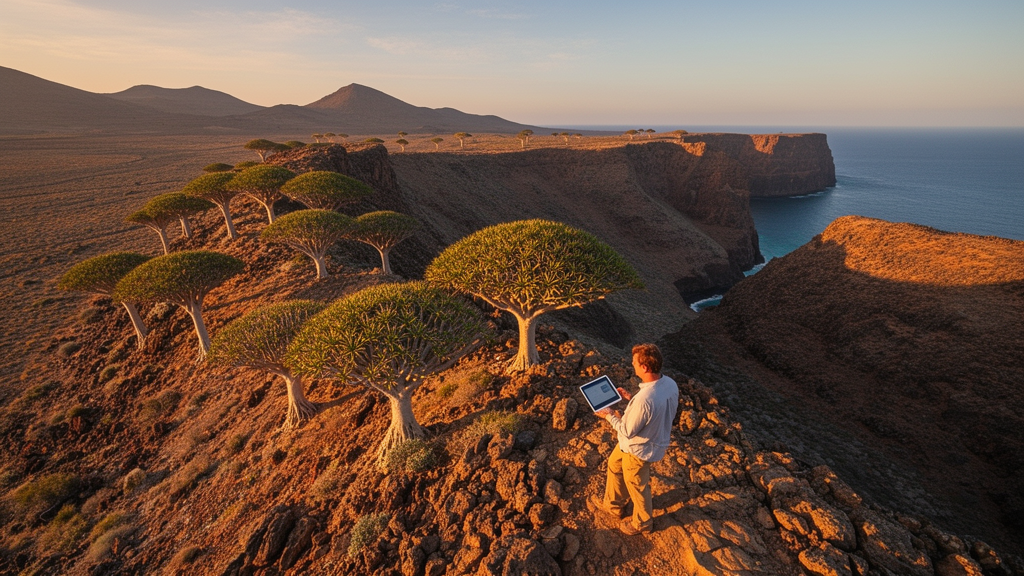
Socotra, the remote Yemeni archipelago in the western Indian Ocean, has long been famous for its otherworldly dragon’s blood trees and its extraordinary endemic flora, with roughly 37 percent of its 835 vascular plant species found nowhere else on Earth. Yet the island’s non-endemic plants, the species that also grow elsewhere, carry an equally fascinating story. They are living records of ancient dispersal routes, vanished land bridges, and climatic corridors that connected the archipelago to Africa, Arabia, and beyond. A new study published in Vegetation Classification and Survey now provides the first fully quantitative classification of these species’ geographic range patterns, known as chorotypes, turning a century-old European tradition of descriptive biogeography into a reproducible, data-driven science.
The research team assembled an astonishing 4,493,566 occurrence records from the Global Biodiversity Information Facility for 477 target taxa, the native non-endemic plants recorded for Socotra. Strictly endemic species were deliberately excluded, because their ranges are confined to the archipelago and therefore carry no information about broader co-distribution patterns. After rigorous filtering, which removed fossils, cultivated specimens, records with spatial uncertainty exceeding ten kilometres, and species flagged as non-native, 417 taxa had usable occurrences and 389 met a minimum threshold of fifteen records for distribution modelling. The result was a dataset of 114,219 modelled occurrences spanning 7,969 grid cells of one degree by one degree, covering the globe.
Turning raw occurrence points into comparable ranges required a sophisticated computational pipeline. The researchers fitted species distribution models using three algorithms, Gradient Boosting Machines, Random Forest, and MaxEnt, within the biomod2 framework. Crucially, the models were not used to draw ecological conclusions about individual species, but purely to regularise the patchy occurrence data into coherent coarse-grained ranges. Environmental predictors came from the CHELSA climatic database, reduced from 36 initial variables to ten by screening for multicollinearity, retaining measures such as isothermality, precipitation seasonality, humidity range, net primary productivity, and wind speed. Model quality was impressive, with ensemble testing scores averaging 0.826 on the True Skill Statistic, comfortably above the 0.8 threshold that marks strong predictive performance.
The heart of the method lies in how the team grouped both places and species. They combined two dissimilarity measures, the turnover component of Sørensen beta-diversity, which captures species replacement between grid cells, and the great-circle geographic distance between cell centroids. Mixing these with a convex parameter scanned from zero to 0.9, and testing cluster numbers from five to fifteen, they identified a parsimonious solution that balanced ecological turnover with spatial cohesion. The global analysis produced ten continent-scale spatial clusters: two covering the Americas, two splitting Africa, one for the Arabian Peninsula with extensions into the Horn of Africa and India, one spanning the Afro-Mediterranean belt and the Levant, one for Australia, and others besides.
Next came the crucial step of translating spatial clusters into chorotypes, groups of species that share similar geographic ranges. For each species, the researchers asked whether it occupied a given cluster more often than expected by chance, using a use-availability framework borrowed from animal habitat-selection studies. A binomial test compared each species’ observed occupancy against the cluster’s share of global land area, with false discovery rate correction and a demanding effect-size requirement of at least 1.74 times the null expectation. Each species then received a compositional signature, the proportions of its occurrences across all clusters, and species were compared using Jensen-Shannon distance, a metric well suited to probability-like data. Clustering these signatures with Partitioning Around Medoids yielded ten global macro-chorotypes, the largest containing 79 species distributed mainly across Africa and the Arabian Peninsula.
To resolve finer structure around the archipelago itself, the team repeated the entire workflow on a Socotra-centred subset of 4,049 cells and 242 species, excluding the Americas and Oceania. This regional refinement produced 25 spatial clusters and 12 meso-chorotypes, operational labels for chorotypes with narrower extents. The regionalisation was strikingly detailed: the central-eastern belt of the Arabian Peninsula separated cleanly from its southern sector, Africa split along west-east and north-south lines, and Madagascar emerged as a distinct unit. Clusters along the southern Arabian margin and the Horn of Africa were strongly enriched, with 174 species significantly associated with one cluster alone, confirming that many species share these corridors and providing a robust basis for the chorotype delineation.
The resulting chorological spectrum of Socotra’s non-endemic flora tells a clear story. It is dominated by the Xeric Tropical-Subtropical chorotype at 13.8 percent, followed by the Paleoarabian-Somali-Masai chorotype at 10.1 percent and the Temperate-Subtropical Belt at 9.2 percent. The rarest group, the Western Indian Ocean Humid Arc, accounts for just 0.8 percent. This dominance of xeric, tropical-subtropical Eastern Hemisphere elements places the island firmly within a thermo-xeric macro-network linking Northeast Africa, southern Arabia, and adjoining arid belts, consistent with classical placements of southern Arabia within the Somalo-Arabian and Eritreo-Arabian phytochoria.
The study then performed something genuinely novel: linking species-level chorotypes to the archipelago’s vegetation types. By aggregating the chorotype assignments of species listed in synoptic vegetation tables, the researchers calculated the chorological signature of each plant community, from Boswellia woodlands to halophytic marshes. The results reveal a sharp ecological gradient. Endemic-rich woodlands and shrublands, such as Boswellia ameero woodland and Commiphora ornifolia woodland, showed high specialisation, with dominant chorotypes often exceeding 55 to 70 percent of their composition. In contrast, grasslands and halophytic communities displayed mixed spectra and higher Shannon diversity, reflecting greater connectivity with continental species pools and, in many cases, more recent arrival from the mainland. Croton sarcocarpus shrubland, for example, carries a strong Paleoarabian-Somali-Masai signal suggesting relict status, while Eragrostis papposa-Arthraxon micans grassland is dominated by the Temperate-Subtropical Belt, pointing to ongoing immigration.
The biogeographic interpretation reaches deep into geological time. The archipelago sits on the Socotra Platform, where oceanic rifting in the Gulf of Aden began roughly 20 to 17 million years ago, though biogeographically relevant land emergence dates back at least to the late Eocene, 38 to 34 million years before present. The authors propose a two-stage scenario: Neogene aridification and tectonic uplift assembled dry biomes across Northeast Africa and Arabia, establishing corridor footprints during the Miocene, while Quaternary sea-level oscillations repeatedly opened and closed coastal passages around the Red Sea and Gulf of Aden, periodically narrowing the distance between the Horn of Africa and Socotra. The prominence of the Red Sea-Gulf of Aden rim in their results marks it as a potential biogeographic hinge, a gateway where dry-adapted lineages pass easily while humid-adapted taxa are constrained to fog-fed enclaves. Under this reading, Socotra acts less as a source area and more as a selective sink, filtering, compressing, and preserving regional floristic signals under insular conditions.
The authors are candid about the limitations. GBIF sampling is uneven, model validation relied on random rather than spatial cross-validation, and the chosen clustering parameters, though supported by inertia and silhouette diagnostics, are not unique; the workflow remains experimental. Phylogeographic dating of the chorotypes is not yet possible, because genetic knowledge of Socotran and African endemics remains too patchy, though the authors suggest that combining chorotype frameworks with molecular phylogenies could open a new phase in the discipline. Still, the achievement is substantial. The ten macro-chorotypes recover traditionally recognised phytochoria across Africa and Southwest Asia, and the Socotra-centred analysis resolves nested sub-units tied to orography and coastal climatic gradients, broadly confirming the qualitative synthesis long offered by expert florists. What has changed is the epistemology: classical chorology, once dependent on the intuitions of individual specialists, can now be quantified, mapped, monitored, and reused for other taxa and through time. For a tiny archipelago that has preserved the fingerprints of Miocene deserts and glacial sea-level lows in its flora, that is a powerful new lens on both the past and the conservation future.
Subject of Research: Quantitative chorotype classification of the non-endemic flora of the Socotra Archipelago
Article Title: A quantitative classification of chorotypes for the Socotra Archipelago’s non-endemic plants
Article References: La Montagna, D., Fanelli, G., De Sanctis, M., Farcomeni, A., Maděra, P., Malatesta, L., Van Damme, K., & Attorre, F. (2026). A quantitative classification of chorotypes for the Socotra Archipelago’s non-endemic plants. Vegetation Classification and Survey, 7, 49-63. https://doi.org/10.3897/vcs.176349
Image Credits: AI Generated
DOI: 10.3897/VCS.176349
Keywords: Socotra, chorotypes, biogeography, plant distribution, species distribution models, GBIF, vegetation classification, Afro-Arabian flora, beta diversity, arid corridors, endemism, Yemen
Cite Scienmag News
Margaret Porter. (October 15, 2026). Machine Maps Reveal the Hidden Biogeographic highways Shaping Socotra’s Plants. Scienmag. https://scienmag.com/machine-maps-reveal-the-hidden-biogeographic-highways-shaping-socotras-plants/
Margaret Porter. "Machine Maps Reveal the Hidden Biogeographic highways Shaping Socotra’s Plants." Scienmag, 15 October 2026, https://scienmag.com/machine-maps-reveal-the-hidden-biogeographic-highways-shaping-socotras-plants/. Accessed 15 October 2026.
Margaret Porter. "Machine Maps Reveal the Hidden Biogeographic highways Shaping Socotra’s Plants." Scienmag. October 15, 2026. https://scienmag.com/machine-maps-reveal-the-hidden-biogeographic-highways-shaping-socotras-plants/


