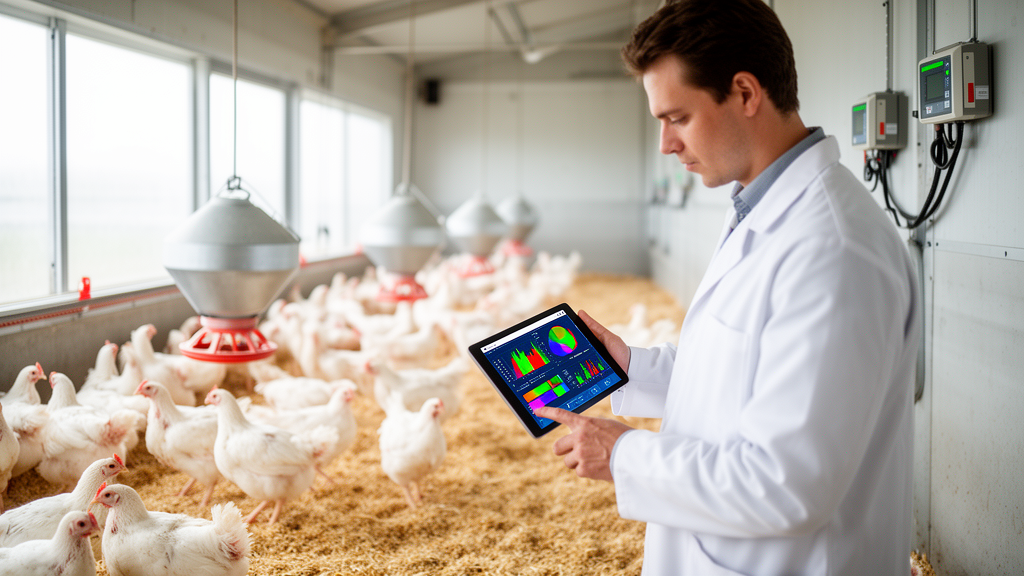
Global poultry farming is under growing pressure to produce more animal protein with fewer resources, and a new peer-reviewed review argues that big data and artificial intelligence could be the key to making feed use dramatically more efficient. Researchers from Jilin University, China Agricultural University and the Jilin Academy of Agricultural Sciences published their synthesis in a review article, examining how digital technologies and biotechnology can be combined to match nutrient supply more precisely to what birds actually need.
The starting point for the analysis is a familiar problem. Feed represents one of the largest cost and environmental burdens in poultry production, and traditional nutrition models often fail to accurately predict dynamic nutrient requirements. The review notes that this mismatch leads to wasted resources and excess greenhouse gas emissions, at a time when the industry also faces feed source shortages, environmental pollution and the need to maintain animal welfare amid rising consumer demand.
To assess the state of the field, the authors conducted a comprehensive review of current precision nutrition technologies rather than running new feeding trials. They explored how the Internet of Things, computer vision and sensor-based monitoring can be combined with advanced AI algorithms and machine learning, creating a cycle in which data collection feeds AI modeling, which in turn supports precision farming decisions.
The review’s central technical finding concerns the limits of classical statistics. Traditional linear regression models are described as insufficient for capturing the dynamic physiological states and environmental variations that occur in poultry flocks. In contrast, machine learning algorithms demonstrate superior performance in predicting feed energy values and nutrient requirements, according to the authors’ synthesis of the published literature.
Beyond prediction, the review emphasizes that the integration of big data allows for precise diet formulation and real-time adjustments, significantly enhancing the accuracy of nutritional supply. In practice, this means diets can be reformulated continuously as birds grow and as conditions change, rather than relying on static feeding programs that assume uniform requirements across a production cycle.
The authors also look beyond software. They summarized how biotechnologies, including omics techniques and biotechnology-derived proteins, can be integrated into modern poultry farming. Combining AI with omics technologies, the review argues, provides a deeper biological understanding of nutrient metabolism, linking the data streams from sensors and farm records to mechanisms operating at the molecular level.
The promised practical payoff is twofold: economic and environmental. By precisely matching nutrient supply to animal requirements, producers can improve feed efficiency and reduce production costs, while significantly lowering nitrogen and carbon emissions.
Because the work is a review, its conclusions describe what the analyzed studies report rather than results from a single new experiment, and the authors frame the technology as a promise for transforming current poultry practices rather than a demonstrated industry-wide outcome. Even so, the direction of travel is clear. A data-driven approach that pairs AI modeling with sensing and omics, the authors conclude, supports sustainable agricultural development, ensuring food security while promoting better animal welfare.
For producers, the message is that precision nutrition is no longer a futuristic concept but an assembling toolkit of IoT sensors, computer vision, machine learning and biotechnology. The review, published with the DOI 10.63823/ARP0260010, positions these tools as a sustainable solution to optimize feed efficiency and reduce the environmental footprint of global poultry farming, provided the industry can integrate them at scale.
Subject of Research: Integration of big data, AI and biotechnologies in precision poultry nutrition
Article Title: Big data and AI drive the future of precision poultry nutrition
Article References: Big data and AI drive the future of precision poultry nutrition. Original publication (Bibliographic details unavailable.)
Image Credits: AI Generated
DOI: Not provided
Keywords: poultry nutrition, precision agriculture, machine learning, big data, artificial intelligence, feed efficiency, greenhouse gas emissions, Internet of Things, omics, animal welfare, sustainable farming, data
Cite Scienmag News
William Thompson. (October 29, 2026). Machine learning outperforms traditional models in precision poultry nutrition review. Scienmag. https://scienmag.com/machine-learning-outperforms-traditional-models-in-precision-poultry-nutrition-review/
William Thompson. "Machine learning outperforms traditional models in precision poultry nutrition review." Scienmag, 29 October 2026, https://scienmag.com/machine-learning-outperforms-traditional-models-in-precision-poultry-nutrition-review/. Accessed 29 October 2026.
William Thompson. "Machine learning outperforms traditional models in precision poultry nutrition review." Scienmag. October 29, 2026. https://scienmag.com/machine-learning-outperforms-traditional-models-in-precision-poultry-nutrition-review/