

Wednesday, November 11, 2026
Science
No Result
View All Result
  • Login
  • HOME
  • SCIENCE NEWS
  • CONTACT US
  • HOME
  • SCIENCE NEWS
  • CONTACT US
No Result
View All Result
Scienmag
No Result
View All Result
Home Science News Technology and Engineering

Machine learning optimizes silk sensors for spatial motion detection

October 22, 2026
in Technology and Engineering
Teresa Odom
By Teresa Odom Scienmag Editorial Profile - Machine Learning
Reading Time: 2 mins read
0
Machine learning optimizes silk sensors for spatial motion detection

Machine learning optimizes silk sensors for spatial motion detection

65
SHARES
587
VIEWS
Share on FacebookShare on Twitter
ADVERTISEMENT

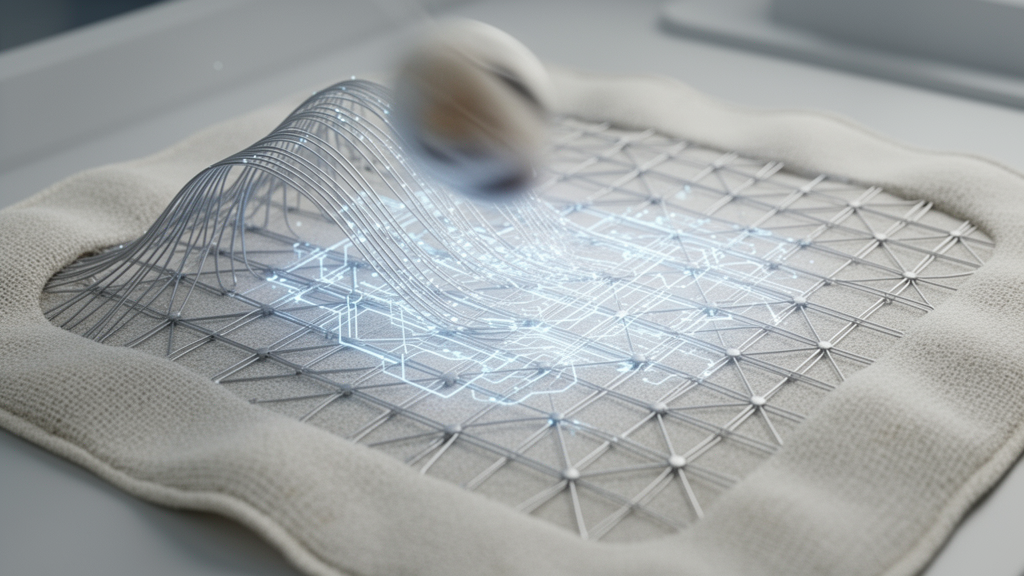
Machine-learning-guided geometric optimization produced stretchable silk fibroin ionic conductors whose resistance responses can map where a bent joint moves. Researchers designed three zigzag-patterned devices with different predicted unfoldability values and experimentally showed that each generated a distinct spatial response fingerprint during repeated flexion. The approach combines fast surrogate modelling with reinforcement-learning search, then translates the selected structures into directly printed sensors with ten-channel resistance readout.

The study targets a central design problem in wearable electronics: flexible ionic conductors must withstand large deformation while retaining measurable electrical changes. The geometry of a zigzag unit cell influences its ability to unfold, but conventional trial-and-error optimization becomes inefficient when topology, manufacturability and deformability are coupled across a high-dimensional parameter space. To make that search more systematic, the researchers parameterized each zigzag unit cell with four control points and generated 3,000 mirror-tiled structural variants.

Each candidate was evaluated by quasi-static simulation to quantify biaxial unfoldability, represented by the mean stretch ratio, λmean. The investigators trained an XGBoost surrogate model using 15 structural descriptors, obtaining a coefficient of determination of R² = 0.97 when predicting the simulated value. They then used the surrogate within a continuous-action A2C reinforcement-learning agent to search for configurations with high unfoldability while satisfying manufacturability constraints. Three optimized designs, with predicted mean stretch ratios of 1.27, 1.77 and 2.04, were selected for fabrication.

Direct-write printing turned the optimized patterns into silk fibroin ionic conductors equipped with ten-channel resistance readout. Under cyclic joint flexion, the λ = 1.27 design produced a symmetric dual-hotspot response, indicating two dominant sensing regions. The intermediate λ = 1.77 design concentrated its response in one channel and reached a peak absolute relative resistance change, |ΔR/R0|, of 0.82. The most unfoldable design, λ = 2.04, generated a broader multi-hotspot pattern and achieved the highest mean response amplitude, 0.27.

These distinct patterns did not collapse when the bending speed changed. Across the tested speeds, their similarity was assessed by Spearman correlation coefficients ranging from 0.75 to 0.84, showing that the spatial fingerprints remained substantially consistent under different deformation rates. The work therefore establishes an experimental pathway from geometric parameterization and simulation, through machine-learning optimization, to printed devices that convert joint motion into position-specific electrical signals. The source reports proof-of-principle device testing rather than a clinical trial or a general-purpose wearable system, so the results are best understood as a demonstration that computational design can tune the spatial behavior of a soft ionic sensor.

Subject of Research: Machine-learning optimization of silk fibroin ionic conductors for spatially resolved wearable motion sensing

Article Title: Machine learning–driven structural optimization of zigzag silk fibroin ionic conductors for spatially resolved wearable motion detection

Article References: Yang, Y., Sun, S., Xu, C., Ren, J., & Ling, S. (2026). Machine learning–driven structural optimization of zigzag silk fibroin ionic conductors for spatially resolved wearable motion detection. npj Flexible Electronics. https://doi.org/10.1038/s41528-026-00656-z

Image Credits: AI Generated

DOI: 10.1038/s41528-026-00656-z

Keywords: machine learning, silk fibroin, ionic conductors, wearable sensors, structural optimization, reinforcement learning, motion detection, XGBoost, flexible electronics, spatial sensing, Machine, learning

Cite Scienmag News

Teresa Odom. (October 22, 2026). Machine learning optimizes silk sensors for spatial motion detection. Scienmag. https://scienmag.com/machine-learning-optimizes-silk-sensors-for-spatial-motion-detection/

Teresa Odom. "Machine learning optimizes silk sensors for spatial motion detection." Scienmag, 22 October 2026, https://scienmag.com/machine-learning-optimizes-silk-sensors-for-spatial-motion-detection/. Accessed 11 November 2026.

Teresa Odom. "Machine learning optimizes silk sensors for spatial motion detection." Scienmag. October 22, 2026. https://scienmag.com/machine-learning-optimizes-silk-sensors-for-spatial-motion-detection/

Tags: 3D printed multi-channel resistance sensorsAI-guided design of deformable wearable sensorsflexible electronicsgeometric design of stretchable electronicshigh-dimensional parameter space optimizationionic conductorslarge deformation resistance in ionic conductorslearningmachineMachine learningmachine learning optimization in wearable sensorsmotion detectionreinforcement learningreinforcement learning for sensor designsilk fibroinSilk fibroin ionic conductorssimulation-based structural evaluation of stretchable devicesspatial sensingstructural optimizationsurrogate modeling for flexible device developmenttopology and manufacturability in flexible electronicswearable sensorsXGBoostzigzag-patterned sensors for spatial motion detection
Share26Tweet16
Previous Post

Intrastromal AAV genetically labels corneal sensory neurons in mouse study

Next Post

Case Report Documents Bladder Rupture With OHVIRA Syndrome

Related Posts

Dual-Energy CT Visualizes High-Grade Glioma Without Contrast
Technology and Engineering

Dual-Energy CT Visualizes High-Grade Glioma Without Contrast

November 11, 2026
Engineered Gold and Graphene Nanocomposite Triggers Apoptosis in Ovarian Cancer Cells
Technology and Engineering

Engineered Gold and Graphene Nanocomposite Triggers Apoptosis in Ovarian Cancer Cells

November 11, 2026
CTAB-Modified Nickel-Cobalt Sulfide Enhances Supercapacitor Performance
Technology and Engineering

CTAB-Modified Nickel-Cobalt Sulfide Enhances Supercapacitor Performance

November 11, 2026
Hybrid Path Planning Algorithm Accelerates Robotic Tomato Harvesting in Complex Canopies
Technology and Engineering

Hybrid Path Planning Algorithm Accelerates Robotic Tomato Harvesting in Complex Canopies

November 11, 2026
New Confocal Microscope Captures Live Cell Dynamics at 4 Hz
Technology and Engineering

New Confocal Microscope Captures Live Cell Dynamics at 4 Hz

November 11, 2026
Urban Building Layouts Directly Dictate Wind Speeds Around High-Rise Structures
Technology and Engineering

Urban Building Layouts Directly Dictate Wind Speeds Around High-Rise Structures

November 11, 2026
Next Post
Case Report Documents Bladder Rupture With OHVIRA Syndrome

Case Report Documents Bladder Rupture With OHVIRA Syndrome

  • Mothers who receive childcare support from maternal grandparents show more optimized

    Mothers who receive childcare support from maternal grandparents show more parental warmth, finds NTU Singapore study

    27656 shares
    Share 11059 Tweet 6912
  • University of Seville Breaks 120-Year-Old Mystery, Revises a Key Einstein Concept

    1061 shares
    Share 424 Tweet 265
  • Bee body mass, pathogens and local climate influence heat tolerance

    682 shares
    Share 273 Tweet 171
  • Researchers record first-ever images and data of a shark experiencing a boat strike

    546 shares
    Share 218 Tweet 137
  • Groundbreaking Clinical Trial Reveals Lubiprostone Enhances Kidney Function

    531 shares
    Share 212 Tweet 133
Science

Embark on a thrilling journey of discovery with Scienmag.com—your ultimate source for cutting-edge breakthroughs. Immerse yourself in a world where curiosity knows no limits and tomorrow’s possibilities become today’s reality!

RECENT NEWS

  • Nepal Expands Open-Source Electronic Medical Records Across Nineteen Public Hospitals
  • Cancer Telemedicine Study Uncovers Participation Gaps and End-of-Life Messaging Trends
  • Quality of Life Rose in Observational Study of Glaucoma App Users
  • Researchers Propose Butyrate and RNA Methylation Hypothesis for Post-Stroke Depression

Categories

  • Agriculture
  • Anthropology
  • Archaeology
  • Athmospheric
  • Biology
  • Biotechnology
  • Blog
  • Bussines
  • Cancer
  • Chemistry
  • Climate
  • Earth Science
  • Editorial Policy
  • Marine
  • Mathematics
  • Medicine
  • Pediatry
  • Policy
  • Psychology & Psychiatry
  • Science Education
  • Science News
  • Social Science
  • Space
  • Technology and Engineering

Subscribe to Blog via Email

Enter your email address to subscribe to this blog and receive notifications of new posts by email.

Join 5,150 other subscribers

© 2026 Scienmag - Science Magazine

Welcome Back!

Login to your account below

Forgotten Password?

Retrieve your password

Please enter your username or email address to reset your password.

Log In
No Result
View All Result
  • HOME
  • SCIENCE NEWS
  • CONTACT US

© 2026 Scienmag - Science Magazine

Discover more from Science

Subscribe now to keep reading and get access to the full archive.

Continue reading

