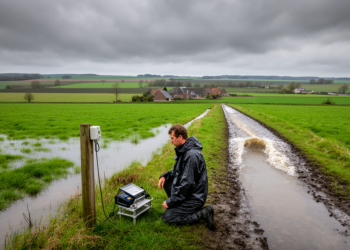
Lead contamination of farmland has long been treated as a numbers game: measure the total concentration of lead in the soil, compare it with a threshold, and declare the land safe or hazardous. A new study argues that this approach misses the point, because what actually matters is not how much lead is present but how much of it crops can take up. An international research team led by Yohannes Kebede Gebreyes and Zhaojun Li, publishing in Environmental Science and Pollution Research, has built a machine learning framework that predicts bioavailable lead in soil from lead speciation and soil properties, offering a more nuanced picture of risk to food safety and ecosystem health.
The researchers compiled a global dataset of paired soil and crop lead measurements drawn from the Web of Science database. From this they developed and validated ten machine learning models on a dataset linking soil available lead to crop lead. Hyperparameters were tuned using grid search with fivefold cross-validation to select the best-performing configuration. The optimized XGBoost model came out on top, achieving a coefficient of determination of 0.9, a result the authors say reflects the genuinely non-linear character of the soil-crop system that simpler models fail to capture.
What sets the study apart is its emphasis on interpretability. Using SHAP analysis, the team determined which features most strongly influenced the model’s predictions and quantified each factor’s individual effect. Organic matter and pH emerged as the most dominant controllers of lead bioavailability. More strikingly, the analysis identified the acid-soluble fraction of lead as the primary predictor of risk, even though the reducible fraction occurs at higher concentrations in soil.
The model also revealed that different crops behave very differently. Lead accumulation in rice grains followed a linear relationship with soil available lead, with a coefficient of determination of 0.419, while wheat showed a more complex, cubic uptake pattern with a coefficient of 0.37. This crop-specific divergence suggests that a single soil threshold cannot adequately protect all agricultural systems, and that risk assessment may need to be tailored to what is actually being grown.
The authors position their work as a robust, interpretable tool that goes beyond total lead concentration to predict bioavailable lead in soil. They conclude that risk assessment measures should prioritize not only soil properties but also lead fractions and crop-specific models to ensure the sustainable use of agricultural systems. As farmland contamination continues to threaten food safety worldwide, the study offers a data-driven path toward more accurate and actionable soil risk assessment.
Subject of Research: Machine learning prediction of bioavailable lead in agricultural soils using lead speciation and soil properties.
Article Title: Evaluation of machine learning models incorporating soil properties and speciation to determine soil bioavailable lead
Article References: Gebreyes, Y. K., Maneh, K. J., Kukpieun Zackariah, G. S., Andom, O., Gebeyehu, Y., Liu, Y., Mi, H., Guo, X., Tremblay, L. A., & Li, Z. (2026). Evaluation of machine learning models incorporating soil properties and speciation to determine soil bioavailable lead. Environmental Science and Pollution Research. https://doi.org/10.1007/s11356-026-38321-7
Image Credits: AI Generated
DOI: 10.1007/s11356-026-38321-7
Keywords: lead contamination, soil bioavailability, machine learning, XGBoost, SHAP analysis, lead speciation, soil pH, organic matter, rice, wheat, food safety, risk assessment
Cite Scienmag News
Teresa Odom. (October 28, 2026). Machine Learning Model Predicts Bioavailable Lead in Farmland Soils. Scienmag. https://scienmag.com/machine-learning-model-predicts-bioavailable-lead-in-farmland-soils/
Teresa Odom. "Machine Learning Model Predicts Bioavailable Lead in Farmland Soils." Scienmag, 28 October 2026, https://scienmag.com/machine-learning-model-predicts-bioavailable-lead-in-farmland-soils/. Accessed 29 October 2026.
Teresa Odom. "Machine Learning Model Predicts Bioavailable Lead in Farmland Soils." Scienmag. October 28, 2026. https://scienmag.com/machine-learning-model-predicts-bioavailable-lead-in-farmland-soils/