


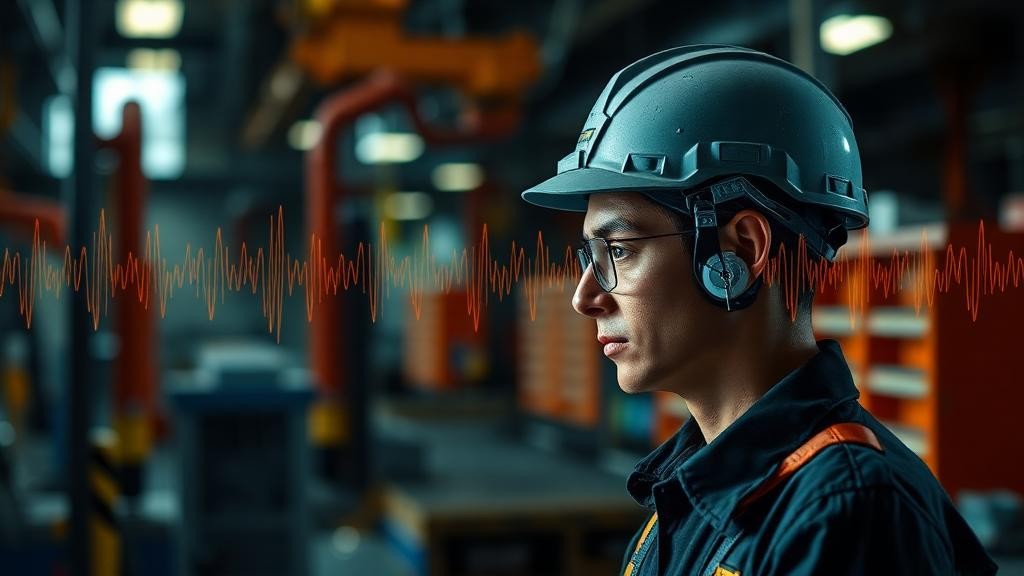
A machine-learning framework combining electroencephalography and functional near-infrared spectroscopy with self-reported stress ratings estimated perceived stress intensity during a simulated factory workflow, according to an exploratory study of 20 participants. The strongest ensemble model achieved a test root mean square error of 10.86 when predicting State-Trait Anxiety Inventory scores, while a related classifier separated three stress groups with 84.1% accuracy. The researchers describe the result as a proof of concept for monitoring perceived cognitive stress, not as a universal physiological measure of stress or a clinical test.
The experiment took place at a packaging station built around a Universal Robots UR5 collaborative robot and a conveyor belt. Participants answered moderate-difficulty cognitive questions printed on packets, placed the packets into a box and positioned the completed box in front of the robot for packing. High-complexity episodes added a second task in which damaged packets had to be identified and excluded. The experiment contained nine episodes, with the first lasting approximately three and a half minutes, while task speed and complexity, lighting and noise were varied in predefined low and high settings. Low light was 50–60 lux, high light exceeded 250 lux, low noise was below 55 decibels and high noise was 80–85 decibels.
Twenty volunteers aged 18 to 55 took part, including 13 men and five women. People with neurological disease or cardiac implants were excluded, as were those unable to complete the activities or affected by color blindness. The experimental session lasted about an hour and began with a two-minute rest period. After each episode, participants completed the NASA Task Load Index, which measures perceived workload, and the State-Trait Anxiety Inventory, which supplied the anxiety-related target used in the most successful models. One participant withdrew after completing four episodes, leaving 175 episode-level observations. Quality control for artifacts, missing values and incomplete recordings reduced the machine-learning dataset to 147 samples, divided into 103 training samples and 44 test samples.
Neurophysiological data were recorded throughout the task using a 19-electrode wireless EEG system sampled at 4,000 hertz and a 21-channel fNIRS system sampled at 75 hertz. Gaze was tracked with Tobii Pro Glasses 3, while task error rate served as a behavioral measure. EEG data were cleaned with independent component analysis, downsampled to 250 hertz and filtered from 0.5 to 40 hertz. Features included average power in five frequency bands—delta, theta, alpha, beta and gamma—and statistical measures such as variance, skewness, kurtosis and root mean square. For fNIRS, the researchers extracted linear measures including mean and standard deviation, plus nonlinear features such as entropy, box-count fractal dimension and detrended fluctuation analysis.
The machine-learning pipeline mapped physiological features to questionnaire results so that supervised models could learn the relationship between recorded brain activity and reported stress. Seven regression techniques and eight classification approaches were compared across EEG-only, fNIRS-only and combined feature sets, with five-fold cross-validation used during model development. Regression models estimated continuous STAI and NASA-TLX scores. NASA-TLX was already scored from 0 to 100, while the STAI score was rescaled from 1–4 to 0–100 for comparison. Classification divided STAI results into low, moderate and high groups, producing 82 low-stress, 31 moderate-stress and 34 high-stress samples. Feature selection was performed only on training data, and four ensemble strategies were considered: averaging, weighted averaging, majority voting and weighted majority voting. Gaze and behavioral measures were not direct model inputs; they were analyzed separately as supporting indicators of how participants responded to the changing conditions.
Data quality and preprocessing had a marked effect on model behavior. Before the final feature-selection stage, a combined fNIRS and EEG statistical model with NASA-TLX as the target reached 65.9% test accuracy and 63.1% validation accuracy, while the strongest unfiltered feature combination produced 67.3% test accuracy for STAI classification with 60.97% validation accuracy. Removing the first five seconds of each episode, when participants were not yet performing the cognitive task, and filling the resulting gaps by averaging raised a support-vector classifier to 79.55% test accuracy using fNIRS and EEG statistical features with STAI as the target; its validation accuracy was 66.02%. Normalization preserved that test accuracy, with validation accuracy changing to 64.08%. In regression, normalization allowed an SVM model to reach a test RMSE of 11.563 and a validation RMSE of 15.884 for STAI. The authors emphasize that a lower test error does not automatically make an unfiltered dataset superior: artifacts can produce deceptively good performance, whereas the smaller gap between validation and test results after quality control is more consistent with robustness and less overfitting.
Feature selection produced the headline results. For continuous STAI estimation from combined fNIRS and EEG spectral features, ReliefF retained 213 of 284 features and paired them with an ensemble of three classifiers, yielding the lowest reported test RMSE of 10.86. An F-test approach retained 211 features but produced an RMSE of 11.3269. Removing an entire EEG channel and six fNIRS channels when more than four of their features had been rejected slightly worsened the regression result to 11.1882, indicating that the broader feature set retained useful information. For three-class classification, a chi-squared procedure that eliminated features falling below 10% of the highest ranking retained 338 variables and achieved 84.1% accuracy with a seven-model ensemble. A different chi-squared threshold, using the 10th percentile for exclusion, retained 331 features and produced 79.54% accuracy. Channel-level pruning based on the best chi-squared configuration reduced accuracy to 77.27%, again suggesting that useful signals may be lost when complete channels are removed.
The final classifier was strongest at identifying low stress, where the reported F1 score was 0.941, with recall of 0.960 and precision of about 0.923. Its performance was weaker and more ambiguous for moderate and high stress: the moderate class had an F1 score of 0.706, precision of 0.750 and recall of 0.667, while the high class had precision and recall of 0.700 and an F1 score of 0.700. Of 25 low-stress samples in the test set, 24 were correctly classified; 6 of 9 moderate samples and 7 of 10 high-stress samples were correct. The researchers attribute some confusion between adjacent categories to overlapping physiological responses and the relatively small number of high-stress examples. The physiological features were also more closely aligned with STAI-based anxiety than with NASA-TLX workload, potentially because the latter combines several dimensions that do not all represent stress directly.
Eye tracking provided complementary behavioral evidence. Average fixation duration, maximum fixation duration and average visit duration were highest during the first episode and then declined through the ninth, while the number of visits increased, a pattern the authors interpret as a learning effect as participants became familiar with the task. Average pupil diameter was larger under low-light conditions—5–6 millimetres—than under high-light conditions—4–5 millimetres—and generally decreased as questionnaire scores rose. Participants also made fewer fixations on incorrect answers than on correct ones. Subjective scores responded to the experimental conditions: STAI was highest in the episode combining fast, complex work, high noise and low light, while NASA-TLX rose overall as the session progressed, consistent with cumulative task engagement and fatigue. The robot and human comparison appeared only once, so the similar scores in those final episodes do not establish a general difference between collaboration modes.
The study remains exploratory in several important ways. It was conducted in a controlled simulation with only 20 participants and has not been tested across other workplaces. The system does not yet operate in real time because signal preprocessing, feature extraction and prediction are performed offline. Normalization was carried out before the train-test split, potentially leaking information from the test set, while the sample-level split allowed participant-specific characteristics to influence both training and testing. Some movement-related artifacts also survived cleaning. The authors propose larger and more diverse studies, participant-wise or leave-one-subject-out validation, confidence intervals and significance tests, and development of adaptive real-time monitoring. They also built an Android application, Stress Sense, that converts predicted scores into a visual stress scale, although the evidence presented supports the predictive framework rather than real-time workplace deployment.
Subject of Research: Machine-learning estimation of perceived cognitive stress from EEG and fNIRS during a simulated human-robot factory workflow
Article Title: Transforming neurophysiological data into measurable stress metric using machine learning-based stress quantification framework for smart factory workers
Article References: Arif, A., Zakeri, Z., Omurtag, A., Breedon, P., & Khalid, A. (2026). Transforming neurophysiological data into measurable stress metric using machine learning-based stress quantification framework for smart factory workers. Frontiers in Neuroergonomics, 7, Article 1871817. https://doi.org/10.3389/fnrgo.2026.1871817
Image Credits: AI Generated
DOI: 10.3389/fnrgo.2026.1871817
Keywords: machine learning, workplace stress, EEG, fNIRS, human-robot collaboration, neuroergonomics, gaze tracking, feature selection, ensemble learning, occupational health, Transforming, neurophysiological
Cite Scienmag News
Cassandra Pierce. (October 21, 2026). Machine learning estimates factory-worker stress from brain signals. Scienmag. https://scienmag.com/machine-learning-estimates-factory-worker-stress-from-brain-signals/
Cassandra Pierce. "Machine learning estimates factory-worker stress from brain signals." Scienmag, 21 October 2026, https://scienmag.com/machine-learning-estimates-factory-worker-stress-from-brain-signals/. Accessed 21 October 2026.
Cassandra Pierce. "Machine learning estimates factory-worker stress from brain signals." Scienmag. October 21, 2026. https://scienmag.com/machine-learning-estimates-factory-worker-stress-from-brain-signals/


