


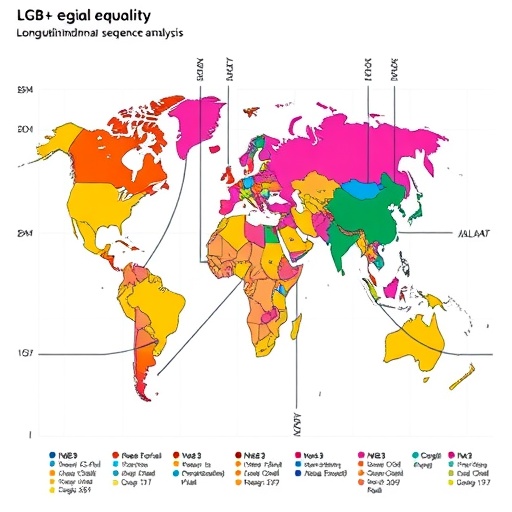
The global landscape of legal rights for lesbian, gay, and bisexual people is far more fragmented than simple world maps of progress and resistance suggest. A new study published in the journal Genus has tracked the adoption of nine distinct LGB+ rights across all 193 United Nations member countries between 1995 and 2023, and found that nations do not follow a single road to legal equality but at least six distinct paths, each with its own timing, ordering, and pace. The research, conducted by Anna Karmann of the University of Vienna and the Bielefeld Graduate School in History and Sociology and Lisa de Vries of the German Institute for Adult Education, applied an advanced statistical technique known as sequence analysis to legal data drawn from the International Lesbian, Gay, Bisexual, Trans, and Intersex Association database, revealing patterns that conventional analyses focused solely on timing have missed.
The scale of legal change over recent decades is striking. In 2004, same-sex sexual acts were criminalized in 82 countries while same-sex marriage was legal in only two. By 2023, the number of criminalizing countries had fallen to 64, while 32 countries had legalized same-sex marriage and 82 had enacted workplace anti-discrimination legislation. Yet the picture remains deeply uneven: 101 countries either still criminalize same-sex sexual acts or have decriminalized them without introducing any further rights. The pace of adoption is also slowing, and in some countries the trend has reversed altogether. Since the 2000s, more than 25 countries have updated their criminalization laws, with examples including Russia’s 2023 court ban on the LGBT+ movement, Hungary’s 2021 propaganda law, and Uganda’s 2023 Anti-Homosexuality bill, which introduced the death penalty for so-called aggravated homosexuality.
To capture this complexity, the researchers grouped the nine rights into three analytical categories. The first and most fundamental is decriminalization of consensual same-sex sexual acts, historically the prerequisite for everything else. The second covers protection rights, including safeguards against workplace discrimination, hate crimes, and incitement to hatred. The third comprises familial and partnership recognition, such as same-sex marriage, partnership registration, and adoption rights. The team set 1995 as the starting point of their analysis because most significant variation in protection and recognition rights begins in the 1990s, and because many countries gained sovereignty after the collapse of the Soviet Union and Yugoslavia in the early 1990s, allowing them to chart independent legal courses. A right was counted as introduced only when implemented nationwide, and the researchers focused on first introductions rather than subsequent modifications unless a right was completely repealed.
Methodologically, the study breaks new ground by treating each country’s legal history between 1995 and 2023 as a sequence of 29 annual states, coded from an alphabet of five empirically observed conditions: criminalization, decriminalization, decriminalization plus recognition, decriminalization plus protection, and the full combination of all three. The authors then compared these sequences using an extended form of the optimal matching algorithm called spell-length-sensitive optimal matching, or OMslen. Unlike classical optimal matching, which quantifies dissimilarity through the number of insertion, deletion, and substitution operations needed to transform one sequence into another, the extended algorithm allowed the researchers to weight dissimilarity so that it increases as more rights are introduced, while ensuring that protection and recognition carry equal weight rather than an assumed hierarchy. The resulting distance matrix for all 193 country sequences was then subjected to hierarchical clustering using Ward’s linkage method, yielding a six-cluster solution.
The six clusters reveal a typology of national trajectories. The largest group, labeled Full Resisters, comprises 85 countries, 80 percent of which continued to criminalize same-sex sexual acts through 2023, with punishments ranging from fines to life imprisonment and, in a few cases, the death penalty. The Partial Resisters cluster includes 55 countries that have decriminalized but stopped there, remaining in a state of bare decriminalization without further rights; this group includes several post-Soviet states in Central Asia and the South Caucasus. Late Adopters, a cluster of 26 countries including much of Southeastern Europe, began introducing protection rights in the 2000s and, by 2023, all had adopted at least one additional category. The smallest cluster, the Recognizers, contains just six countries: Argentina, Israel, Germany, Iceland, Brazil, and Slovenia, all of which followed the atypical path of introducing familial recognition rights before enacting three or more protection rights. Early Adopters, 13 countries that had decriminalized before 1995, moved toward full rights between roughly 2000 and the early 2010s, while the eight Pioneers, comprising Belgium, Canada, Spain, the Netherlands, South Africa, Denmark, Sweden, and Norway, completed all three categories by the late 1990s or early 2000s.
Beyond classification, the analysis uncovered a strong regularity in the order of rights adoption: in most countries, protection rights precede familial recognition rights. The researchers attribute this to several converging factors. Protection against discrimination is often framed as urgent and universal, extending to multiple marginalized groups rather than LGB+ people alone, which broadens political support. International institutions have actively promoted this sequencing, most notably through the European Union’s Employment Equality Directive of 2000, which prohibited sexual orientation discrimination and was transposed into national law by most member states in the early 2000s, while the International Labour Organization has similarly pushed employment protections. Recognition rights, by contrast, arrived later and spread more slowly, beginning with Denmark’s pioneering partnership law in 1989 and Norway’s in 1993, before the Netherlands became the first country to legalize same-sex marriage in 2001. The Recognizers stand as the exception to the typical order, and the authors found no common explanation for why these particular countries deviated.
Duration analysis added another layer of insight. Resister clusters are defined by stagnation, with Full Resisters spending an average of 27.1 years in criminalization and Partial Resisters an average of 27.7 years in decriminalization. Among adopting countries, the average time spent in the states of criminalization or bare decriminalization was longest, roughly 12 years in each. However, once a country begins moving, the process accelerates: after introducing either protection or recognition rights, the complementary category typically follows within a few years. Pioneers spent only 3.8 years on average in the protection-only state and a single year in the recognition-only state before achieving the full combination, often legislating both categories almost simultaneously. Early Adopters spent nearly twice as long in decriminalization as in the subsequent protection phase before completing the full set, while Recognizers lingered an average of 13.3 years in the recognition state before finally adding protection rights.
The study’s most politically significant finding concerns democracy. Linking the six clusters to data from the Varieties of Democracy project on each country’s first transition to democracy, and defining six waves of democratization from 1900 to 2023, the researchers found a statistically significant association between the timing of democratization and cluster membership. A Fisher’s exact test on 172 countries produced a p-value below 0.001, with a Cramér’s V of 0.376, indicating a large effect size. The pattern is clear: countries that democratized in the first wave are predominantly Pioneers and Early Adopters, while nearly all countries that never underwent a democratic transition are Full or Partial Resisters. This supports the argument advanced by political scientist Omar Encarnación that although gay rights are not found in all democracies, they are virtually nonexistent in nondemocracies, and that the timing of democratization matters as much as its presence.
The exceptions to this pattern are as instructive as the rule. Cuba, despite never transitioning to democracy, belongs to the Late Adopters cluster, having decriminalized in 1979 and introduced the full spectrum of protection and familial recognition rights by 2022. Switzerland, Australia, and the United States democratized early but lag in legal equality, largely because of federal structures in which rights were introduced gradually at the subnational level; same-sex marriage was legal in 37 US states before nationwide legalization in 2015. Poland, Latvia, and the Czech Republic experienced early democratization followed by reversals to autocracy, and Poland’s recent populist backlash has been linked to antigay mobilization. Conversely, South Africa decriminalized only in 1998 yet rapidly adopted comprehensive rights after its 1995 democratic transition, joining the Pioneers, while Malta and Spain overcame mid-century autocratic reversals to become Early Adopters and Pioneers respectively.
The authors emphasize that legal rights do not automatically translate into lived equality, citing research showing that rainbow maps of legal progress fail to capture the actual experiences of discrimination and violence faced by LGBT+ people. They also acknowledge limitations, including the exclusion of rights specific to gender minorities, conversion therapy regulations, and indicators of backlash severity such as propaganda laws. Nevertheless, the study demonstrates that timing, order, and duration are all essential dimensions for understanding the global development of LGB+ rights, and that democratization is likely one piece of a larger puzzle shaped by globalization, international networks, cultural values, and economic development. With a large share of the world’s LGB+ population still living without adequate legal protection, and recent developments endangering existing rights, the six paths mapped by this research provide a framework for understanding both how far the world has traveled toward legal equality and how uneven that journey remains.
Cite Scienmag News
Courtney Benton. (September 6, 2026). Longitudinal sequence analysis traces global paths to LGB+ legal equality. Scienmag. https://scienmag.com/longitudinal-sequence-analysis-traces-global-paths-to-lgb-legal-equality/
Courtney Benton. "Longitudinal sequence analysis traces global paths to LGB+ legal equality." Scienmag, 6 September 2026, https://scienmag.com/longitudinal-sequence-analysis-traces-global-paths-to-lgb-legal-equality/. Accessed 6 September 2026.
Courtney Benton. "Longitudinal sequence analysis traces global paths to LGB+ legal equality." Scienmag. September 6, 2026. https://scienmag.com/longitudinal-sequence-analysis-traces-global-paths-to-lgb-legal-equality/


