


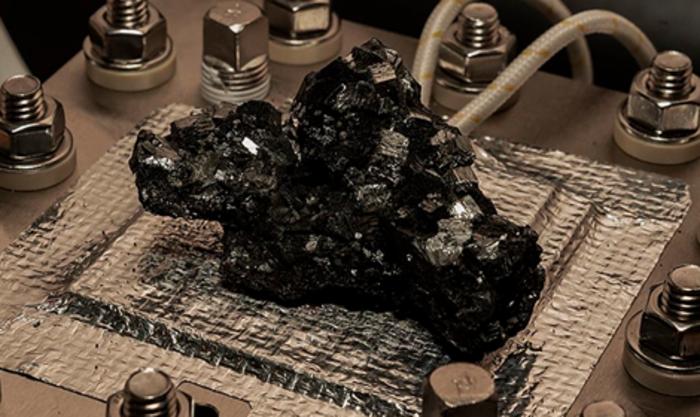
Researchers led by Ryuhei Nakamura at the RIKEN Center for Sustainable Resource Science (CSRS) in Japan have improved on their green and sustainable method of extracting hydrogen from water by using a custom-made catalyst for the chemical reaction. Published in Nature Catalysis, the study details how they manipulated the catalyst’s 3D structure, which led to improved stability and an increase in the catalyst’s lifetime by almost 4,000%. The findings impact the ability to achieve a lasting and sustainable hydrogen-based energy economy.

Credit: RIKEN
Researchers led by Ryuhei Nakamura at the RIKEN Center for Sustainable Resource Science (CSRS) in Japan have improved on their green and sustainable method of extracting hydrogen from water by using a custom-made catalyst for the chemical reaction. Published in Nature Catalysis, the study details how they manipulated the catalyst’s 3D structure, which led to improved stability and an increase in the catalyst’s lifetime by almost 4,000%. The findings impact the ability to achieve a lasting and sustainable hydrogen-based energy economy.
Water electrolysis using proton exchange membranes is a green electrochemical process for splitting water into oxygen and hydrogen. Hydrogen produced this way can then be stored and used at a later time. For example, when combined with a proton exchange membrane (PEM) fuel cell, the stored hydrogen can be used to power an electric car. However, PEM electrolysis still has limitations that prevent widespread industrial uses such as in power plants. In particular, the necessary chemical reactions happen in a highly acidic environment, and the best catalysts for these reactions are extremely rare earth metals, such as iridium. As Nakamura explains, “scaling up PEM electrolysis to the terawatt scale would require 40 years’ worth of iridium, which is certainly impractical and highly unsustainable.”
Almost two years ago, Nakamura and his team developed a breakthrough process that allowed acid water electrolysis that did not rely on rare earth metals. By inserting manganese into a cobalt oxide lattice, they created a process that relied only on common and sustainable earth metals. Despite the success, the process was still not as stable as it needs to be in a PEM electrolyzer. Now, they have built on their previous discovery and developed a longer-lasting earth-abundant catalyst.
The new catalyst is a form of manganese oxide (MnO2). The key finding was that reaction stability could be increased over 40 times by altering the catalyst’s lattice structure. Oxygen in the 3D lattice structure of manganese oxide comes in two configurations, planar and pyramidal. The planar version forms stronger bonds with manganese, and the researchers discovered that increasing the amount of planar oxygen in the lattice significantly enhanced catalytic stability.
They tested four different manganese oxides, which varied in the percentage of planar oxygen. When using the version with the highest achievable percentage, 94%, the critical oxygen evolution reaction could be maintained in acid for one month at 1000 mA/cm2. The total amount of charge transferred in this case was 100 times more than anything seen in previous studies.
When tested in a PEM electrolyzer, water electrolysis could be sustained for about 6 weeks at 200 mA/cm2. The total amount of water electrolyzed in this time period, and therefore the amount of hydrogen produced, was 10 times more than has been achieved in the past with other non-rare metal catalysts. “Surprisingly,” says co-first author Shuang Kong, “the improved stability did not come at a cost in activity, which is usually the case. A PEM water electrolyzer that generates hydrogen with an earth-abundant catalyst at a rate of 200 mA/cm2 is highly efficient.”
There is still work to be done. Industrial applications typically require a stable current density of 1000 mA/cm2 that lasts for several years, rather than a month. Nevertheless, the researchers think that tangible, real-world applications will eventually be possible and contribute to carbon neutrality. “We will continue to modify catalyst structure to increase both current density and catalyst lifetime,” says Nakamura. “In the long-term, our efforts should help achieve the ultimate objective for all stakeholders — to conduct PEM water electrolysis without the use of iridium.”
In the meantime, the researchers hope that their findings will ignite further public interest in sustainable hydrogen production as a realistic solution for slowing fossil fuel-related climate change.
Journal
Nature Catalysis
Cite Scienmag News
Bethany Barker. (April 26, 2024). Longer-lasting and more sustainable green hydrogen production. Scienmag. https://scienmag.com/longer-lasting-and-more-sustainable-green-hydrogen-production/
Bethany Barker. "Longer-lasting and more sustainable green hydrogen production." Scienmag, 26 April 2024, https://scienmag.com/longer-lasting-and-more-sustainable-green-hydrogen-production/. Accessed 7 September 2026.
Bethany Barker. "Longer-lasting and more sustainable green hydrogen production." Scienmag. April 26, 2024. https://scienmag.com/longer-lasting-and-more-sustainable-green-hydrogen-production/

