


Tuberculosis is the infectious disease caused by a single bacterium that claims the most lives worldwide. Approximately 10 million people are diagnosed with tuberculosis each year, and about 1.5 million of them die from the disease. Around 3 million of these cases never receive a diagnosis because current diagnostic methods are either too expensive or unavailable. The research group aims to change that.

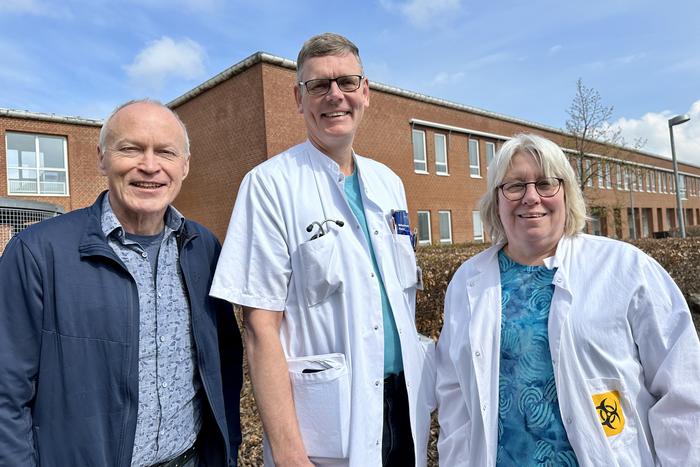
Credit: Lisbeth Heilesen, Aarhus University
Tuberculosis is the infectious disease caused by a single bacterium that claims the most lives worldwide. Approximately 10 million people are diagnosed with tuberculosis each year, and about 1.5 million of them die from the disease. Around 3 million of these cases never receive a diagnosis because current diagnostic methods are either too expensive or unavailable. The research group aims to change that.
With the grant from the Innovation Fund Denmark’s Grand Solutions programme, the researchers will develop and test a method that can determine if a patient has tuberculosis by testing saliva. Initially, the method will be tested in Guinea-Bissau, West Africa.
The project is a collaboration between Christian Wejse from Aarhus University and Aarhus University Hospital, Birgitta Knudsen from the Department of Molecular Biology and Genetics at Aarhus University, and several international researchers from Guinea-Bissau and the company VPCIR Biosciences ApS.
“We don’t just want to detect tuberculosis in saliva but develop an entirely new testing method that can be performed close to the patient without the need for expensive equipment or an advanced laboratory. The project could have significant implications for a group of patients who currently either do not receive a tuberculosis diagnosis or receive it too late – this includes patients in low-income countries, socially disadvantaged individuals, and migrants,” says Christian Wejse.
“After many years of basic research, we have developed a new testing method that uses a specific marker to detect the tuberculosis bacterium in clinical samples. It’s a simple technology, but it’s very sensitive. With the grant from the Innovation Fund Denmark’s Grand Solutions programme, we look forward to completing the development of the testing method and testing it on a large number of patients in West Africa,” says Birgitta Knudsen.
“It is crucial that the test is economically feasible for healthcare systems in low-income countries and meets the WHO’s various requirements for such tests. Despite these challenges, we see significant commercial opportunities in this development, due to the large number of patients who could benefit from this test. ‘ Many a little makes a mickle’ as the saying goes,” says CEO Jørgen Schøller from VPCIR Biosystems.
Contact
Professor and Senior Consultant Christian Wejse
Aarhus University, Department of Clinical Medicine
and Aarhus University Hospital, Department of Infectious Diseases
Mobile: +45 51 94 45 19 – Email: wejse@clin.au.dk
Associate Professor Birgitta R. Knudsen
Department of Molecular Biology and Genetics
Aarhus University
Mobile: +45 6020 2673 – Email: brk@mbg.au.dk
CEO Jørgen Schøller
VPCIR Bioscience ApS
Email: js@vpcir.com
Cite Scienmag News
Drew Townsend. (April 26, 2024). Major funding allocated to develop a method for tracking tuberculosis through saliva. Scienmag. https://scienmag.com/major-funding-allocated-to-develop-a-method-for-tracking-tuberculosis-through-saliva/
Drew Townsend. "Major funding allocated to develop a method for tracking tuberculosis through saliva." Scienmag, 26 April 2024, https://scienmag.com/major-funding-allocated-to-develop-a-method-for-tracking-tuberculosis-through-saliva/. Accessed 4 September 2026.
Drew Townsend. "Major funding allocated to develop a method for tracking tuberculosis through saliva." Scienmag. April 26, 2024. https://scienmag.com/major-funding-allocated-to-develop-a-method-for-tracking-tuberculosis-through-saliva/

