


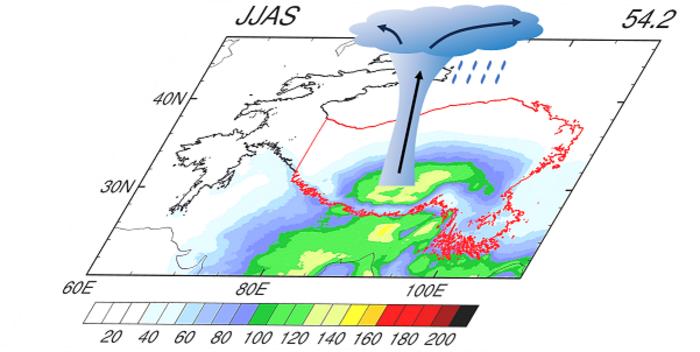
The Tibetan Plateau is a prevalent region for deep convection owing to its unique thermodynamic forcing. Deep convection can exist as isolated deep convection (IDC), which is small in size, or mesoscale convective systems (MCSs), which are convective storms organized into larger and longer-lived systems. Most previous research has focused on MCSs over the Tibetan Plateau, but less so on IDC systems (hereafter, IDCs).

Credit: Ying Na
The Tibetan Plateau is a prevalent region for deep convection owing to its unique thermodynamic forcing. Deep convection can exist as isolated deep convection (IDC), which is small in size, or mesoscale convective systems (MCSs), which are convective storms organized into larger and longer-lived systems. Most previous research has focused on MCSs over the Tibetan Plateau, but less so on IDC systems (hereafter, IDCs).
Dr. Ying Na from Wuxi University, and Dr. Chaofan Li from the Institute of Atmospheric Physics, Chinese Academy of Sciences, China, examined the climatological features of IDCs by using high-resolution satellite observations in June to September during 2001–2020. The results have recently been published in Atmospheric and Oceanic Science Letters.
According to this study, IDCs mainly concentrate over the southern Tibetan Plateau. The number of IDCs per rainy season over the Tibetan Plateau ranges from approximately 10 to 140, with an average value of 54.2. The initiation time of IDCs exhibits an obvious diurnal cycle, with the peak at 1400–1500 LST (local standard time) and the valley at 0900–1000 LST, indicating the effect of daytime sensible heating from the plateau. Most IDCs only last a few hours, with around 90% lasting no more than five hours. IDCs generally have a cold cloud area of 7422.9 km2, containing a precipitation area of approximately 65%. The larger the IDC, the larger the fraction of intense precipitation it contains.
Although the spatial and temporal scales of IDCs are small, their contribution in terms of precipitation is important. IDCs contribute approximately 20%–30% of all precipitation, and approximately 30%–40% of extreme precipitation, over the Tibetan Plateau, with some areas contributing up to 70% in July and August. Dr. Li, the corresponding author of the study, emphasizes that “IDCs over the Tibetan Plateau account for a larger fraction than MCSs, indicating their important role in the region”. A comprehensive understanding of IDCs will be helpful for weather prediction and disaster mitigation, and it is worth examining how well state-of-the-art models perform in simulating them.
Journal
Atmospheric and Oceanic Science Letters
Article Title
Isolated deep convections over the Tibetan Plateau in the rainy season during 2001–2020
Article Publication Date
26-Mar-2024
Cite Scienmag News
Russell Cooper. (April 10, 2024). Long-term satellite observations show climatological characteristics of isolated deep convection over the Tibetan Plateau. Scienmag. https://scienmag.com/long-term-satellite-observations-show-climatological-characteristics-of-isolated-deep-convection-over-the-tibetan-plateau/
Russell Cooper. "Long-term satellite observations show climatological characteristics of isolated deep convection over the Tibetan Plateau." Scienmag, 10 April 2024, https://scienmag.com/long-term-satellite-observations-show-climatological-characteristics-of-isolated-deep-convection-over-the-tibetan-plateau/. Accessed 4 September 2026.
Russell Cooper. "Long-term satellite observations show climatological characteristics of isolated deep convection over the Tibetan Plateau." Scienmag. April 10, 2024. https://scienmag.com/long-term-satellite-observations-show-climatological-characteristics-of-isolated-deep-convection-over-the-tibetan-plateau/

