


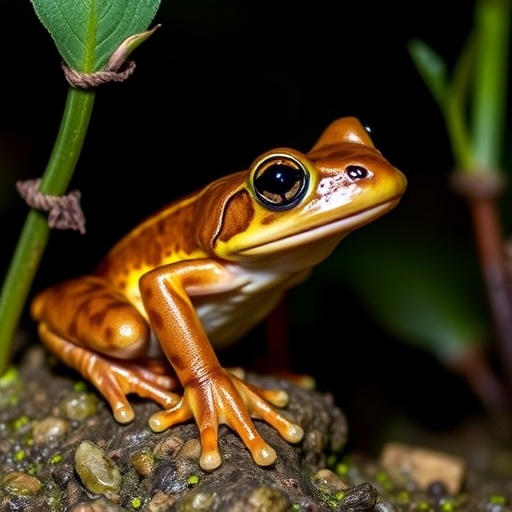
A frog that scientists have heard and observed for decades has finally received its own scientific identity. Researchers from the Pontificia Universidad Católica del Ecuador have formally described Pristimantis milpe, a common and widely distributed amphibian from the Chocó forests of western Ecuador and southern Colombia. The species, known as the Milpe Robber Frog or Cutín de Milpe, had been confused with another frog for more than a century. Its recognition resolves a long-standing taxonomic mystery and demonstrates how specimens collected in the 19th century can transform modern understanding of biodiversity.
The discovery is unusual because many newly described amphibians are rare, geographically restricted, or known from only a handful of specimens. Pristimantis milpe is different. It is abundant, widespread, and relatively easy to detect because males produce a loud, distinctive nocturnal call resembling a sharp click. The frog occupies more than 67,000 square kilometers of habitat, extending from sea level to approximately 1,200 meters in elevation. Its range includes the Ecuadorian Chocó and southern Colombia, a globally important biodiversity region where humid forests support an exceptional concentration of endemic plants and animals.
The species was formally described in a study published in ZooKeys, an international journal specializing in taxonomy and biodiversity research. The scientific name Pristimantis milpe places the frog within one of the most diverse amphibian genera in the world. Robber frogs in the genus Pristimantis are especially notable for their reproductive biology. Unlike many frogs, they often bypass a free-living aquatic tadpole stage. Instead, their eggs develop directly into miniature froglets, allowing them to reproduce in forest environments far from ponds and streams. This adaptation helps explain why Pristimantis species can occupy a wide range of elevations and microhabitats in the Andes and neighboring tropical forests.
To solve the identity of the Milpe Robber Frog, Santiago Ron, a researcher at the Pontificia Universidad Católica del Ecuador and the study’s lead author, examined historical amphibian collections at the Natural History Museum in London. These collections contain type specimens, the preserved individuals upon which scientific names are based. Type specimens are essential in taxonomy because they serve as permanent reference points for identifying species. When populations in the wild are assigned names incorrectly, returning to these original specimens can reveal whether the historical classification accurately reflects the living animals found today.
The London specimens had been collected in Ecuador during the 19th century and preserved ever since. By comparing them with modern populations from the Ecuadorian Chocó, the researchers found that the historical frogs had been incorrectly associated with another species, Pristimantis subsigillatus. The error effectively concealed P. milpe in plain sight. Although the frog had been encountered repeatedly and was familiar to field researchers, it remained without a valid scientific name of its own because its identity was tied to the wrong taxon. The study now establishes that the specimens represent a distinct species and proposes the synonymy of Pristimantis subsigillatus, meaning that the name is no longer treated as separate in the same way under the revised classification.
The frog’s biology also helped distinguish it from related species. Pristimantis milpe is primarily nocturnal, with males calling from leaves of shrubs and bromeliads several meters above the forest floor. Such elevated calling sites may help males project their calls through dense vegetation and attract females while reducing competition at ground level. The species also displays pronounced sexual dimorphism, in which females and males differ in appearance. Females have a conspicuous pattern on the groin and thighs, combining orange or pale blue coloration with black spots. Males generally show more uniform coloration. These visual differences, together with vocal characteristics, morphology, geography, and comparisons with museum specimens, provide the evidence needed to separate the species from close relatives.
The discovery underscores why natural history collections remain central to modern science. Museum specimens are not simply historical objects; they preserve physical evidence that can be reexamined as research tools improve. Scientists can compare body proportions, skin coloration, skeletal features, geographic origins, and other diagnostic traits across specimens collected decades or centuries apart. Historical material can also reveal how species were distributed before major environmental changes occurred. In the case of Pristimantis milpe, the preserved frogs allowed researchers to connect a name used in old taxonomic literature with a living population that field scientists could observe and hear in the forest today.
The case also carries implications for conservation. The Chocó is one of the planet’s most biologically rich regions, but its forests face pressure from habitat loss, agriculture, infrastructure development, and other human activities. Correctly identifying species is the foundation of conservation planning because threatened populations cannot be evaluated accurately if they are hidden under another name. The recognition of P. milpe gives researchers a clearer picture of the amphibian diversity present in the region and provides a valid framework for future studies of its population size, ecology, distribution, and vulnerability. It also illustrates a broader scientific lesson: even common species can remain undiscovered in a formal sense when historical classifications are not tested against living populations.
For Jhael Ortega, a PhD student at Virginia Tech and one of the study’s authors, the frog’s long misidentification highlights the importance of linking scientific names to organisms in nature. That connection is especially significant in an era when DNA sequencing, bioacoustic monitoring, digital databases, and advanced imaging are expanding the tools available to taxonomists. Yet the discovery also shows that modern methods do not replace traditional collections. Instead, they work alongside them. The story of Pristimantis milpe began with frogs calling at night in the tropical forest and was completed through a dialogue between present-day fieldwork and specimens gathered more than a century ago. A species that had been familiar but scientifically overlooked has now entered the official record, offering another reminder that the world’s biodiversity still contains major surprises—even among animals that have been living in plain sight.
News Publication Date: 24 July 2026
Web References: https://zookeys.pensoft.net/article/194383/ ; https://www.nhm.ac.uk/ ; https://www.puce.edu.ec/
References: ZooKeys. DOI: 10.3897/zookeys.1286.194383
Cite Scienmag News
Drew Townsend. (August 14, 2026). London-held mystery leads scientists to discover a new Ecuadorian frog. Scienmag. https://scienmag.com/london-held-mystery-leads-scientists-to-discover-a-new-ecuadorian-frog/
Drew Townsend. "London-held mystery leads scientists to discover a new Ecuadorian frog." Scienmag, 14 August 2026, https://scienmag.com/london-held-mystery-leads-scientists-to-discover-a-new-ecuadorian-frog/. Accessed 4 September 2026.
Drew Townsend. "London-held mystery leads scientists to discover a new Ecuadorian frog." Scienmag. August 14, 2026. https://scienmag.com/london-held-mystery-leads-scientists-to-discover-a-new-ecuadorian-frog/


