


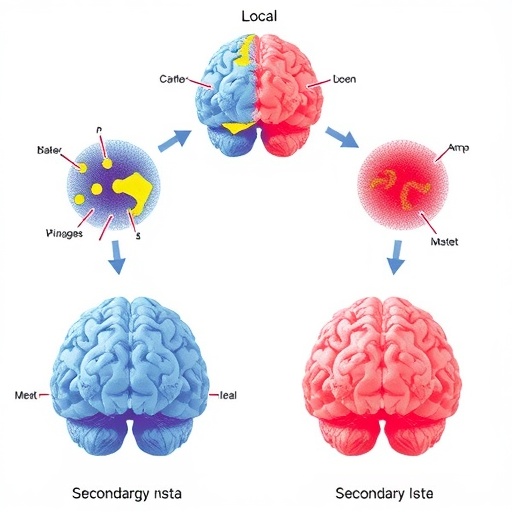
Neurological death, an unfortunate consequence of cancer progression, often remains poorly understood. Recent research conducted by a team of distinguished scientists sheds light on this critical issue, discussing two major causes of neurological death: local metastatic expansion and secondary intra-organ dissemination. This research aims to unravel the complex mechanisms involved in metastatic colonization patterns, ultimately enhancing our understanding of cancer’s fatal journey.
The study delineates the distinctions between local metastatic expansion and secondary intra-organ dissemination, underpinning the fundamentally different biological processes that define them. Local metastatic expansion refers to the growth of cancer cells within a specific region, typically originating from a primary tumor. In this instance, the metastatic cells invade adjacent tissues, including the surrounding nervous system, where they induce significant tissue damage and functional impairment. This process can rapidly progress, leading to neurological deficits and, ultimately, death.
Conversely, secondary intra-organ dissemination denotes the spread of cancer cells to non-adjacent organs, creating multiple metastatic foci within disparate anatomical sites. This type of dissemination significantly complicates treatment and prognosis, as the cancer cells migrate through the circulatory system or lymphatic pathways to distant locations. The ability of cancer cells to survive, adapt, and thrive in these new environments contributes to the complexity of the disease and underscores the necessity of comprehensive treatment strategies that address multifocal disease.
Understanding these distinct pathways holds great potential for developing targeted therapies. The metastatic colonization patterns identified in this study could pave the way for innovative therapeutic strategies aimed at specific mechanisms of metastasis. By targeting the processes that enable local metastasis or organ dissemination, researchers can potentially halt the progression of neurological symptoms associated with cancer.
The research team employed an advanced comparative analysis of patient samples, laboratory models, and advanced imaging techniques to unveil critical differences between these two modes of metastasis. Their findings indicate that local expansion is often characterized by a more aggressive and destructive phenotype, leading to rapid neurological deterioration. In contrast, secondary intra-organ dissemination tends to result in a more insidious onset of symptoms, often complicating diagnostics and delaying timely intervention.
Moreover, the study introduced novel biomarkers associated with these distinct metastasis patterns. These biomarkers could play an essential role in the early detection of neurological involvement in cancer patients. By identifying patients at high risk for specific types of metastasis, clinicians can tailor interventions more effectively, potentially improving outcomes and quality of life.
As the cancer landscape evolves, understanding the biological underpinnings of metastatic patterns becomes increasingly crucial. This research emphasizes the necessity for dynamic and multifactorial approaches to cancer treatment, given the heterogeneity of metastatic behavior across different cancer types. Personalized medicine that considers an individual patient’s unique tumor biology might not only enhance treatment efficacy but also mitigate the risk of neurological complications associated with cancer progression.
To further complicate the picture, cancer is not a singular disease; it comprises a range of malignancies, each with distinct genetic backgrounds and biological behaviors. This complexity necessitates a deeper exploration into the specific mechanisms driving metastatic expansion and dissemination across different tumor types. Consequently, research focused on identifying common pathways and unique tumor markers may yield critical insights into effective prevention and treatment strategies.
The implications of this research extend beyond understanding the mechanisms of cancer progression. Insights gained may influence how clinical trials are designed, particularly those exploring novel therapies aimed at addressing metastatic disease. By integrating the understanding of variable metastasis patterns, researchers can develop more robust efficacy endpoints and better predict treatment response based on individual patient and tumor characteristics.
In conclusion, the work presented by Komljenovic and colleagues represents a significant stride in the realm of cancer research, particularly in understanding how metastatic processes contribute to neurological death. As the field progresses, ongoing investigations will undoubtably catalyze advancements in therapeutic interventions, offering hope for improved survival rates and enhanced quality of life for cancer patients suffering from neurological complications.
This study underscores the importance of early diagnosis and the need for individualized treatment approaches, acknowledging the complexity of cancer as a systemic disease. As we continue to unravel the intricacies of metastasis, there lies the potential for innovative strategies that not only target the metastatic cells but also cultivate an environment that is inhospitable for cancer progression.
The evolving landscape of cancer research is ushering in a new era of understanding that acknowledges the multifaceted nature of malignancies and their spread. By bridging the gap between laboratory findings and clinical application, researchers hope to fortify the arsenal against cancer, aiming to turn the tide in what has historically been a daunting battle. With ongoing studies like this, the hope for significant advancements in combatting cancer’s most devastating effects becomes more tangible.
Komljenovic, D., Bäuerle, T., Alves-de-Lima, J. et al. Local metastatic expansion versus secondary intra-organ dissemination: two causes of neurological death explained by fundamentally different metastatic colonization patterns.
Mol Cancer (2026). https://doi.org/10.1186/s12943-026-02574-0
Cite Scienmag News
Nathaniel Bowman. (January 24, 2026). Local vs. Secondary Metastasis: Divergent Pathways to Neurodegeneration. Scienmag. https://scienmag.com/local-vs-secondary-metastasis-divergent-pathways-to-neurodegeneration/
Nathaniel Bowman. "Local vs. Secondary Metastasis: Divergent Pathways to Neurodegeneration." Scienmag, 24 January 2026, https://scienmag.com/local-vs-secondary-metastasis-divergent-pathways-to-neurodegeneration/. Accessed 3 September 2026.
Nathaniel Bowman. "Local vs. Secondary Metastasis: Divergent Pathways to Neurodegeneration." Scienmag. January 24, 2026. https://scienmag.com/local-vs-secondary-metastasis-divergent-pathways-to-neurodegeneration/


