


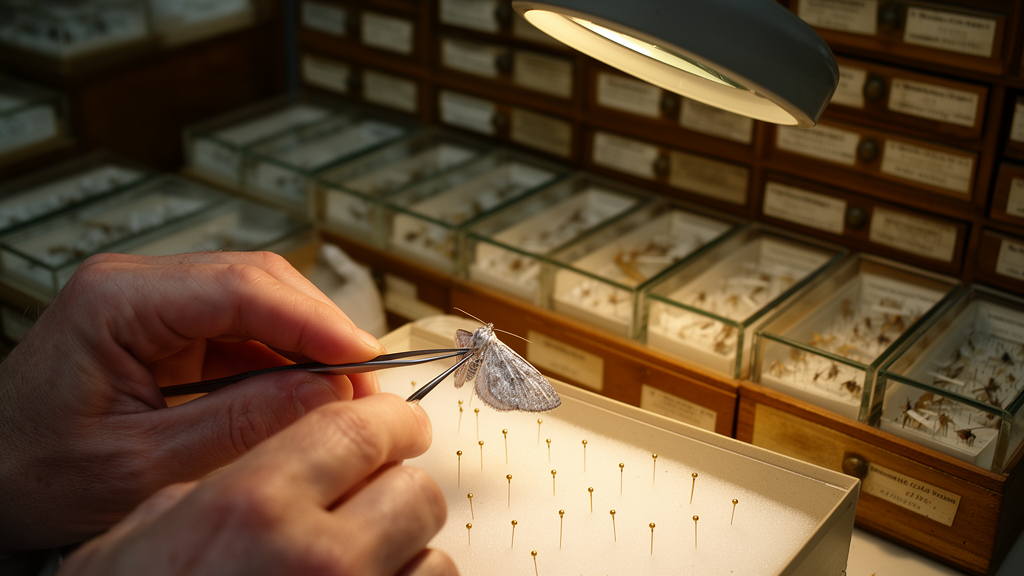
Deep in museum collections…
The story of Galacticidae illustrates how much of Lepidoptera taxonomy still rests on the careful comparison of physical specimens rather than on molecular data alone. Although modern phylogenetic studies have placed the family with increasing confidence among the Apoditrysia, the species-level work described here depended on the kind of traditional evidence that remains indispensable: dissected genitalia, type specimens retrieved from historic collections, and the slow accumulation of material from regions where collecting effort has historically been sparse. The author’s account of resuming a study after sixteen years, during which only a handful of additional specimens had reached the relevant collections, is a candid reminder that for many small moth families the raw material of taxonomy is not abundant, and that revisions must often proceed with whatever material exists rather than with statistically robust series.
The morphological evidence that ultimately defined the family is worth appreciating in detail. The autapomorphies recognised by Dugdale and colleagues in the late 1990s concern striking modifications of the terminal segments in both sexes. In males, the eighth tergal segment forms a hood that conceals the ninth and tenth segments, which are retracted deeply into the abdomen. In females, the genital opening sits at the tip of a tube-like projection emerging from the membrane between the seventh and eighth segments. Such intimate structural specialisations are exactly the kind of features that persist across related lineages while remaining stable within them, which is why they carry such weight in lepidopteran higher classification. The discovery that these traits characterise Australian species of Homadaula as well as Palaearctic relatives helped cement the family’s status as a natural group rather than an assemblage of convenience.
The genital characters also explain why earlier attempts to classify these moths went astray. The four original genera were founded on wing venation differences that later proved trivial. Chrétien separated Zarcinia and Amsel separated Bahrlutia on features of the venation that, when examined across a wider sample of species, turned out to vary only slightly within the family. This is a recurring pattern in microlepidopterology: external and venational characters, which are easy to observe and were therefore the basis of most nineteenth- and early twentieth-century descriptions, frequently fail to delimit natural groups, while genitalic structures, which require dissection, reveal the real boundaries. The present study’s finding that the presence or absence of the henia, together with the corresponding length of the male phallus, cleanly separates two genera is a textbook example of this principle.
It is also instructive that the henia itself is not unique to Galacticidae. Comparable structures occur in Tineidae, Scythrididae, Gelechiidae and even in butterflies of the family Lycaenidae. In those groups the character has not been treated as genus-defining, which raises the question of why it should be given such weight here. The answer lies in the combination of characters: within Galacticidae the henia correlates with a suite of other genitalic differences, so that the two genera recognised in the Palaearctic fauna are each defined by a coherent set of features rather than by a single trait in isolation. This kind of corroboration among characters is what taxonomists look for when deciding how much weight to give any single feature.
The synonymies established in the study carry practical consequences beyond nomenclatural housekeeping. Galactica, the name from which the family name Galacticidae derives, is now considered a junior synonym of Homadaula. Under the International Code of Zoological Nomenclature, the family-group name remains valid even when its type genus is synonymised, because family-group names are based on the stem of a genus name regardless of whether that genus is currently recognised as valid. Homadaula, being the older name from 1899, takes priority over Galactica from 1911, and the family name Galacticidae Minet, 1986 continues in use despite the change in the type genus. Similar logic applies to Bahrlutia, which now falls within Zarcinia. These changes reduce the number of recognised Palaearctic genera from four to two, simplifying the classification while preserving the family name that European lepidopterists have begun to encounter in checklists.
The biogeographic picture that emerges from the checklist is one of a family distributed around the Mediterranean Basin and across the arid interior of Asia. Species are recorded from North Africa, including Tunisia, Algeria and Egypt; from the Levant and Iran; from Central Asia in Uzbekistan, Kyrgyzstan, Tajikistan and Kazakhstan; and from eastern Russia, with one species reaching Dagestan in the European part of the Russian Federation. This distribution pattern, concentrated in dry and mountainous regions, suggests that Galacticidae may be adapted to arid environments, and that the true diversity of the family in Central Asia and the Middle East is likely greater than current records indicate. The description of a new species from Tajikistan and Afghanistan, based in part on material collected decades earlier and stored unstudied in Berlin and Vienna, hints at how much remains to be discovered in these under-sampled areas.
The history of the type localities themselves tells a story of early twentieth-century entomological networks. Walsingham described Galactica from material collected in Algeria, and Caradja reciprocated by naming a species after Walsingham from North Kazakhstan. Such mutual dedications were common among lepidopterists of that era and often reflect exchanges of specimens across vast distances. The type of Zarcinia nigrosignatella, collected in southern Tunisia, was described without a statement of the number or sex of the type specimens, a practice that was not unusual at the time but complicates modern work, since determining which specimen is the name-bearing type requires careful detective work in the collections where such material was deposited.
The placement of the family within the lepidopteran tree has shifted considerably over the decades, and the current consensus rests on a combination of molecular and morphological evidence. Early morphological work placed Galacticidae within the Yponomeutoidea, a superfamily of small moths that includes the ermine moths. Later proposals suggested affinities with the Tineoidea or with the Urodidae. Molecular analyses published in the 2010s, however, recovered the family as the sister group of the Tortricoidea, the superfamily that contains the tortrix moths, many of which are significant agricultural pests. If this sister-group relationship holds up under further scrutiny, it would mean that Galacticidae occupies a phylogenetic position of considerable interest, being close to one of the most species-rich and economically important lineages of Lepidoptera while itself remaining species-poor and poorly studied.
One morphological detail highlighted in the study deserves particular attention: the presence of an unscaled, transparent patch at the base of the hindwing, situated between the veins Cu1 and Cu2. This feature, which occurs in most of the examined species, had gone largely unnoticed in earlier descriptions. Transparent wing patches of this kind have attracted attention in recent years because of their role in sound production in some moths. In the ermine moth genus Yponomeuta, a similar patch bears an array of microscopic ridges that function as an aeroelastic tymbal, a structure that can be buckled and released to produce ultrasonic clicks, presumably as a defence against bats or as a signalling mechanism. The fact that the transparent patches of Galacticidae lack these ridges suggests either that the patches serve a different function in this family or that sound production evolved independently in the yponomeutid lineage. Recent research on the function and distribution of such patches across Microlepidoptera is likely to clarify their evolutionary significance, and Galacticidae, with its patch but without the ridged tymbal structure, may prove to be an informative comparison point.
The methodological details of the study reflect standard practice in microlepidopteran taxonomy, but they are worth describing for readers unfamiliar with the field. Genitalia are dissected by macerating the abdomen in a alkaline solution, clearing the soft tissue, and then mounting the sclerotised structures on microscope slides in a medium such as Euparal. Stains such as Chlorazol Black help to render the membranous parts of the female genitalia visible under the compound microscope. Drawings made with a camera lucida, an optical device that superimposes the image of the specimen onto the drawing surface, remain the preferred way of documenting genitalic morphology in many taxonomic papers, since they capture exactly what the taxonomist observed. The practice of storing cleared abdomens in glycerin in polyethylene vials on the specimen’s pin allows future researchers to re-examine the material without redissolving the slide mount.
The three species left as incertae sedis represent the unresolved residue of the revision. Galactica variinotella from Tunisia, Homadaula disperdita from China, and Zarcinia sacra from Egypt could not be placed with confidence because their type specimens could not be examined. This situation is common in taxonomy: the name-bearing specimens may be lost, damaged, or located in collections that are difficult to access. Until such types are studied, the species names remain in a state of limbo, recognised as valid but not assignable to a genus with certainty. The designation of incertae sedis is an honest acknowledgment of this uncertainty rather than a forced placement that might later prove wrong.
Looking forward, the study identifies several priorities for future work. The fauna of northern Africa and Asia, particularly Central Asia and the Arabian Peninsula, remains poorly sampled, and additional species are likely to be found as collecting intensifies in these regions. The relationship between Galacticidae and Tortricoidea warrants testing with broader molecular datasets that include more galacticid species, since the current evidence comes from studies that sampled only a few representatives of the family. The biology of the larvae is almost entirely unknown; host plants have not been reliably recorded for any Palaearctic species, and nothing is known about larval morphology, feeding habits, or life history. For a family whose closest relatives include some of the most intensively studied pest moths in the world, this gap in biological knowledge is striking, and filling it would likely require targeted fieldwork in the arid regions where the adults have been collected.
The study also demonstrates the continuing value of historical collections. Material borrowed from Vienna and discovered in the Stshetkin collection in Berlin provided the basis for describing a new species and for resolving synonymies that had stood for decades. Museums thus function not merely as repositories of old specimens but as active research infrastructure whose holdings can yield new discoveries long after the material was collected. The sixteen-year delay between the initial borrowing of material and its eventual study is not unusual in taxonomy, where the pace of work is limited by the availability of specialists rather than by the availability of specimens. The hope expressed by the author that the study will attract attention to this neglected family is a common sentiment in taxonomic literature, but in the case of Galacticidae it carries particular weight, since the family sits at an interesting phylogenetic position, occupies a distinctive biogeographic range, and remains one of the least-studied groups of moths in the Palaearctic fauna.
Subject of Research: Taxonomic notes on Palearctic taxa of Galacticidae, a little-known family of Lepidoptera (Galacticoidea)
Article Title: Taxonomic notes on Palearctic taxa of Galacticidae , a little-known family of Lepidoptera ( Galacticoidea )
Article References: Mey, W. (2022). Taxonomic notes on Palearctic taxa of Galacticidae, a little-known family of Lepidoptera (Galacticoidea). Nota Lepidopterologica, 45, 169-190. https://doi.org/10.3897/nl.45.78574
Image Credits: AI Generated
DOI: 10.3897/nl.45.78574
Keywords: Taxonomic, notes, Palearctic, taxa, Galacticidae, little-known, family, Lepidoptera, Galacticoidea, scientific research
Cite Scienmag News
Gavin Prescott. (October 18, 2026). Little-Known Butterfly Family Galacticidae Gets First Modern Taxonomic Overhaul. Scienmag. https://scienmag.com/little-known-butterfly-family-galacticidae-gets-first-modern-taxonomic-overhaul/
Gavin Prescott. "Little-Known Butterfly Family Galacticidae Gets First Modern Taxonomic Overhaul." Scienmag, 18 October 2026, https://scienmag.com/little-known-butterfly-family-galacticidae-gets-first-modern-taxonomic-overhaul/. Accessed 18 October 2026.
Gavin Prescott. "Little-Known Butterfly Family Galacticidae Gets First Modern Taxonomic Overhaul." Scienmag. October 18, 2026. https://scienmag.com/little-known-butterfly-family-galacticidae-gets-first-modern-taxonomic-overhaul/


