


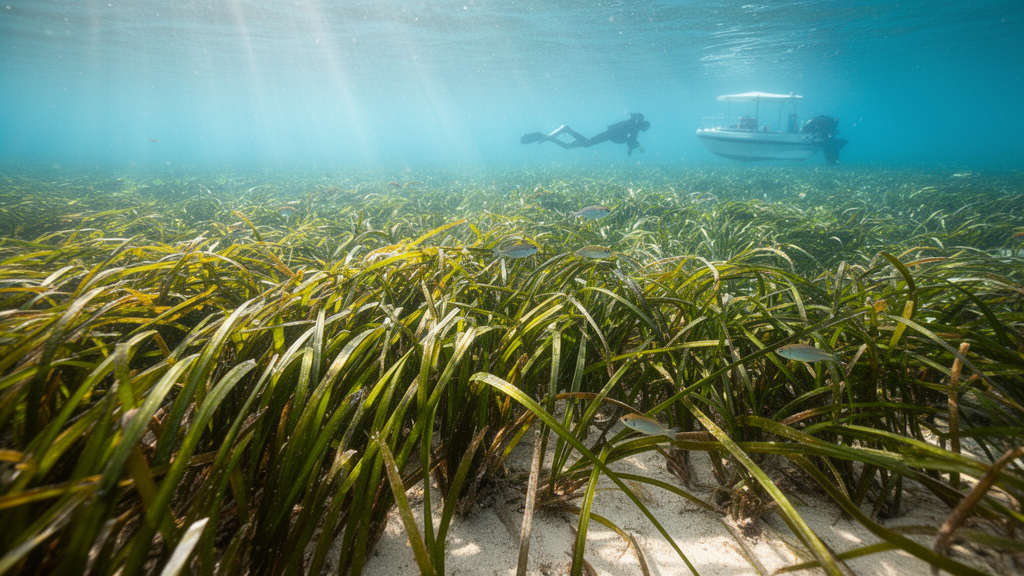
Underwater meadows of Posidonia oceanica, an endemic Mediterranean seagrass, do far more than anchor sediments and shelter marine life. According to a new study published in One Ecosystem, these flowering marine plants also underpin a measurable slice of Italy’s coastal tourism economy, generating exchange values of roughly €6 million in 2019 and €3.7 million in 2021. The research presents the first ecosystem accounts for Marine-Based Tourism (MBT) in Italy, built within the System of Environmental-Economic Accounting – Ecosystem Accounting (SEEA EA) framework adopted by the United Nations, and offers a replicable template for putting a hard number on what seagrass is worth to the people who flock to the coast every summer.
The stakes are considerable. The EU Blue Economy Observatory reported that the marine-based tourism sector generated a Gross Value Added of €81.5 billion in 2019, while the Nature Conservancy’s Mapping Ocean Wealth project estimated that coral reefs alone draw some 70 million trips annually worldwide, worth about $36 billion each year, of which $19 billion comes from direct on-reef activities such as diving and wildlife observation. Against this backdrop, the Italian team set out to isolate a question that has long frustrated economists and ecologists alike: how much of the tourism flowing into a coastal town can actually be attributed to the ecosystem beneath the waves?
The researchers chose Posidonia oceanica as their focal species for good reason. The seagrass is a keystone species within its habitat, sensitive to environmental change, and officially used as a biological quality element for monitoring obligations under the EU Habitats and Birds Directives and the Marine Strategy Framework Directive. It stabilises sediments, sequesters carbon, and provides habitat and food for a wide range of marine organisms. Previous monetary valuations have already highlighted its substantial contribution to human well-being, but no prior study had connected it to tourism demand in an accounting framework.
The methodology unfolds in three steps. First, the team mapped the extent and assessed the condition of Italian P. oceanica meadows. Using the EUSeaMap 2021 predictive seabed habitat map developed under the EMODnet Seabed Habitats project, they extracted meadows matching specific EUNIS habitat codes for Posidonia beds within Italian administrative boundaries, then linked each meadow to its coastal municipality. Condition was measured through shoot density, a recognised proxy for the health of the meadow, using monitoring data from ISPRA collected under the Marine Strategy Framework Directive across two time ranges, 1999-2011 and 2018-2021.
Because density data were unavailable for all years and all municipalities, the researchers applied two types of statistical interpolation. A fixed-effect ordinary least squares model with site-specific identifiers captured local characteristics and predicted density values for missing years. A second spatial model then regressed density on year, latitude, longitude, and concentrations of phosphorus and nitrogen, which served as proxies for anthropogenic pressure on marine ecosystems. Through these temporal and spatial regressions, the team established the condition of P. oceanica in each of Italy’s coastal municipalities, revealing a decreasing trend in estimated density between 2019 and 2021 in the mapped areas.
The second step quantified the ecosystem service flow in physical terms: the number of tourist arrivals directly dependent on the seagrass. The researchers assembled a comprehensive dataset for each coastal municipality, including the presence of marine protected areas, the number of seaside resorts, clubs, hotels, campsites and bed and breakfasts, Blue Flag beach status, diving centres, coastline length, Natura 2000 sites, and the P. oceanica density derived from the first phase. A log-linear regression model, with lagged variables to address endogeneity issues such as accommodation supply responding to tourist flows, isolated the effect of seagrass density on arrivals while controlling for every other attraction.
The results were striking. Marine protected areas positively influenced arrivals in both pooled and fixed-effect models, and Blue Flag status, accommodation abundance, bathing establishments and coastline length also mattered. But the positive and statistically significant relationship between seagrass density and tourist arrivals held consistently across both model specifications. Using the fixed-effect model, which fit the data best, the team found that a one-unit increase in P. oceanica density corresponds to a 0.2 percent increase in arrivals, a percentage they then applied to attribute a share of visits to the seagrass ecosystem itself.
The third step converted this physical flow into money using the travel expenditure method, one of the approaches approved under SEEA EA for valuing recreational ecosystem services. Because the origin of individual tourists was unknown, the researchers drew on regional tourism statistics to assign origins to arrivals, then computed travel costs between each of Italy’s 583 coastal municipalities and the centroids of its 110 provinces. Distances were calculated with routing tools in QGIS software, doubled for the round trip, multiplied by a per-kilometre cost, and divided by two on the assumption that travellers share expenses with at least one companion. This travel cost served as the price applied to the seagrass-dependent arrivals.
The final figures reveal both the promise and the fragility of the ecosystem’s contribution. While the average per-arrival price was higher in 2021 than in 2019, the total value generated fell from €6 million to €3.7 million, a discrepancy driven entirely by the reduced number of tourist arrivals recorded in 2021. The team compiled supply and use tables in both physical and monetary terms at the national level for both years, filling a key requirement of the ecosystem accounting framework and demonstrating, for the first time in Italy, how marine habitat data and tourism statistics can be joined into a single coherent account.
The authors emphasise that their findings come with caveats and a clear call to action. Data on the condition of Italian marine ecosystems remain scarce, outdated or fragmented, which limited the spatial interpolation model, and additional variables such as recreational boat anchorages, water turbidity and sediment quality could sharpen future estimates. Even so, the accounts provide a starting point for policy-makers who can now read the supply and use tables to plan investments in monitoring, conservation or restoration of marine ecosystems with a quantified view of the tourism industry’s dependence on them. As the Blue Economy grows and biodiversity commitments from COP15 take hold, the humble seagrass meadow has acquired a new role: a line item in the national accounts, and one worth protecting.
Subject of Research: Ecosystem accounting of the contribution of Posidonia oceanica seagrass to marine-based tourism in Italy
Article Title: Ecosystem Accounting for Marine-Based Tourism provided by Posidonia oceanica in Italy
Article References: Bartolini, A., Di Gennaro*, V., Reas, V., Mascolo, R. A., La Notte, A., Capriolo, A., & Ferrini, S. (2024). Ecosystem Accounting for Marine-Based Tourism provided by Posidonia oceanica in Italy. One Ecosystem, 9, Article e129751. https://doi.org/10.3897/oneeco.9.e129751
Image Credits: AI Generated
Keywords: Posidonia oceanica, ecosystem accounting, SEEA EA, marine-based tourism, seagrass, ecosystem services, travel cost method, Blue Economy, Italy, natural capital, coastal tourism, marine conservation
Cite Scienmag News
Margaret Porter. (October 18, 2026). Italy’s Seagrass Meadows Quietly Power a Multi-Million-Euro Tourism Economy. Scienmag. https://scienmag.com/italys-seagrass-meadows-quietly-power-a-multi-million-euro-tourism-economy/
Margaret Porter. "Italy’s Seagrass Meadows Quietly Power a Multi-Million-Euro Tourism Economy." Scienmag, 18 October 2026, https://scienmag.com/italys-seagrass-meadows-quietly-power-a-multi-million-euro-tourism-economy/. Accessed 18 October 2026.
Margaret Porter. "Italy’s Seagrass Meadows Quietly Power a Multi-Million-Euro Tourism Economy." Scienmag. October 18, 2026. https://scienmag.com/italys-seagrass-meadows-quietly-power-a-multi-million-euro-tourism-economy/


