


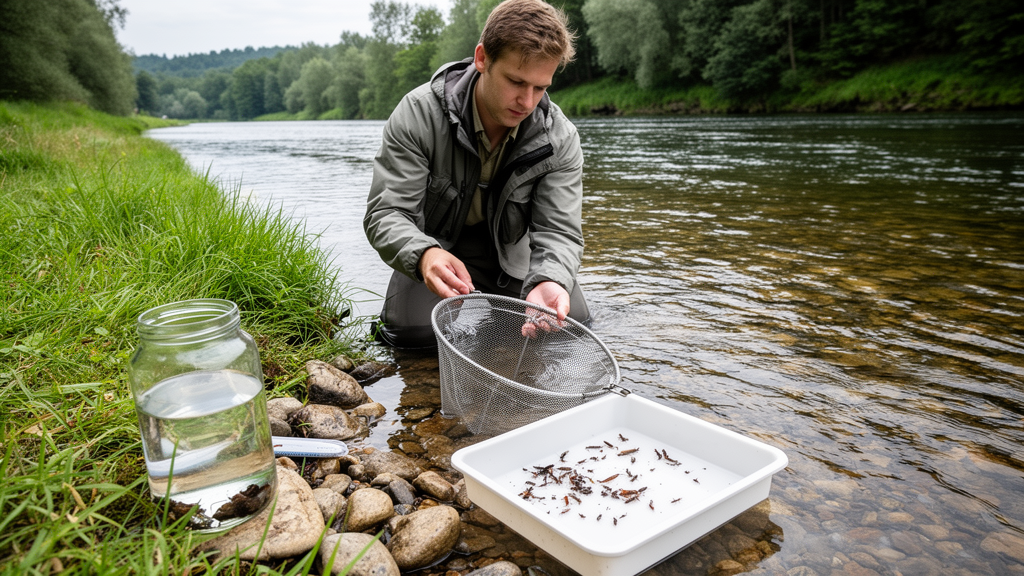
A standardized national list of freshwater macroinvertebrates produced ecological quality results that closely matched Lithuania’s existing monitoring assessments despite a 61.3% reduction in recorded taxonomic richness. Researchers synthesized literature and biomonitoring records, validated names against contemporary taxonomic backbones, and assigned 1,124 operational taxonomic units to 3,804 accepted taxa across 10 phyla. They then applied the list to 931 samples from 401 natural waterbody monitoring sites sampled between 2014 and 2022. The recalculated ecological quality ratios correlated strongly with previously reported values, and 91.4% of samples retained the same ecological status class. The study indicates that Lithuania’s river macroinvertebrate index is not adversely sensitive to standardized changes in taxonomic resolution, while exposing one systematic error in the treatment of Malacostraca.
The work addresses a problem created by the practical difficulty of identifying freshwater macroinvertebrates. Morphologically similar species, juvenile or damaged specimens lacking diagnostic features, limited specialist expertise, and changing genetic classifications can all lead records to be reported at inconsistent levels. A national list may consequently contain entries such as Amphipoda, Gammaridae, Gammarus and Gammarus pulex for organisms that do not represent equivalent taxonomic precision. Such inconsistencies can inflate apparent richness, prevent datasets from being combined reliably and introduce uncertainty into ecological quality calculations. The Lithuanian operational taxa list, or OTL, was designed to preserve each practitioner’s original identification while converting validated names into standardized units suitable for analysis.
The researchers first constructed a consolidated inventory from national checklists, papers, books, theses, online databases and macroinvertebrate records collected under Lithuania’s Water Framework Directive monitoring programme. Taxonomic names were checked against the Global Biodiversity Information Facility for most groups and against MolluscaBase for molluscs. When databases disagreed, lacked a record or accepted multiple names, the researchers consulted relevant literature and original descriptions. The resulting list also included ecological information, including habitat preference, rarity, non-native status, national and international conservation designations, exclusion rules and linked Biological Monitoring Working Party scores. Every species-level taxon was cross-referenced with genetic information in the National Center for Biotechnology Information, including available barcoding regions and sequenced genes.
Four identification specialists independently assessed the 2,657 species and subspecies in the initial inventory, reporting the lowest taxonomic level at which they could reliably identify each organism under routine conditions. Agreement was limited: only 29.8% of cases satisfied a rule requiring all four specialists to agree, and 46.8% converged at family level, while 35.5% converged at order level. The operational assignments were then guided by both expert agreement and the minimum taxonomic levels required by the four components of the Lithuanian River Macroinvertebrate Index. A four-phase decision tree included forced levels for difficult groups, metric-specific target levels and hierarchical fallbacks for material that cannot be identified beyond a phylum, class, order, family, genus or species. Taxa occurring in non-freshwater settings were retained in the inventory but flagged for exclusion from quality calculations.
The final list contained 1,124 operational taxonomic units, most commonly at genus level, which accounted for 73.3% of units, followed by family level at 13.3% and species level at 8.9%. Hierarchical fallback entries made up 4.5%, and 161 units were flagged for exclusion before ecological quality ratios were calculated. Applying the list to the original monitoring records transformed 860 reported taxa into 333 operational units, eliminating erroneous names, spelling errors and duplicate taxonomic forms. The largest contraction occurred among insects, whose 638 reported taxa became 256 units. Within the pollution-sensitive Ephemeroptera, Plecoptera and Trichoptera groups, richness declined by 52.7%, including reductions from 60 to 29 Ephemeroptera taxa, 32 to 18 Plecoptera and 191 to 87 Trichoptera. For the index’s richness-based metric, 224 unique taxa became 74 operational units, a 67% reduction.
Despite these extensive changes, the overall ecological quality ratios agreed closely with those published by the Lithuanian Environmental Protection Agency across all 931 samples. Pearson’s correlation was 0.984, with a p-value below 0.001. More than half the recalculated values were within 0.01 units of the reported results, and 304 samples produced numerically identical ratios at the published precision. Of the 931 samples, 851 received the same ecological quality class, while every disagreement involved adjacent classes rather than a large shift in assessment. In a separate analysis of 82 samples representing all five national river types and all five ecological status classes, three constituent metrics showed particularly strong agreement: correlation was 0.998 for the group-richness metric, 0.995 for Average BWMP Score per Taxon and 0.981 for the Danish Stream Fauna Index.
The exception was the index component calculated as the proportion of Ephemeroptera, Hemiptera and Plecoptera minus the proportions of Malacostraca and Hirudinea. Its correlation with the originally reported values was lower, at 0.774, and recalculated values were consistently lower than the published results. The discrepancy arose because the original workflow sometimes labelled crustaceans as “Crustacea” and sometimes as “Malacostraca,” even though the metric searched only for the former term. As a result, Malacostraca records could be omitted from the calculation. Correcting that inconsistency produced a small positive residual in the final ecological quality ratio, with class agreement remaining 91.5% in the curated subset. All seven class mismatches occurred at a boundary, and each standardized result placed the sample one class below the original classification.
The operational list is intended as a post-processing tool rather than a replacement for the sampling and laboratory procedures required under European monitoring standards. It retains raw taxon names, validated names and standardized units, allowing users to trace analytical decisions back to the observations reported by field and laboratory personnel. Users must still aggregate duplicate records and manually remove taxa marked for exclusion before calculating ecological quality ratios. The tool also retains taxa associated with riparian, transitional or marine habitats because some may reflect misidentification or unusual occurrences, but their flags keep them out of freshwater calculations. The researchers say the list can be adapted to other national indices by replacing the Lithuanian reference table and repeating the specialist assessment with local taxonomists.
Several limitations constrain how broadly the results can be applied. The comparison covered only natural waterbodies; heavily modified and artificial rivers use different ecological status boundaries and were not evaluated. The minimum identification levels also rested on the judgments of four specialists without independent re-identification, so a larger panel could establish different thresholds. National monitoring excludes rivers with catchment areas below 30 square kilometres and lakes and ponds smaller than 50 hectares, meaning some species may remain absent from the inventory. In addition, 1,029 of the 2,652 evaluated species were assigned operational units finer than the level all four specialists could reliably reach, a feasibility gap concentrated in Diptera, Lepidoptera and Coleoptera. The authors note that the list is a snapshot that will require revision as species descriptions, distributions, genetic classifications and non-native records change.
Beyond river assessment, the list provides a reference for biodiversity and molecular monitoring. Its conservation fields identify taxa covered by Lithuanian and European Red Lists, its habitat and non-native annotations help flag records that should not enter freshwater indices, and its genetic cross-references reveal where sequence data are available or lacking. The distinction may become increasingly important as environmental DNA methods detect genera or species that morphological identification often cannot resolve, particularly in Diptera. The study does not test whether the standardized units outperform the existing index or establish a new ecological status for Lithuanian rivers. Instead, it demonstrates that a carefully validated national taxonomy can make existing assessments more traceable and consistent with little disruption to the final monitoring result, while correcting a consequential naming inconsistency and identifying where future investment in identification keys, training and genetic reference libraries could improve reliability.
Subject of Research: National operational taxonomy for Lithuanian freshwater macroinvertebrate biomonitoring and ecological quality assessment
Article Title: Standardizing freshwater macroinvertebrate taxonomy: a Lithuanian operational taxa list for ecological quality assessments and biodiversity research
Article References: Osadčaja, D., Višinskienė, G., Solovjova, S., Skyrienė, G., & Baker, N. J. (2026). Standardizing freshwater macroinvertebrate taxonomy: a Lithuanian operational taxa list for ecological quality assessments and biodiversity research. Environmental Monitoring and Assessment, 198(11), Article 1240. https://doi.org/10.1007/s10661-026-16088-1
Image Credits: AI Generated
DOI: 10.1007/s10661-026-16088-1
Keywords: freshwater biomonitoring, macroinvertebrates, taxonomic standardization, ecological quality ratios, biodiversity data, Lithuania, Water Framework Directive, DNA barcoding, environmental monitoring, Standardizing, freshwater, macroinvertebrate
Cite Scienmag News
Violet Maxwell. (October 22, 2026). Lithuanian macroinvertebrate list preserves river quality results. Scienmag. https://scienmag.com/lithuanian-macroinvertebrate-list-preserves-river-quality-results/
Violet Maxwell. "Lithuanian macroinvertebrate list preserves river quality results." Scienmag, 22 October 2026, https://scienmag.com/lithuanian-macroinvertebrate-list-preserves-river-quality-results/. Accessed 22 October 2026.
Violet Maxwell. "Lithuanian macroinvertebrate list preserves river quality results." Scienmag. October 22, 2026. https://scienmag.com/lithuanian-macroinvertebrate-list-preserves-river-quality-results/


