


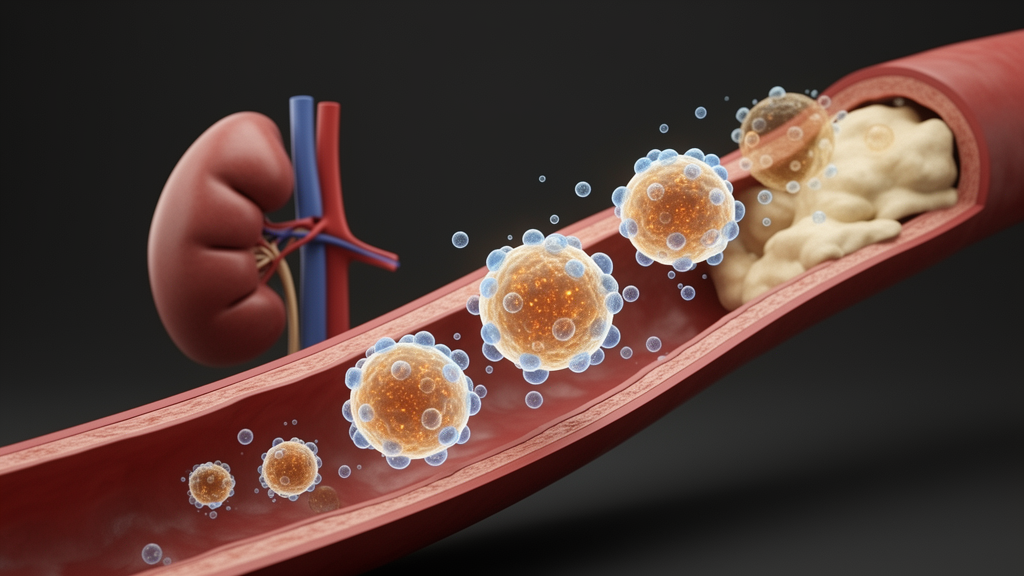
For millions of people living with chronic kidney disease, the greatest threat to survival is not kidney failure itself but the heart and blood vessels that fail alongside it. Atherosclerotic cardiovascular disease remains the leading cause of death and disability in this population, and it strikes early: from the first stages of kidney dysfunction, patients develop accelerated atherosclerosis driven by a mixture of kidney-specific conditions such as anemia, uremia, and mineral disturbances, and by traditional risk factors like hypertension, diabetes, and dyslipidemia. Yet even when clinicians rigorously correct blood pressure, cholesterol, and glucose, a stubborn excess of cardiovascular events persists. A new review published in Frontiers in Nephrology by Leonardo A. Sechi and colleagues at the University of Udine argues that a genetically determined particle called lipoprotein(a) may be a central, and now potentially targetable, contributor to this residual risk.
Lipoprotein(a), abbreviated Lp(a), is structurally an LDL particle with a twist. It contains apolipoprotein B100 covalently linked, in a one-to-one molar ratio, to apolipoprotein(a), a glycoprotein whose gene sits on chromosome 6 and shares more than 80 percent structural homology with plasminogen, the key enzyme precursor of blood clot dissolution. Apolipoprotein(a) is built from repeated kringle domains, and one of them, kringle 4 type 2, is present in a variable number of copies, usually between 3 and more than 40. This copy number varies enormously between individuals and ancestry groups and is the major determinant of both the size of the particle and the concentration of Lp(a) in plasma: smaller isoforms are secreted more efficiently by hepatocytes, so people carrying fewer repeats tend to have higher circulating levels. The entire production process occurs in the liver, where apo(a) and apoB are secreted separately and assembled into mature Lp(a) particles outside the cell.
The scientific history of Lp(a) is a story of enthusiasm, disappointment, and redemption. After observational studies in the late 1980s linked plasma levels to coronary heart disease, early prospective trials produced discordant results, and because no diet or drug could reliably lower the particle, interest waned for roughly two decades. That picture changed dramatically with population-based studies, meta-analyses, genome-wide association studies, and Mendelian randomization analyses, which together established Lp(a) as a strong, independent, and genetically determined causal risk factor for atherosclerotic cardiovascular disease. Plasma Lp(a) measurement now reclassifies the risk category of approximately 40 percent of primary prevention patients who sit in the intermediate band of the Framingham risk score, and recent guidelines recommend widespread testing. Values above 50 mg/dL, or 125 nmol/L, are conventionally considered elevated; roughly 15 to 20 percent of people worldwide exceed this threshold, and the population distribution is strongly skewed, ranging from less than 0.2 to more than 200 mg/dL.
The concept of residual cardiovascular risk is central to the review’s argument. Even when blood pressure, LDL cholesterol, blood glucose, obesity, and smoking are treated to the best standards of care, a substantial probability of major adverse cardiovascular events remains. The evidence is striking. In the PRIME study, which followed 9,649 men aged 50 to 59 for ten years, treated hypertensive patients had a 50 percent higher relative risk of major cardiovascular events after adjustment for concurrent risk factors. In the Framingham Offspring Cohort, treated hypertensive patients whose blood pressure was below 140/90 mm Hg still carried a 50 percent higher risk of cardiovascular events than untreated subjects with comparable readings. On the lipid side, long-term reassessments of early statin trials show a residual risk of approximately 30 percent, and even trials of the most potent PCSK9 inhibitors, which drove LDL cholesterol to a median below 30 mg/dL, could not normalize cardiovascular risk. A recent participant-level meta-analysis demonstrated that effective LDL reduction does not offset Lp(a)-related risk: participants with Lp(a) above 50 mg/dL and LDL below 77 mg/dL still had a 38 percent greater risk than patients with lower Lp(a) levels.
What makes Lp(a) especially relevant to kidney disease is that the kidney itself appears to be a major site of Lp(a) clearance. Clinical studies consistently show that plasma Lp(a) rises progressively as glomerular filtration rate falls, and the review’s authors contributed their own evidence: in 417 patients with arterial hypertension, 160 of whom had hypertensive nephroangiosclerosis with creatinine clearance between 30 and 89 mL/min/1.73 m², Lp(a) levels were significantly higher in those with renal involvement, correlated inversely with creatinine clearance, and were associated with more prevalent coronary, cerebrovascular, and peripheral artery disease. Notably, urinary albumin losses did not correlate with Lp(a) levels and apo(a) phenotype distribution was comparable across levels of kidney function, suggesting that kidney damage itself, rather than altered isoform expression, drives the increase. Stable isotope turnover studies and urinary apo(a) clearance studies support the conclusion that elevated Lp(a) in chronic kidney disease reflects reduced renal clearance rather than increased hepatic production.
Prospective cohort data now confirm that this biochemical elevation translates into clinical harm. In the Chronic Renal Insufficiency Cohort study, 3,744 participants followed for 7.5 years showed that those in the highest quartile of Lp(a), above 61.3 mg/dL, had a 49 percent higher risk of myocardial infarction and a 28 percent higher risk of death. The German Chronic Kidney Disease study, which followed 5,043 subjects for 6.5 years, found that each 10 mg/dL increase in Lp(a) raised cardiovascular disease risk by 6.5 percent, with risk climbing more than 30 percent in subjects above 70 mg/dL regardless of traditional risk factors. A systematic review of 15 studies encompassing 12,260 participants with kidney disease confirmed that high Lp(a) independently predicts cardiovascular events and death, and data from the China Renal Data System, covering more than 50,000 participants, linked rising Lp(a) to both progression of renal failure and cardiovascular mortality. The particle is also entwined with calcific aortic valve disease, which frequently accompanies advanced kidney disease, although MESA study data on 6,346 subjects found the association between valve calcification and kidney dysfunction occurred independently of Lp(a) levels.
The dialysis and transplantation literature provides a natural experiment that strengthens the causal interpretation. Patients on hemodialysis have higher Lp(a) than healthy subjects and patients with early kidney disease, and peritoneal dialysis patients show elevations independent of apo(a) isoform size. Crucially, neither hemodialysis nor peritoneal dialysis lowers Lp(a), whereas renal transplantation significantly reduces it, a rapid change consistent with the restoration of renal clearance. In nephrotic syndrome, where heavy urinary protein wasting raises Lp(a) independently of filtration rate, levels normalize after remission of the causative condition, likely reflecting increased hepatic synthesis rather than impaired catabolism. Together these observations justify repeated Lp(a) measurements during the course of progressive kidney disease, since levels fluctuate with inflammatory states and changes in treatment even though they are largely stable over time in the general population.
The therapeutic landscape is changing rapidly. Traditional lipid-lowering drugs have negligible effects on Lp(a), and dietary interventions are unpredictable at best, although replacing saturated fatty acids with unsaturated fats and long-chain carbohydrates produces small reductions. The PCSK9 inhibitors evolocumab and alirocumab lower Lp(a) by only about 27 and 23 percent respectively, from baseline levels that were mostly well below risk thresholds. The new generation of agents is different. Pelacarsen, an antisense oligonucleotide delivered to hepatocytes via the asialoglycoprotein receptor, degrades LPA mRNA and reduced Lp(a) by 80 percent at a dose of 20 mg weekly over six months. Small interfering RNAs conjugated with N-acetyl-galactosamine, including olpasiran, zerlasiran, and lepodisiran, harness the RNA-induced silencing complex to the same end: olpasiran achieved placebo-adjusted reductions of 97 percent, zerlasiran 95 percent with a single 450 mg dose, and lepodisiran 94 percent with 400 mg. Muvalaplin, an oral small molecule that blocks the kringle 4-mediated interaction between apo(a) and apoB, reduced Lp(a) by 86 percent at 240 mg per day over three months. Phase 3 outcome trials such as Lp(a)HORIZON, OCEAN(a), and ACCLAIM-Lp(a) are now testing whether these dramatic biochemical reductions translate into fewer cardiovascular events.
There is, however, a critical caveat for the kidney community: every trial of these investigational drugs excluded patients with advanced chronic kidney disease or on dialysis, so efficacy, dosing, and long-term safety in renal patients remain unknown and cannot be extrapolated. In the meantime, the review’s authors emphasize that rigorous application of proven preventive measures remains essential, including smoking cessation, salt restriction, exercise, blood pressure targets below 130/80 mm Hg with renin-angiotensin system inhibitors, glycated hemoglobin below 7.0 percent, SGLT2 inhibitors, GLP-1 receptor agonists, finerenone, and intensive lipid lowering to LDL below 55 mg/dL using statins, ezetimibe, and PCSK9 inhibitors as needed. For selected high-risk patients with elevated Lp(a), lipoprotein apheresis offers an existing, if cumbersome, option: retrospective series report reductions from a mean of 138 mg/dL to 51 mg/dL with a 94 percent reduction in major cardiovascular events over four years, and in nine hemodialysis patients undergoing combined apheresis, median Lp(a) fell from 242.7 to 64.2 nmol/L with a 57 percent reduction in adverse cardiac and vascular events over four years.
A landmark Mendelian randomization analysis adds a note of scientific caution: genetically predicted lifelong differences in Lp(a) correspond to an estimated 6 percent decrease in atherosclerotic cardiovascular disease odds for every 10 mg/dL reduction, but such estimates cannot be directly translated into the expected effect of short-term pharmacological lowering, and meaningful clinical benefit would likely require reductions greater than 50 mg/dL. Still, with new therapies capable of cutting Lp(a) by up to 90 percent from baseline, the potential is enormous. If ongoing trials demonstrate that profound Lp(a) reduction lowers residual cardiovascular risk, and if dedicated studies in patients with kidney disease follow, Lp(a) could be transformed from a passive risk marker into a primary therapeutic target for one of the most vulnerable populations in cardiovascular medicine.
Subject of Research: The role of lipoprotein(a) in residual cardiovascular risk among patients with chronic kidney disease and emerging Lp(a)-lowering therapies
Article Title: Lipoprotein(a): a potential target for the reduction of residual cardiovascular risk in patients with chronic kidney disease
Article References: Sechi, L. A., Bulfone, L., Vacca, A., Comand, J., Marcante, S., Brosolo, G., Pagano, C., & Catena, C. (2026). Lipoprotein(a): a potential target for the reduction of residual cardiovascular risk in patients with chronic kidney disease. Frontiers in Nephrology, 6, Article 1950030. https://doi.org/10.3389/fneph.2026.1950030
Image Credits: AI Generated
DOI: 10.3389/fneph.2026.1950030
Keywords: lipoprotein(a), chronic kidney disease, residual cardiovascular risk, atherosclerotic cardiovascular disease, antisense oligonucleotides, small interfering RNA, pelacarsen, olpasiran, muvalaplin, lipoprotein apheresis, renal clearance, cardiovascular prevention
Cite Scienmag News
Jerry Hayes. (October 15, 2026). Lipoprotein(a) Emerges as Hidden Driver of Cardiovascular Risk in Chronic Kidney Disease. Scienmag. https://scienmag.com/lipoproteina-emerges-as-hidden-driver-of-cardiovascular-risk-in-chronic-kidney-disease/
Jerry Hayes. "Lipoprotein(a) Emerges as Hidden Driver of Cardiovascular Risk in Chronic Kidney Disease." Scienmag, 15 October 2026, https://scienmag.com/lipoproteina-emerges-as-hidden-driver-of-cardiovascular-risk-in-chronic-kidney-disease/. Accessed 15 October 2026.
Jerry Hayes. "Lipoprotein(a) Emerges as Hidden Driver of Cardiovascular Risk in Chronic Kidney Disease." Scienmag. October 15, 2026. https://scienmag.com/lipoproteina-emerges-as-hidden-driver-of-cardiovascular-risk-in-chronic-kidney-disease/


