


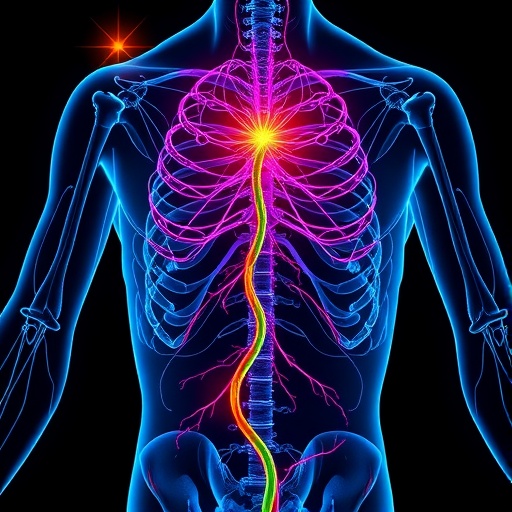
A groundbreaking study has illuminated the extraordinary complexity underlying the intrinsic cardiac nervous system (ICNS), revealing it as a marvel of developmental precision maintained by a specialized extracellular matrix (ECM) niche. This research, recently published in Nature, employs cutting-edge single-cell RNA sequencing to dissect the cellular microenvironment that scaffolds the ICNS within the developing heart, offering transformative insights into how organ-resident nervous systems are constructed and stabilized.
The ICNS, a dense network of neurons intrinsic to the heart, orchestrates cardiac autonomic regulation, yet the origin of its stereotyped architecture has remained elusive. By contrasting cardiac cells from regions proximal to the ICNS with those in more distal zones at embryonic day 14.5 (E14.5) in mouse hearts, the researchers have discovered that the ICNS is nestled within a highly specialized niche enriched in ECM and defined by distinct cellular compositions. This niche is characterized predominantly by an abundance of fibroblasts and cardiomyocytes, suggesting a collaborative microenvironment pivotal for ICNS development.
Fibroblasts emerged as nearly twice as prevalent near the ICNS compared to distant heart regions, positioning them as principal architects of the local environment. These fibroblasts, alongside cardiomyocytes, were predicted through intricate computational ligand-receptor interaction analyses to be dominant signaling sources to the ICNS neurons, underscoring a tightly regulated communication axis. Spatial transcriptomics and proteomics further reinforced this cellular interplay, showing an ECM-rich milieu encasing the ICNS, indicative of both molecular signaling and physical anchorage roles.
The ECM composition in the ICNS niche features elevated expression of several key molecules integral to tissue architecture and signaling: fibrillar collagens (Col1a1, Col1a2, Col6a1, Col14a1), laminin isoforms (Lama2), and elastin (Eln). Such enrichment highlights ECM not merely as a structural scaffold but as an active participant in neuronal differentiation, maturation, and potentially in directing spatial patterning. Gene ontology analyses reveal upregulated pathways linked to neurodevelopmental programs, including secreted factors and cell adhesion components, further echoing the vital cross-talk facilitated by ECM constituents.
Strikingly, despite the stable cytoarchitectural framework provided by fibroblasts and cardiomyocytes, the ICNS does not form randomly but undergoes highly stereotyped morphogenesis. The developmental trajectory reveals a morphogenetic progression beginning with a dense central ganglion that transforms through expansion into a ring-like structure by E16.5, subsequently bifurcating into anterior and posterior clusters and eventually segregating into multiply discrete ganglia by postnatal day 1. This spatial refinement occurs without changes in ICNS neuron number or density, indicating that structural rearrangement rather than neurogenesis shapes the final architecture.
This transition—likened by authors to a “beads-on-a-necklace” organization—is accompanied by prolific proliferation in adjacent cardiac tissues. The resultant tissue growth exerts mechanical forces that likely drive the displacement and segregation of the initially compact neuronal mass. Indeed, computational modeling emulating tissue expansion robustly recapitulated the observed formation of discrete ICNS ganglia, highlighting the inherent developmental plasticity conferred by organ growth dynamics.
To probe the molecular underpinnings responsible for the ECM-mediated structural integrity of the ICNS niche, the researchers focused on lysyl oxidase (LOX), an enzyme critical for the covalent cross-linking of collagen, elastin, and laminin fibers. LOX expression was markedly elevated at the interface of ICNS neurons and surrounding fibroblasts, implying a vital role in reinforcing the ECM scaffold. Functional interrogation using Lox knockout mice yielded profound disruptions in ICNS spatial organization: whereas total neuron numbers remained intact, the stereotyped ganglionic architecture was lost, leading to disorganized, scattered neuron clusters and increased inter-individual variability.
These Lox mutant phenotypes underscore that covalent crosslinking by LOX establishes biomechanical stability and positional fidelity, anchoring ICNS neurons within their niche and preserving precise ganglion size and distribution. This disruption of ECM integrity compromises the emergent neuronal patterning despite the persistence of key cell types, highlighting ECM’s pivotal role as both a developmental cue and physical framework.
Beyond unraveling the cardiac intrinsic nervous system’s developmental choreography, these findings have broader implications for understanding how intrinsic nervous systems in other organs are formed and maintained. The convergence of lineage signals, ECM remodeling, and tissue growth dynamics delineates a paradigm wherein organ-derived signals sequentially create specialized niches that regulate neural architecture. This integrated framework bridges key knowledge gaps, from embryonic organogenesis to adult homeostasis and repair mechanisms.
Intriguingly, the study’s multidisciplinary approach combines high-resolution transcriptomic profiling with spatial and proteomic analyses, bolstered by precise genetic perturbations. This integrative methodology not only charts the molecular landscape of the ICNS niche but also reveals mechanistic insights into how ECM composition and mechanical properties govern neural tissue patterning. Such advances herald novel avenues for therapeutic interventions targeting ECM remodeling in cardiac pathologies and beyond.
Future investigations leveraging these foundational insights could explore how ECM modifications impact neural plasticity and regenerative potential post-injury, or how aberrations in ECM enzymatic processes contribute to congenital or acquired autonomic dysfunctions. The elucidation of LOX’s role prompts further exploration into ECM enzyme networks influencing nerve anchorage and signaling within diverse organ systems.
In sum, this landmark study illuminates the intimate liaison between cardiac cells and ECM in sculpting the spatial precision of the intrinsic cardiac nervous system. It reveals that the organ’s resident neurons are not lone players but are embedded within a dynamic, ECM-rich microenvironment orchestrated by neighboring fibroblasts and cardiomyocytes. This biochemical and biomechanical interplay culminates in a stereotyped, resilient neuronal architecture essential for robust cardiac regulation, redefining our understanding of organ-intrinsic nervous system development.
The insights gleaned here provide a compelling blueprint for decoding other organ-intrinsic nervous systems across the body and exemplify the increasing resolution at which we can characterize cellular ecosystems. By illuminating how growth signals, ECM refinement, and cellular cross-talk conspicuously sculpt nervous system assembly, these findings pave the way for innovative strategies harnessing ECM modulation in tissue engineering and regenerative medicine.
Cite Scienmag News
Denise Maddox. (May 14, 2026). Lineage and Organ Signals Forge Intrinsic Nerves. Scienmag. https://scienmag.com/lineage-and-organ-signals-forge-intrinsic-nerves/
Denise Maddox. "Lineage and Organ Signals Forge Intrinsic Nerves." Scienmag, 14 May 2026, https://scienmag.com/lineage-and-organ-signals-forge-intrinsic-nerves/. Accessed 3 September 2026.
Denise Maddox. "Lineage and Organ Signals Forge Intrinsic Nerves." Scienmag. May 14, 2026. https://scienmag.com/lineage-and-organ-signals-forge-intrinsic-nerves/


