


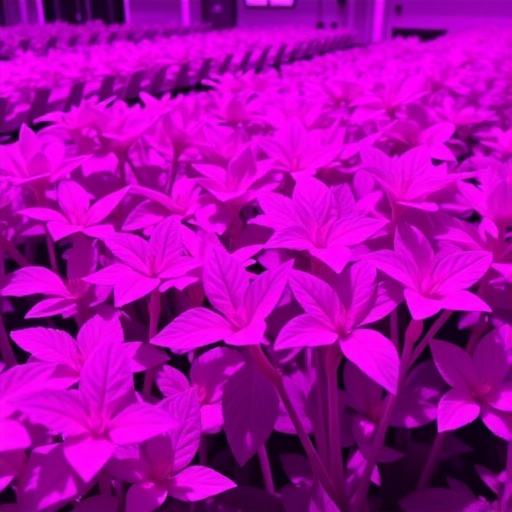
The relentless advance of industrial activities has dramatically altered the planet’s atmosphere, unleashing a cascade of environmental challenges that imperil global agriculture. Among these challenges, stratospheric ozone depletion stands out as a key driver of increased surface-level ultraviolet-B (UV-B) radiation, which, combined with escalating global temperatures, profoundly affects plant biology. Recent groundbreaking research has now unveiled a molecular mechanism in rice that intricately links the plant’s UV-B perception to its heat-stress response—a discovery that holds promise for cultivating crops resilient to the mounting pressures of climate change.
For years, scientists have recognized that higher UV-B radiation and heat stress individually hinder plant growth by disturbing metabolic pathways and reducing photosynthetic efficiency. However, the molecular circuitry that couples energy signaling with thermotolerance in plants has remained elusive, limiting our capacity to engineer heat-resilient crops effectively. The study published in Cell Research by Li et al. breaks new ground by identifying a natural variation within a key photoreceptor protein, UV RESISTANCE LOCUS 8b (OsUVR8b), that governs this critical balance in rice.
The OsUVR8b protein acts as a photoreceptor, sensitive to UV-B, triggering protective responses against damaging radiation. Intriguingly, the study pinpoints OsUVR8b as a substrate of the SNF1-related protein kinase 1 (SnRK1), an essential energy-sensing enzyme conserved across plants. Phosphorylation by SnRK1 at a specific amino acid site—serine 177 (Ser177)—emerges as a molecular switch that modulates the photoreceptor’s stability and function under heat stress. By comparing natural rice variants, the researchers discovered that the phosphorylation state at this site defines a tradeoff between heat tolerance and yield.
Rice varieties carrying a serine at position 177, designated OsUVR8b^Ser177, exhibit decreased protein stability during heat stress, which hampers their ability to neutralize reactive oxygen species (ROS), thereby compromising thermotolerance. In contrast, those with an alanine substitution at this position, OsUVR8b^Ala177, show enhanced protein stability and a superior capacity to scavenge ROS, conferring robust heat tolerance. This allelic variation is not merely an academic curiosity—it correlates geographically with adaptation to tropical climates characterized by elevated temperatures.
To ensure that this association reflects causality, the team employed cutting-edge prime editing techniques to recreate the Ser177-to-Ala177 substitution and vice versa in rice plants. This precise genome editing validated the functional impact of the site: edited plants bearing the alanine variant demonstrated significantly enhanced heat tolerance, while the reciprocal edit compromised it. These elegant genetic manipulations cement the role of the Ser177 phosphorylation site as a pivotal regulator of heat stress resilience.
Importantly, the researchers extended their investigations beyond rice to demonstrate that this regulatory mechanism is conserved across diverse species, including Arabidopsis, tobacco, and soybean. Such conservation underscores the evolutionary significance of the OsUVR8b phosphorylation switch and suggests broad applicability in crop breeding programs aimed at enhancing climate resilience.
Despite the clear advantage conferred by OsUVR8b^Ala177 under heat stress, the study uncovered a compelling complexity: a tradeoff exists between thermotolerance and productivity. Under non-stressful conditions, rice plants with the Ser177 variant maintain higher fertility and yield, revealing a balancing act between energy investment in stress protection and reproductive output. This nuanced understanding equips breeders with critical insights for optimizing crop performance under fluctuating environmental conditions.
At the cellular level, mechanistic analyses revealed that phosphorylation at Ser177 affects the conformational stability of OsUVR8b, influencing its degradation rate under heat stress. The phosphorylation-triggered destabilization reduces the photoreceptor’s capacity to mediate UV-B protective pathways and mitigate oxidative damage, which are crucial for maintaining cellular homeostasis during thermal stress. The alanine substitution, by resisting such phosphorylation, stabilizes OsUVR8b and enhances its functional longevity.
Reactive oxygen species, often produced during abiotic stress, cause significant biomolecular damage if unchecked. The enhanced ROS scavenging ability in Ala177-containing OsUVR8b plants likely reduces oxidative stress, safeguarding cellular structures and facilitating survival under heat. This functional insight bridges molecular signaling with physiological outcomes, providing a comprehensive picture of plant stress adaptation.
The discovery also sheds light on the intricate crosstalk between light perception and energy metabolism in plants. By integrating UV-B signaling with systemic energy status—via SnRK1-mediated phosphorylation—the plants dynamically adjust their stress response, optimizing resource allocation. This integrative perspective challenges the previous paradigm of isolated stress pathways and opens avenues for multi-targeted crop improvement.
From an applied perspective, harnessing this phosphorylation-based molecular switch offers a pragmatic strategy for developing climate-resilient crop varieties. Targeted breeding or genome editing to introduce or optimize OsUVR8b alleles could yield cultivars tailored for high-temperature environments without sacrificing yield potential under favorable conditions. Such precision agriculture aligns with global food security imperatives in an era of unprecedented climatic variability.
The environmental context of the study accentuates its urgency. With ozone depletion contributing to surging UV-B radiation and concomitant global warming, agricultural systems worldwide face dual stressors that threaten productivity. Elucidating molecular adaptations like OsUVR8b phosphorylation equips researchers and farmers with vital tools to mitigate these challenges, safeguarding livelihoods and ecosystems.
Furthermore, the work exemplifies the power of natural variation analysis combined with advanced genome editing, showcasing a pathway from molecular discovery to translational crop science. The ability to validate causative allelic effects in situ marks a milestone in functional genomics, accelerating the pace of innovation in plant breeding.
Looking ahead, future research may explore how OsUVR8b interacts with other stress signaling networks and whether its manipulation can confer tolerance to combined abiotic stresses like drought and salinity. Additionally, understanding the ecological and evolutionary origins of the Ser177/Ala177 polymorphism may provide deeper insights into plant adaptation strategies in diverse environments.
In summary, Li and colleagues have illuminated a vital molecular mechanism that balances heat tolerance and yield in rice by modulating a UV photoreceptor’s stability through SnRK1-mediated phosphorylation. This discovery not only advances fundamental plant biology but also offers a potent lever for engineering climate-resilient crops—a beacon of hope for global agriculture amid escalating climatic adversity.
Cite Scienmag News
Alan Morgan. (May 14, 2026). UVR8 Variations Influence Plant Heat Tolerance and Yield. Scienmag. https://scienmag.com/uvr8-variations-influence-plant-heat-tolerance-and-yield/
Alan Morgan. "UVR8 Variations Influence Plant Heat Tolerance and Yield." Scienmag, 14 May 2026, https://scienmag.com/uvr8-variations-influence-plant-heat-tolerance-and-yield/. Accessed 7 September 2026.
Alan Morgan. "UVR8 Variations Influence Plant Heat Tolerance and Yield." Scienmag. May 14, 2026. https://scienmag.com/uvr8-variations-influence-plant-heat-tolerance-and-yield/


