


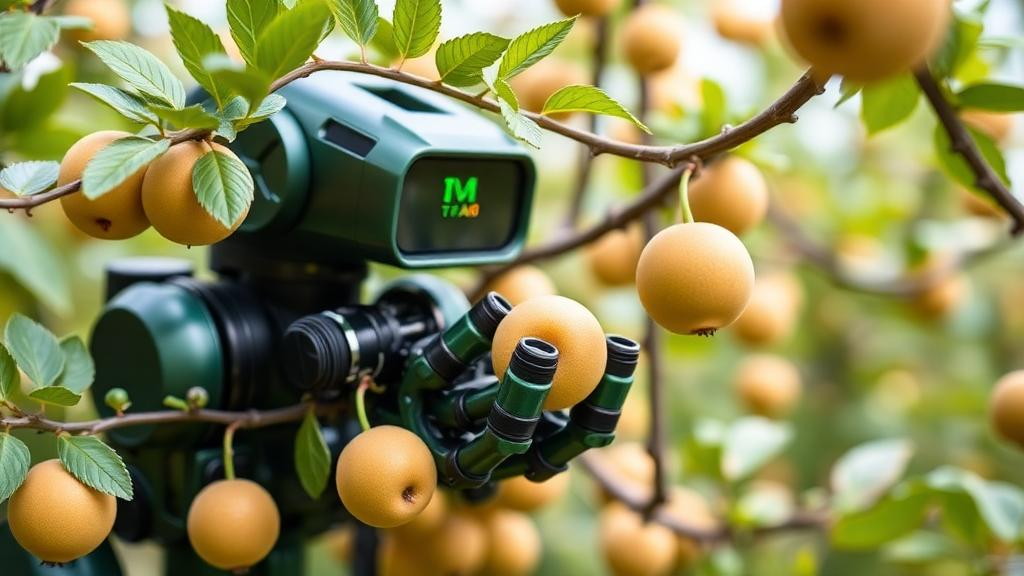
Robotic fruit picking has long promised to ease the labor crunch facing orchard growers, but the promise has repeatedly collided with a stubborn technical reality: a robot’s camera sees a chaotic world of overlapping leaves, dappled light, and fruit hanging at awkward angles. A study published in BMC Plant Biology by Hongyan Zhu, Runlong Cao, and colleagues at Guangxi Normal University, working with Yong He of Zhejiang University, now describes a perception framework designed specifically for one of the trickiest targets in automated agriculture, the green jujube. The system, published as open access research on 3 October 2026, combines a purpose-built lightweight detection network with a powerful general-purpose segmentation model, and the authors report that the pairing can locate not just the fruit itself but the precise anatomical landmark a robotic gripper needs to sever it cleanly.
The core challenge the team set out to solve is the localization of picking points. In automated harvesting, knowing where a fruit is only half the battle; a robot must also determine where the pedicel meets the fruit, the transition zone where a cutting tool should be applied, and the angle at which the cut should be made. Human pickers perform this judgment effortlessly, reading the posture of each fruit in an instant. Machines, by contrast, have struggled because the pedicel-fruit junction is small, often partially hidden, and easily confused with branches or shadows in a dense canopy. Errors of even a few pixels at this junction can translate into failed cuts, damaged fruit, or worse, a severed branch.
The researchers’ answer is a two-part architecture they call a collaborative perception framework. The first component, named RDA-YOLO, is a streamlined neural network built on the YOLOv11n-POSE architecture, a family of models known for real-time object detection and human pose estimation. The team modified this backbone in three significant ways. First, they introduced Distribution Shift Convolution, or DSConv, a technique that reduces computational overhead by restructuring how convolutional operations are distributed across the network’s channels. Second, they designed a module called C3k2_RepViT, which borrows ideas from efficient vision transformer designs to improve multi-scale feature fusion, allowing the network to recognize jujubes of very different apparent sizes depending on their distance from the camera. Third, and most consequentially, they replaced the standard keypoint prediction structure with a custom Adaptive Regression Coordination Pose Head, abbreviated ARC-PoseHead.
The ARC-PoseHead is the technical heart of the system. Traditional keypoint heads regress coordinates directly in image space, which can make them insensitive to small positional differences, particularly when the object of interest sits against a cluttered background. The new head instead employs log-scale polar regression, describing each keypoint’s position in terms of angle and logarithmically scaled distance rather than raw horizontal and vertical offsets, and then applies subpixel refinement to sharpen the final coordinate estimate. According to the authors, this design significantly improves the model’s coordinate perception of both the jujube fruits and their critical keypoints under complex orchard backgrounds. In effect, the network learns to think about where a pedicel attaches in a way that is more forgiving of scale variation and background noise than conventional regression.
The second component of the framework is Segment Anything Model 2, or SAM2, a large foundation model for promptable image segmentation. While RDA-YOLO handles the fast, real-time work of detecting fruits and pinpointing keypoints, SAM2 is called upon for fine-grained contour segmentation within the detection boxes that RDA-YOLO produces. This division of labor matters because the two tasks have different computational profiles. Detection and keypoint localization must run quickly enough to guide a moving robot arm, whereas contour analysis can be more deliberate. By constraining SAM2 to operate on candidate regions rather than entire images, the framework keeps its heavier computation focused where it is needed.
The payoff of the segmentation step is an assessment of occlusion, the degree to which leaves, branches, or neighboring fruits block access to a target. A fruit that is mostly visible can be approached directly; one that is half-hidden behind foliage may require the robot to reposition, wait for a different viewing angle, or defer the pick. Using the segmented contours, the system determines each fruit’s occlusion status and establishes a harvesting priority, effectively generating a posture-aware harvest plan rather than a simple list of fruit coordinates. This planning layer is what elevates the work beyond detection alone, turning raw perception into an actionable strategy for a harvesting robot operating in an unstructured environment.
The reported numbers are striking for a model of this size. RDA-YOLO achieved 93.9 percent precision and a mean average precision at an intersection-over-union threshold of 0.5, or mAP@50, of 94.9 percent for green jujube detection. For keypoint detection, the model attained a precision of 90.4 percent and an mAP@50 of 83.6 percent, which the authors describe as superior performance for this task. Just as important for field deployment, the network is genuinely lightweight: it contains only 2.490 million parameters and requires just 5.7 gigafloating-point operations, or GFLOPs, per inference. By comparison, many modern detection models run into the tens or hundreds of millions of parameters, which typically demands GPU hardware that is impractical to mount on an agricultural robot.
Lightweight design is not merely an engineering vanity metric. Orchard robots operate on battery power, often in hot and dusty conditions, and every watt spent on computation is a watt not spent on locomotion or manipulation. A model that can run on a modest field robot control computer, as the authors verified in their deployment testing, means the entire perception pipeline can live on the machine rather than on a remote server, eliminating the latency and connectivity problems that plague wireless links in rural settings. The team demonstrated deployment feasibility on a field robot control computer and on a robotic platform using jujube fruit models, providing an early proof that the framework can move from benchmark datasets to physical hardware.
The choice of green jujube as a test crop is also telling. Jujubes are an economically significant fruit in China and across much of Asia, and their harvest shares the difficulties common to many orchard crops: small pedicels, dense canopies, and a long picking season that strains seasonal labor supplies. A perception framework validated on jujubes, with its emphasis on pedicel-fruit transition localization and occlusion-aware prioritization, could plausibly be adapted to other tree fruits where similar anatomical landmarks govern the cut. The authors frame the work as a contribution to smart agriculture broadly, and the modular design, in which a fast detector cooperates with a heavyweight segmenter, is a pattern that other agricultural robotics groups are likely to study closely.
There remain, of course, the usual caveats that separate laboratory results from open-field reliability. The robotic platform trials described in the study used jujube fruit models rather than live crops, and real orchards will add variables such as wind-blown motion, variable illumination across the day, and the sheer diversity of fruit postures in a mature tree. The published work, received in July 2026 and accepted in August, is also flagged by the publisher as an early-release version subject to further edits. Still, the combination of high precision, tiny computational footprint, and a demonstrated path to on-robot deployment makes this a notable step in the long project of teaching machines to pick fruit as deftly as people do. If collaborative frameworks of this kind continue to mature, the sight of robots working alongside pickers in jujube orchards may arrive sooner than the industry once assumed.
Subject of Research: Lightweight deep learning and segmentation-based perception for robotic green jujube harvesting
Article Title: A collaborative perception framework for green jujube: from lightweight key point detection to posture-aware harvest analysis
Article References: Zhu, H., Cao, R., Qin, S., Lin, C., Sun, W., Zou, Y., Liao, Z., & He, Y. (2026). A collaborative perception framework for green jujube: from lightweight key point detection to posture-aware harvest analysis. BMC Plant Biology. https://doi.org/10.1186/s12870-026-09842-7
Image Credits: AI Generated
DOI: 10.1186/s12870-026-09842-7
Keywords: RDA-YOLO, green jujube, robotic harvesting, key point detection, SAM2, computer vision, precision agriculture, pose estimation, lightweight neural networks, occlusion assessment, smart agriculture, orchard automation
Cite Scienmag News
Alan Morgan. (October 3, 2026). Lightweight AI Gives Harvesting Robots a Sharper Eye for Green Jujubes. Scienmag. https://scienmag.com/lightweight-ai-gives-harvesting-robots-a-sharper-eye-for-green-jujubes/
Alan Morgan. "Lightweight AI Gives Harvesting Robots a Sharper Eye for Green Jujubes." Scienmag, 3 October 2026, https://scienmag.com/lightweight-ai-gives-harvesting-robots-a-sharper-eye-for-green-jujubes/. Accessed 4 October 2026.
Alan Morgan. "Lightweight AI Gives Harvesting Robots a Sharper Eye for Green Jujubes." Scienmag. October 3, 2026. https://scienmag.com/lightweight-ai-gives-harvesting-robots-a-sharper-eye-for-green-jujubes/


