


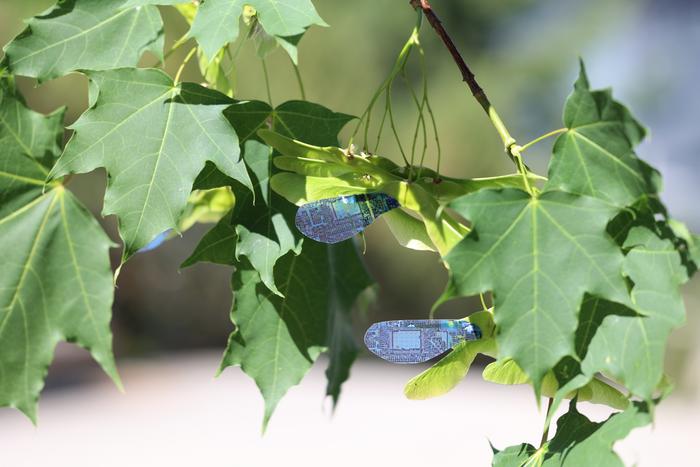
Researchers from Tampere University, Finland, and the University of Pittsburgh, USA, have developed a tiny robot replicating the aerial dance of falling maple seeds. In the future, this robot could be used for real-time environmental monitoring or delivery of small samples even in inaccessible terrain such as deserts, mountains or cliffs, or the open sea. This technology could be a game changer for fields such as search-and-rescue, endangered species studies, or infrastructure monitoring.

Credit: Jianfeng Yang, Tampere University
Researchers from Tampere University, Finland, and the University of Pittsburgh, USA, have developed a tiny robot replicating the aerial dance of falling maple seeds. In the future, this robot could be used for real-time environmental monitoring or delivery of small samples even in inaccessible terrain such as deserts, mountains or cliffs, or the open sea. This technology could be a game changer for fields such as search-and-rescue, endangered species studies, or infrastructure monitoring.
At Tampere University, Professor Hao Zeng and Doctoral Researcher Jianfeng Yang work at the interface between physics, soft mechanics, and material engineering in their Light Robots research group. They have drawn inspiration from nature to design polymeric gliding structures that can be controlled using light.
Now, Zeng and Yang, with Professor M. Ravi Shankar, from the University of Pittsburgh utilized a light-activated smart material to control the gliding mode of an artificial maple seed. In nature, maple disperse to new growth sites with the help of flying wings in their samara, or dry fruit. The wings help the seed to rotate as it falls, allowing it to glide in a gentle breeze. The configuration of these wings defines their glide path.
According to the researchers, the artificial maple seed can be actively controlled using light, where its dispersal in the wind can be actively tuned to achieve a range of gliding trajectories. In the future, it can also be equipped with various microsensors for environmental monitoring or be used to deliver, for example, small samples of soil.
Hi-tec robot beats natural seed in adaptability
The researchers were inspired by the variety of gliding seeds of Finnish trees, each exhibiting a unique and mesmerizing flight pattern. Their fundamental question was whether the structure of these seeds could be recreated using artificial materials to achieve a similar airborne elegance controlled by light.
“The tiny light-controlled robots are designed to be released into the atmosphere, utilizing passive flight to disperse widely through interactions with surrounding airflows. Equipped with GPS and various sensors, they can provide real-time monitoring of local environmental indicators like pH levels and heavy metal concentrations” explains Yang.
Inspired by natural maple samara, the team created azobenzene-based light-deformable liquid crystal elastomer that achieves reversible photochemical deformation to finely tune the aerodynamic properties.
“The artificial maple seeds outperform their natural counterparts in adjustable terminal velocity, rotation rate, and hovering positions, enhancing wind-assisted long-distance travel through self-rotation”, says Zeng.
In the beginning of 2023 Zeng and Yang released their first, dandelion seed like mini robot within the project Flying Aero-robots based on Light Responsive Materials Assembly – FAIRY. The project, funded by the Research Council of Finland, started in September 2021, and will continue until August 2026.
“Whether it is seeds or bacteria or insects, nature provides them with clever templates to move, feed and reproduce. Often this comes via a simple, but remarkably functional, mechanical design,” Shankar explains.
“Thanks to advances in materials that are photosensitive, we are able to dictate mechanical behavior at almost the molecular level. We now have the potential to create micro robots, drones, and probes that can not only reach inaccessible areas but also relay critical information to the user. This could be a game changer for fields such as search-and-rescue, endangered or invasive species studies, or infrastructure monitoring,” he adds.
The article “Photochemical Responsive Polymer Films Enable Tunable Gliding Flight” by Jianfeng Yang, M. Ravi Shankar, and Hao Zeng was published in Nature Communications on 1 June, 2024.
Journal
Nature Communications
Article Title
Photochemically responsive polymer films enable tunable gliding flights
Article Publication Date
1-Jun-2024
Cite Scienmag News
Courtney Benton. (June 27, 2024). Light-controlled artificial maple seeds could monitor the environment even in hard-to-reach locations. Scienmag. https://scienmag.com/light-controlled-artificial-maple-seeds-could-monitor-the-environment-even-in-hard-to-reach-locations/
Courtney Benton. "Light-controlled artificial maple seeds could monitor the environment even in hard-to-reach locations." Scienmag, 27 June 2024, https://scienmag.com/light-controlled-artificial-maple-seeds-could-monitor-the-environment-even-in-hard-to-reach-locations/. Accessed 7 September 2026.
Courtney Benton. "Light-controlled artificial maple seeds could monitor the environment even in hard-to-reach locations." Scienmag. June 27, 2024. https://scienmag.com/light-controlled-artificial-maple-seeds-could-monitor-the-environment-even-in-hard-to-reach-locations/

