

Friday, September 4, 2026
Science
No Result
View All Result
  • Login
  • HOME
  • SCIENCE NEWS
  • CONTACT US
  • HOME
  • SCIENCE NEWS
  • CONTACT US
No Result
View All Result
Scienmag
No Result
View All Result
Home Science News Technology and Engineering

Light-activated materials perform well in treatment of textile effluent

April 23, 2024
in Technology and Engineering
Denise Maddox
By Denise Maddox Scienmag Editorial Profile - Mechanical Engineering
Reading Time: 3 mins read
0
Light-activated materials perform well in treatment of textile effluent
67
SHARES
609
VIEWS
Share on FacebookShare on Twitter
ADVERTISEMENT

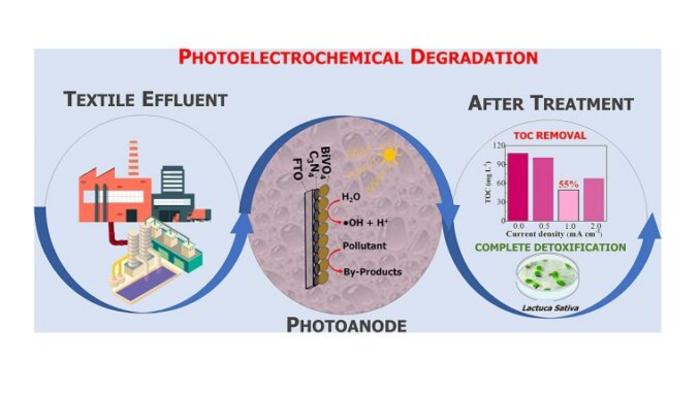
Photoelectrochemical processes have been considered sustainable alternatives for the remediation of water contaminated by domestic or industrial effluents. Simply put, the strategy consists of using solar energy to degrade organic pollutants.

Light-activated materials perform well in treatment of textile effluent

Credit: CDMF

Photoelectrochemical processes have been considered sustainable alternatives for the remediation of water contaminated by domestic or industrial effluents. Simply put, the strategy consists of using solar energy to degrade organic pollutants.

In an article published in the journal Chemosphere, researchers in Brazil describe the synthesis of several different semiconductor materials that can be used as photoanodes. 

Photoanodes are the medium for photogeneration of electrons to produce an electric current in photoelectrochemical systems. The article also describes the use of one of these materials to remove toxic substances such as dyes from real-world effluent produced by the textile industry.

The researchers are affiliated with the Center for Development of Functional Materials (CDMF) and the Center for Innovation in New Energies (CINE).

CDMF is a Research, Innovation and Dissemination Center (RIDC) established by FAPESP at the Federal University of São Carlos (UFSCar). CINE is an Engineering Research Center (ERC) supported by FAPESP and Shell, with facilities at various institutions.

The study was funded by FAPESP via two projects (20/14741-6 and 17/11986-5).

In the study, the researchers synthesized semiconductors comprising carbon nitride (C3N4) and bismuth vanadate (BiVO4).

Bismuth vanadate, associated with the use of solar energy, removed toxic substances efficiently with low electricity consumption. The results suggest that the material, which is inexpensive and easy to produce, has potential applications in industry, especially to treat wastewater from textile mills. Production of the material can be combined with the generation of hydrogen, which in turn can be used to produce electricity. 

About São Paulo Research Foundation (FAPESP)

The São Paulo Research Foundation (FAPESP) is a public institution with the mission of supporting scientific research in all fields of knowledge by awarding scholarships, fellowships and grants to investigators linked with higher education and research institutions in the State of São Paulo, Brazil. FAPESP is aware that the very best research can only be done by working with the best researchers internationally. Therefore, it has established partnerships with funding agencies, higher education, private companies, and research organizations in other countries known for the quality of their research and has been encouraging scientists funded by its grants to further develop their international collaboration. You can learn more about FAPESP at www.fapesp.br/en and visit FAPESP news agency at www.agencia.fapesp.br/en to keep updated with the latest scientific breakthroughs FAPESP helps achieve through its many programs, awards and research centers. You may also subscribe to FAPESP news agency at http://agencia.fapesp.br/subscribe.


Journal

Chemosphere

DOI

10.1016/j.chemosphere.2024.141315

Article Title

Efficient photoelectrochemical real textile wastewater detoxification using photoanodes of C3N4–BiVO4

Article Publication Date

27-Jan-2024

Subject of Research: Technology and Engineering

Article Title: Light-activated materials perform well in treatment of textile effluent

Article References: Original research article

Image Credits: AI Generated

DOI: Not provided

Keywords: Not provided

Cite Scienmag News

Denise Maddox. (April 23, 2024). Light-activated materials perform well in treatment of textile effluent. Scienmag. https://scienmag.com/light-activated-materials-perform-well-in-treatment-of-textile-effluent/

Denise Maddox. "Light-activated materials perform well in treatment of textile effluent." Scienmag, 23 April 2024, https://scienmag.com/light-activated-materials-perform-well-in-treatment-of-textile-effluent/. Accessed 4 September 2026.

Denise Maddox. "Light-activated materials perform well in treatment of textile effluent." Scienmag. April 23, 2024. https://scienmag.com/light-activated-materials-perform-well-in-treatment-of-textile-effluent/

Share27Tweet17
Previous Post

PCORI announces $150 million in funding for new health research

Next Post

Majority of acute care hospitals do not admit representative proportion of Black Medicare patients in their local market

Related Posts

Microplastic extraction methods alter biodegradable polymer detection in soils
Technology and Engineering

Microplastic extraction methods alter biodegradable polymer detection in soils

September 4, 2026
Fluorine doping tunes conductivity in oxyfluoride glasses
Technology and Engineering

Fluorine doping tunes conductivity in oxyfluoride glasses

September 4, 2026
Digital twins enable edge-cloud fault diagnosis for hydropower equipment
Technology and Engineering

Digital twins enable edge-cloud fault diagnosis for hydropower equipment

September 4, 2026
Agricultural waste turned into sustainable supramolecular fibers via wet spinning
Technology and Engineering

Agricultural waste turned into sustainable supramolecular fibers via wet spinning

September 4, 2026
Ferroelectricity discovered in ultrathin two-dimensional gallium oxide films
Technology and Engineering

Ferroelectricity discovered in ultrathin two-dimensional gallium oxide films

September 4, 2026
AI-designed heritage: how audiences respond to authentic cultural designs
Technology and Engineering

AI-designed heritage: how audiences respond to authentic cultural designs

September 4, 2026
Next Post
Majority of acute care hospitals do not admit representative proportion

Majority of acute care hospitals do not admit representative proportion of Black Medicare patients in their local market

  • Mothers who receive childcare support from maternal grandparents show more optimized

    Mothers who receive childcare support from maternal grandparents show more parental warmth, finds NTU Singapore study

    27656 shares
    Share 11059 Tweet 6912
  • University of Seville Breaks 120-Year-Old Mystery, Revises a Key Einstein Concept

    1061 shares
    Share 424 Tweet 265
  • Bee body mass, pathogens and local climate influence heat tolerance

    682 shares
    Share 273 Tweet 171
  • Researchers record first-ever images and data of a shark experiencing a boat strike

    546 shares
    Share 218 Tweet 137
  • Groundbreaking Clinical Trial Reveals Lubiprostone Enhances Kidney Function

    531 shares
    Share 212 Tweet 133
Science

Embark on a thrilling journey of discovery with Scienmag.com—your ultimate source for cutting-edge breakthroughs. Immerse yourself in a world where curiosity knows no limits and tomorrow’s possibilities become today’s reality!

RECENT NEWS

  • Soil chemistry and microbes drive crop nutrient use efficiency
  • Riverbank erosion drives anxiety and PTSD in southwestern Bangladesh communities
  • Machine Learning Predicts Elite Male Sprint Cycling Performance in Multinational Study
  • Microplastic extraction methods alter biodegradable polymer detection in soils

Categories

  • Agriculture
  • Anthropology
  • Archaeology
  • Athmospheric
  • Biology
  • Biotechnology
  • Blog
  • Bussines
  • Cancer
  • Chemistry
  • Climate
  • Earth Science
  • Editorial Policy
  • Marine
  • Mathematics
  • Medicine
  • Pediatry
  • Policy
  • Psychology & Psychiatry
  • Science Education
  • Social Science
  • Space
  • Technology and Engineering

Subscribe to Blog via Email

Enter your email address to subscribe to this blog and receive notifications of new posts by email.

Join 5,151 other subscribers

© 2025 Scienmag - Science Magazine

Welcome Back!

Login to your account below

Forgotten Password?

Retrieve your password

Please enter your username or email address to reset your password.

Log In
No Result
View All Result
  • HOME
  • SCIENCE NEWS
  • CONTACT US

© 2025 Scienmag - Science Magazine

Discover more from Science

Subscribe now to keep reading and get access to the full archive.

Continue reading