


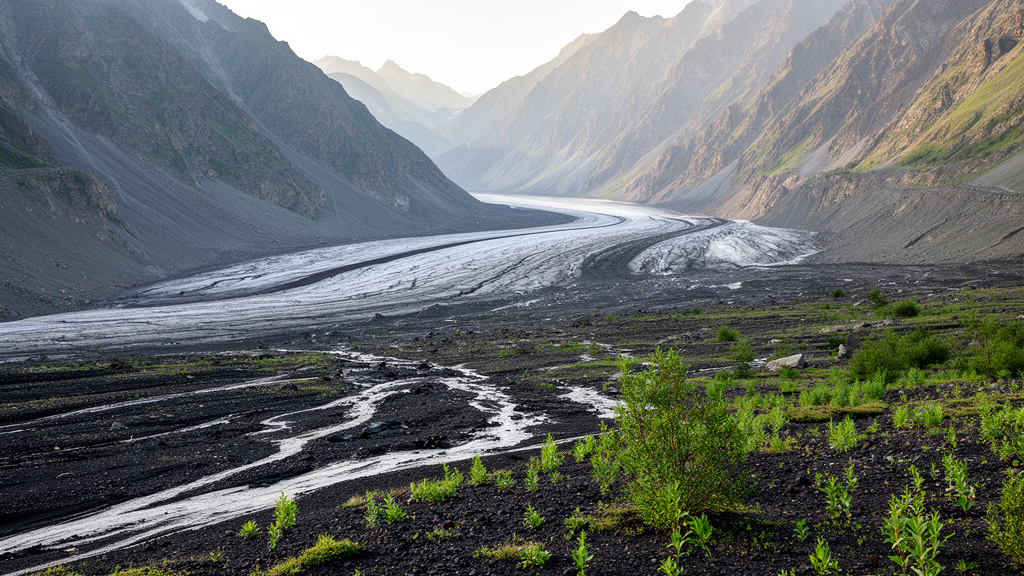
High in the Central Caucasus, at the foot of the Tsey Glacier in North Ossetia – Alania, a team of Russian zoologists has carried out the first study of its kind for the entire Caucasus and for Russia as a whole: a multi-taxa survey of how terrestrial invertebrate communities assemble on land newly freed from ice. Working along a 1.8-kilometre chronosequence of ten precisely dated sites ranging from one to roughly 170 years old, the researchers collected and identified 19,481 specimens belonging to 438 species, from testate amoebae and earthworms to mites, spiders, centipedes, springtails, and beetles. The findings, published in the journal Caucasiana, reveal a succession that is strikingly fast, strongly regional, and dominated at every early stage by endemic high-mountain species.
The scientific backdrop is dramatic. Across the Caucasus, the total glacier area shrank by 23 percent between 2000 and 2022, and the Tsey Glacier itself has retreated by approximately 1,800 metres since the mid-nineteenth century. In the single year before the July 2021 field campaign, the ice margin moved back another 16 metres. Each year of retreat exposes fresh mineral surfaces that are rapidly colonized by living organisms, and over decades these communities transform through primary succession. Because the full trajectory exceeds a scientist’s lifespan, the team used the chronosequence method: sites of known age, established through extensive cartographic work co-registering nineteenth-century military maps, aerial photographs, and modern satellite imagery, stand in for a time series. Crucially, the elevation difference between the youngest and oldest plots was only 265 metres across the 1.8-kilometre profile, allowing the researchers to attribute observed differences to surface age rather than altitude.
The ten plots traced a complete vegetation trajectory. The one-year-old site was bare sandy-gravel ground with 100 percent stoniness and no evident vegetation; by four years, single plantlets and moss patches had appeared; at seven years, reedgrass meadows with draft willows dominated; at fourteen years, a shrub association of willow and birch with isolated young pines had formed. From thirty-four years onward, forests took over: young mixed forest, park-like birch groves, dense small-leaved woodland, sparse pine wood with rhododendron, mature birch forest, and finally an old mossy pine forest with wild strawberry and blueberries. Soil development followed in lockstep, with relative humidity in the upper soil layer rising from about 8 percent on the bare ground to nearly 48 percent in the mature forest, and litter thickness increasing from zero to 20–35 millimetres.
What the invertebrates did on these surfaces challenges some textbook expectations. Testate amoebae, mites, springtails, spiders, harvestmen, beetles, and shore bugs appeared almost immediately, within months of ice retreat. Flightless microarthropods dispersed effectively by air currents, and spiders travelled on their silk threads. On the four-year-old site, enchytraeid worms, dipteran larvae of at least four families, aphids at densities up to 420 individuals per square decimetre, and thrips up to 225 per square decimetre were already present. Woodlice, soil molluscs, and predatory centipedes arrived at seven years; earthworms and millipedes at fourteen; shrews, accompanied by their fleas and ticks, at fourteen years as well. Pseudoscorpions, poor dispersers all, waited sixty to seventy years for a developed forest litter, and cockroaches appeared only on the roughly 170-year-old site.
The pioneer communities were anything but cosmopolitan. Almost all dominant species of the earliest stages are high-montane endemics of the Caucasus: the ground beetle Bembidion pulcherrimum, the springtail Desoria aff. duodecimoculata, and the spider Pardosa aff. ibex on the one-year-old ground; the endemic rove beetle Geodromicus major on the four-year-old site; the granivorous ground beetle Amara cordicollis on the seven-year-old meadow. Among beetles, nearly half of all species found along the profile are Caucasian endemics, and at the pioneer stages they form the main body of the group. The rare ground beetle Deltomerus komarovi, recorded only on the youngest plot, may even be a local endemic of the Tsey Gorge and surrounding mountains. This concentration of endemic specialists on the newest surfaces raises particular concerns about biodiversity losses as Caucasian glaciers shrink dramatically.
Statistical analysis showed that the succession is deterministic and directional, not stochastic. Using non-metric multidimensional scaling, hierarchical cluster analysis, and k-medoids clustering on Bray-Curtis similarities, the communities divided clearly into four large clusters corresponding to the major vegetation stages. Species turnover, measured with the Sørensen-based multiple-site dissimilarity framework of Baselga, was overwhelmingly driven by the turnover rather than the nestedness component for all larger taxa, supporting the replacement model of succession: discrete communities succeed one another along the chronosequence rather than simply accumulating species. Only the passively dispersed testate amoebae, the poorly diverse harvestmen, and the centipedes showed meaningful nestedness, consistent with the addition-and-persistence model expected for weakly dispersing or cold-limited taxa.
Within individual groups, the transformations were radical even where the groups themselves persisted. Once a taxon appeared on the transect, it was generally recorded from most older plots, but its species composition and dominance structure changed often completely, with the strongest restructuring at every major vegetation change. Species diversity generally increased during succession, with Shannon index values rising to 2.7–3.8, though beetles stood out with values never falling below 2.8 from the shrub stage onward. Beetles were also unusual in showing an increase that turned into some decline: the oldest woodlands held only 23–25 species, half as many as in forests just below the mid-nineteenth-century moraine. The general rate of change diminished toward later succession stages, and at the last stages the number of species disappearing began to exceed the number appearing for the first time.
Regional specificity emerged strongly when the pioneer complex was compared with those of the European Alps and northern Europe. Only two spider species found in the Tsey foreland, Agyneta rurestris and Erigone dentipalpis, had been recorded in similar conditions in the Italian Alps, and only one, Zelotes subterraneus, in northern Europe. The Caucasian pioneer spider assemblages were noticeably richer than Alpine ones, with representatives of seven families already at the grassland stage. Among harvestmen, all six species identified are endemic to the Caucasus, and the absence of the genus Mitopus, common in paraglacial communities elsewhere in Europe, is quite special to the study foreland. Among oribatid mites, the ubiquitous Tectocepheus velatus appeared early, mirroring European patterns, but ten of the 74 species found belong to undescribed species, and 11 of the 61 mesostigmatic mites are new to science.
Some arrivals were clearly governed by habitat conditions rather than dispersal capacity. The cosmopolitan testate amoeba Centropyxis cassis proved an absolute pioneer, its live shells confined to the one- and four-year-old plots, yet on a Svalbard glacier foreland the same species remains dominant for at least 150 years, apparently as a non-pioneer cryophile. Earthworm colonization was represented by a single cosmopolitan boreal species, Dendrobaena octaedra, whose cold resistance, parthenogenetic reproduction, small size, and litter lifestyle suit it to new habitats; in the Austrian Alps the same species appears only 50–70 years after ice retreat, whereas in the warmer Caucasus it arrived at fourteen years. The proportion of parthenogenetic mesostigmatic mite species rose steadily during succession, reaching 45 percent of species and 61 percent of abundance in the oldest plots, a pattern the authors link to the Structured Resource Theory of parthenogenesis.
The study also reframes the classical predator-first paradox of paraglacial ecology. In the Central Caucasus, the multi-taxa, multi-guild invertebrate community emerges as a whole almost immediately, so replacing the predator-first principle with a springtail-first principle, as recently proposed for Scandinavian forelands, seems inappropriate here. The authors argue that theoretical constructions about foreland successions remain premature without detailed species identifications, complementary collection methods, and simultaneous data on multiple taxonomic groups. With no grazing by domestic animals in the Tsey Nature Reserve, the postglacial communities restored without human disturbance, and ants, though present from seven years onward, did not damp the diversity growth of most arthropod groups. As the region’s glaciers continue their rapid retreat, the new land they expose is being claimed first by endemic high-mountain specialists, making the fate of these cryophilic species a bellwether for highland biodiversity across the Caucasus.
Subject of Research: Ecology
Article Title: Successions of terrestrial invertebrate communities during the Tsey Glacier retreat, Central Caucasus
Article References: Makarova, O. L., Antipova, M. D., Babenko, A. B., Bushueva, I. S., Chulei, A. D., Golovatch, S. I., Doroshina, G. Y., Kolesnikov, V. B., Mazei, Y. A., Makarov, K. V., Palatov, D., Ponomarev, A. V., Popov, K. P., Rapoport, I. B., Semionenkov, O. I., Snegovaya, N. Y., Sheftel, B. I., Tsyganov, A. N., Turbanov, I. S., & Zuev, R. V. (2024). Successions of terrestrial invertebrate communities during the Tsey Glacier retreat, Central Caucasus. Caucasiana, 3, 41-87. https://doi.org/10.3897/caucasiana.3.e117332
Image Credits: AI Generated
DOI: 10.3897/caucasiana.3.e117332
Keywords: glacier retreat, primary succession, invertebrates, Caucasus, biodiversity, endemic species, chronosequence, paraglacial, Successions, terrestrial, invertebrate, communities
Cite Scienmag News
Gavin Prescott. (October 19, 2026). Life Returns Fast as the Caucasus Tsey Glacier Melts Back. Scienmag. https://scienmag.com/life-returns-fast-as-the-caucasus-tsey-glacier-melts-back/
Gavin Prescott. "Life Returns Fast as the Caucasus Tsey Glacier Melts Back." Scienmag, 19 October 2026, https://scienmag.com/life-returns-fast-as-the-caucasus-tsey-glacier-melts-back/. Accessed 19 October 2026.
Gavin Prescott. "Life Returns Fast as the Caucasus Tsey Glacier Melts Back." Scienmag. October 19, 2026. https://scienmag.com/life-returns-fast-as-the-caucasus-tsey-glacier-melts-back/


