


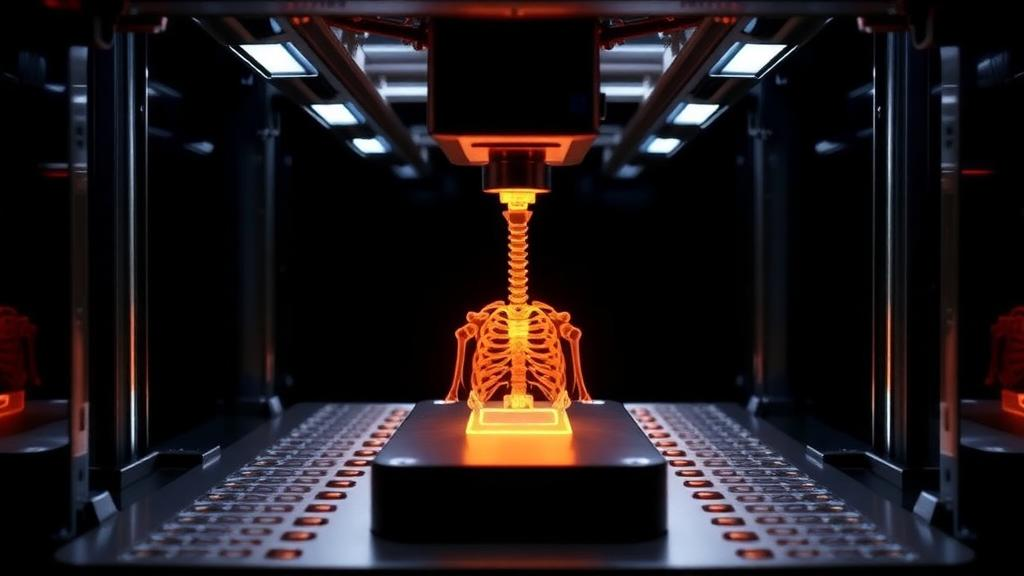
Personalized medicine has a manufacturing problem. The 3D printers that produce patient-specific implants, surgical guides, and porous tissue scaffolds are highly automated at the moment a nozzle lays down molten polymer, yet nearly everything around them—feeding material, inspecting parts, moving finished products—still depends on human hands. A team at the Fraunhofer Institute for Production Technology IPT in Aachen, Germany, working with RWTH Aachen University, has now unveiled a concept for an end-to-end automated production line that could change that, built around a striking piece of engineering: a frictionless, levitating print bed that doubles as the factory’s transport system.
The research, published in Frontiers in Manufacturing Technology, targets extrusion-based 3D printing, known in the standards as material extrusion (MEX) and in its commercial forms as fused filament fabrication or fused granulate fabrication. The technique is cheap, adaptable, and cleanroom-compatible because it needs neither powders nor photoreactive liquids, which makes it a favorite for biomedical polymers such as polycaprolactone, polylactide, and PLGA. But according to the authors, no holistically automated production infrastructure for this process has been established anywhere in academic production technology, and industrial lines still lean heavily on manual steps for material handling and quality control. That gap is the central obstacle to scaling personalized medical devices.
To ground the concept in a concrete use case, the team defined a narrow but demanding product: cell-free, porous tissue-reconstruction scaffolds made of polycaprolactone granulate, printed by fused granulate fabrication. The scaffolds weigh between 10 and 100 grams and measure no more than 100 by 100 by 50 millimeters. Polycaprolactone has a long clinical track record in sutures and implants, and granulate feeding avoids the extra step of producing filament. The choice of a cell-free product matters for process control, because the critical quality attributes of such scaffolds are geometric and mechanical rather than biological: dimensional accuracy, porosity, and the linkage between printed layers.
From a systematic literature review that filtered more than 1,800 papers down to 30 relevant studies, the researchers mapped which process parameters actually matter. Deposition speed, extrusion temperature, and extrusion pressure or rate emerged as the most frequently studied variables. For their use case, the team classified just two as critical process parameters requiring continuous monitoring: the extrusion rate and the extrusion temperature. Other variables, such as nozzle diameter, platform temperature, and cool-down time, are fixed once and validated; ambient temperature and humidity are handled by the cleanroom itself. On the quality side, dimensional accuracy, porosity, and layer linkage were designated critical quality attributes, while biocompatibility is determined by the material choice and biodegradability cannot be measured during production at all.
With requirements in hand—regulatory compliance for cleanroom production under Good Manufacturing Practice, autonomy during production, flexibility and scalability for batch-size-one manufacturing, and integrability with existing equipment—the team used the morphological box method to collect and compare automation solutions for every function in the process chain. A value-benefit analysis then selected the best-rated approach for each function. The result is a coherent architecture in which a magnetic planar drive plays two roles at once: it is the intralogistics transport system for the whole line, and it forms the horizontal X and Y axes of the 3D printer itself.
The planar drive works through magnetic levitation. Movers carrying arrays of permanent magnets float frictionlessly above a stator surface and can be positioned in the plane with a tolerance of 50 micrometers. Each mover carries an exchangeable, sterile, disposable substrate plate on which the scaffold is printed. Because there is no mechanical contact, particle abrasion is minimized—a decisive advantage in a cleanroom, where every shed particle is a potential contaminant. The concept for using a planar drive in 3D printing was first patented in 2022 and validated in the German BMBF-funded research project BellaFactum; the new paper now presents it as the backbone of a complete production system.
The decoupling of print bed and extruder is what unlocks parallelism. While one printed layer cools on one mover, another mover can slide under the extruder and receive the next print job. Movers can also detour to a camera station after every five printed layers, where high-resolution reflected-light images serve three purposes at once: detecting over- or under-extrusion by measuring filament position and thickness, judging layer linkage from the shading at filament intersections, and calculating porosity from the distances between filament lines. If a print fails a threshold, the mover carries the defective substrate to a disposal storage location, reloads, and the same job restarts automatically—no human intervention required.
Final inspection is handled by laser distance measurement, which records a point cloud of the finished scaffold’s outer dimensions and compares it against the planned CAD geometry to catch deformations such as warping. Material logistics are equally automated: a cooled central reservoir stores polycaprolactone granulate under the low-humidity, low-temperature conditions the hydrophilic polymer demands, a gravimetric dosing unit meters precise amounts into transport containers, and an autonomous mobile robot ferries them to the extruder hopper, triggered by an ultrasonic sensor when material runs low. An overarching control software called COPE, developed at Fraunhofer IPT, orchestrates the entire system in a manner the authors describe as compliant with FDA CFR Part 11 requirements for electronic records.
The concept was physically realized as a demonstrator the team calls DIAMS, short for Dynamically Interconnected Additive Manufacturing System. It combines a Beckhoff XPlanar planar drive of twelve tiles, each 240 millimeters square, levitating four movers of 155 by 155 millimeters at a height of 2 millimeters, a screw-based granulate extruder on a vertical linear axis, and a microscope camera on its own axis. A multi-agent path-finding algorithm written in Python, based on model-predictive control with conflict-based search, coordinates the movers collision-free, while a TwinCAT function reads standard G-code and translates it into synchronized motion of the planar and linear axes.
Proof-of-principle tests printed a cuboid scaffold of 50 by 50 by 20 millimeters with a layer height of 200 micrometers five times, using a 400-micrometer nozzle at 130 degrees Celsius and a deposition speed of 15 millimeters per second. The measured base dimensions averaged 49.8 millimeters with a deviation of plus or minus 0.2 millimeters, and the height averaged 19.9 millimeters with a deviation of plus or minus 0.1 millimeters—a maximum shape deviation of 0.4 millimeters from the CAD model. The team observed increased stringing, indicating that print parameters still need optimization, but the general printability of the levitating system was demonstrated. The authors are candid about the limits: the concept covers only polycaprolactone scaffolds in a defined size range, validation used uniform cuboids rather than complex personalized geometries, and economic evaluations remain qualitative. Their next steps include discrete-event simulation of the production line to identify the throughput scenarios where this levitating factory genuinely outperforms conventional printer farms, and deeper research into adaptive, resource-efficient path planning for multi-agent manufacturing systems. If those studies succeed, the frictionless factory floor may move from laboratory demonstrator to the production halls where personalized medicine is actually made.
Subject of Research: Automated extrusion-based 3D printing of personalized medical scaffolds using magnetic planar drive technology
Article Title: Development of an end-to-end automated production concept for extrusion-based additive manufacturing of personalized medical scaffolds
Article References: Janning, K., König, S., Herbst, L., Nießing, B., & Schmitt, R. H. (2025). Development of an end-to-end automated production concept for extrusion-based additive manufacturing of personalized medical scaffolds. Frontiers in Manufacturing Technology, 5, Article 1572842. https://doi.org/10.3389/fmtec.2025.1572842
Image Credits: AI Generated
DOI: 10.3389/fmtec.2025.1572842
Keywords: 3D printing, additive manufacturing, material extrusion, medical scaffolds, personalized medicine, magnetic levitation, planar drive, polycaprolactone, cleanroom production, quality control, automation, biomedical engineering
Cite Scienmag News
Denise Maddox. (October 16, 2026). Levitating Print Beds Could Automate the Factory of Personalized Medical Implants. Scienmag. https://scienmag.com/levitating-print-beds-could-automate-the-factory-of-personalized-medical-implants/
Denise Maddox. "Levitating Print Beds Could Automate the Factory of Personalized Medical Implants." Scienmag, 16 October 2026, https://scienmag.com/levitating-print-beds-could-automate-the-factory-of-personalized-medical-implants/. Accessed 16 October 2026.
Denise Maddox. "Levitating Print Beds Could Automate the Factory of Personalized Medical Implants." Scienmag. October 16, 2026. https://scienmag.com/levitating-print-beds-could-automate-the-factory-of-personalized-medical-implants/


