


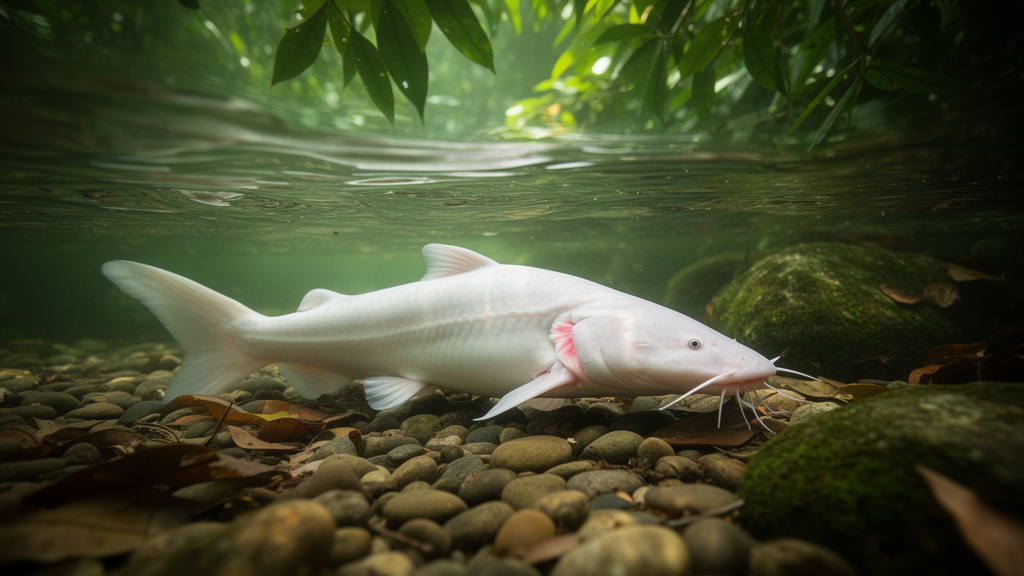
A small, earth-brown catfish from the mountain streams of southern Brazil is offering researchers an unusual window into how color mutations can persist in wild populations instead of being wiped out by natural selection. In a study published in Neotropical Biology and Conservation, a team working in and around the Serra Geral and Aparados da Serra National Parks documented four leucistic individuals of the catfish species Heptapterus mustelinus, all captured at a single site known as Vista Alegre Waterfall in the Mampituba River basin, which straddles the border between the states of Rio Grande do Sul and Santa Catarina. The finding is notable because pigment abnormalities in Neotropical fishes are rarely reported, and even more rarely examined from an ecological point of view.
Leucism is one of several color-altering conditions that can appear in vertebrates, and it is often confused with albinism. In albinistic animals, pigment production fails in both the skin and the eyes, which typically appear red or pink. Leucistic animals, by contrast, lack pigmentation in epithelial tissue while the eyes retain their normal color. Other related conditions include melanism, an excess of dark pigment, and xanthochromism, an unusual abundance of yellow to red pigments. For a nocturnal, bottom-dwelling catfish whose normal earth-brown coloring helps it blend into streambeds and avoid the gaze of fish-eating birds and mammals, the near-white appearance of a leucistic individual would seem to be a serious liability. Yet the new study suggests that in the right circumstances, this mutation may not be a death sentence at all.
The researchers sampled the site using pulsed electric fishing during field campaigns in August 2015 and April 2016. At Vista Alegre Waterfall they captured a total of 39 Heptapterus mustelinus, of which 35 showed the species’ normal coloration and four displayed leucism. The leucistic group included one adult measuring 112.8 millimeters in standard length and three juveniles averaging 62.5 millimeters. The presence of both adults and juveniles, and the fact that leucistic individuals were collected again in a second sampling year after earlier specimens had been removed, convinced the team that the trait was recurring in the population rather than being a one-off curiosity. That recurrence points toward a heritable genetic basis maintained within an isolated subpopulation.
To determine whether leucistic individuals differed from their normally colored relatives in any other way, the team carried out an extensive morphometric analysis. Each fish was measured using 32 characters, including standard length, head length, and dozens of proportional measurements of the body and fins. The leucistic specimens from the Mampituba basin were compared with normally colored fish from the same river and with museum specimens from six additional river basins: the Araranguá River on the coastal drainage, and the dos Sinos, Caí, Gravataí, Jacuí, and Piratini Rivers, all part of the Laguna dos Patos system. These drainages belong to two biogeographic regions recognized for southern Brazil and are known to harbor high levels of endemism among freshwater fishes.
The statistical treatment relied on principal component analysis, or PCA, after log transformation of the data. The results were unambiguous: the morphometric measurements of the leucistic individuals overlapped almost completely with those of normally colored fish from the Mampituba River. In other words, leucistic catfish are not structurally different from their pigmented counterparts; they retain the species’ typical body plan. The components explaining the greatest variation were associated with interdorsal length and preadipose distance, but these accounted for well under one percent of total variation and did not separate leucistic individuals as a distinct group. Among the broader population comparisons, only fish from the Araranguá River showed slight differences from the other basins, and even that did not affect the conclusion about the leucistic specimens.
Why, then, does leucism persist at Vista Alegre? The authors argue that the answer lies in a combination of environmental isolation and relaxed predation pressure. The sampling site is a small stream segmented by rapids and waterfalls, geological features that act as barriers to gene flow among subpopulations. Such isolation can allow unusual traits to become established where they would otherwise be diluted. The stream also runs through dense gallery forest, creating deeply shaded conditions with small caves between the rocks where the catfish can shelter during daylight hours. Under reduced light, the visual advantage that normal brown coloration confers against predators largely disappears, and the conspicuousness of a pale fish matters far less.
The community of fish sharing the stream reinforces this interpretation. Alongside the leucistic catfish, the researchers found only small species: Characidium pterostictum, the armored catfish Pareiorhaphis hypselurus, and a couple of loricariid specimens, all of which are insectivorous or feed on invertebrates and periphyton. Crucially, no piscivorous fish were present at the site. The remaining potential predators, such as the South American raccoon and kingfishers, hunt by sight, and their success in the dim, shaded water is likely to be low. Without strong visual predation, there is little selective pressure against pale individuals, and the mutation can be passed on.
The study also weighs, and largely dismisses, alternative explanations. Exposure to heavy metals is known to induce pigment abnormalities in fish embryos, but the sampling site lies downstream of an environmentally preserved area near a national park, making contamination an implausible cause. Dietary deficiencies, such as a lack of tyrosine needed for melanin synthesis, cannot be ruled out entirely, but the recurrence of the trait across two size classes and two sampling years fits better with a Mendelian pattern of inheritance. The authors point to a comparable case in Japan, where a leucistic catfish crossed with a normal specimen produced offspring in which roughly one quarter lacked skin color, exactly the ratio expected for a recessive trait.
Pigmentation mutations are especially well documented in the order Siluriformes, the catfishes, which account for the majority of the handful of albinism and leucism records in Neotropical freshwater fishes. The broader evolutionary context is provided by the blind cavefish Astyanax mexicanus, which lost its color and eyes after colonizing subterranean environments repeatedly throughout its history. The Brazilian case is different in an important respect: it involves a surface-dwelling species in an open stream, where a color mutation is usually assumed to be deleterious. The authors argue that their findings show such mutations cannot automatically be classified as harmful. In populations restricted to geographically isolated streams with few sympatric species and weak visual predation, leucistic individuals may not only survive but be maintained across generations, and in some circumstances could even increase in abundance.
The team calls for further research into how such traits persist, noting that reports of pigment abnormalities are appearing with growing frequency across the Neotropical region and may reflect environmental influences specific to small, stream-restricted habitats. For now, the pale catfish of Vista Alegre stand as a reminder that a trait which looks like a handicap in a textbook can be a perfectly viable strategy in a dark forest stream, where waterfalls wall off a population and the sun rarely reaches the water.
Subject of Research: Leucism and its possible adaptive value in isolated populations of the catfish Heptapterus mustelinus in southern Brazilian streams
Article Title: A case of leucosis in Heptapterus mustelinus ( Siluriformes , Heptapteridae ) among populations of streams in southern Brazil. Has leucosis in Heptapterus mustelinus an adaptive value in shaded streams?
Article References: Ferraz, M., Schulz, U. H., Santos de Lucena, C. A., & Lehmann A., P. (2023). A case of leucosis in Heptapterus mustelinus (Siluriformes, Heptapteridae) among populations of streams in southern Brazil. Has leucosis in Heptapterus mustelinus an adaptive value in shaded streams?. Neotropical Biology and Conservation, 18(3), 177-189. https://doi.org/10.3897/neotropical.18.e103523
Image Credits: AI Generated
DOI: 10.3897/neotropical.18.e103523
Keywords: leucism, Heptapterus mustelinus, catfish, Brazil, morphometry, PCA, predation, geographic isolation, pigmentation, Neotropical fishes, stream ecology, genetics
Cite Scienmag News
Gavin Prescott. (October 19, 2026). Leucistic Catfish Thrive in Shaded Brazilian Streams, Study Finds. Scienmag. https://scienmag.com/leucistic-catfish-thrive-in-shaded-brazilian-streams-study-finds/
Gavin Prescott. "Leucistic Catfish Thrive in Shaded Brazilian Streams, Study Finds." Scienmag, 19 October 2026, https://scienmag.com/leucistic-catfish-thrive-in-shaded-brazilian-streams-study-finds/. Accessed 19 October 2026.
Gavin Prescott. "Leucistic Catfish Thrive in Shaded Brazilian Streams, Study Finds." Scienmag. October 19, 2026. https://scienmag.com/leucistic-catfish-thrive-in-shaded-brazilian-streams-study-finds/


