


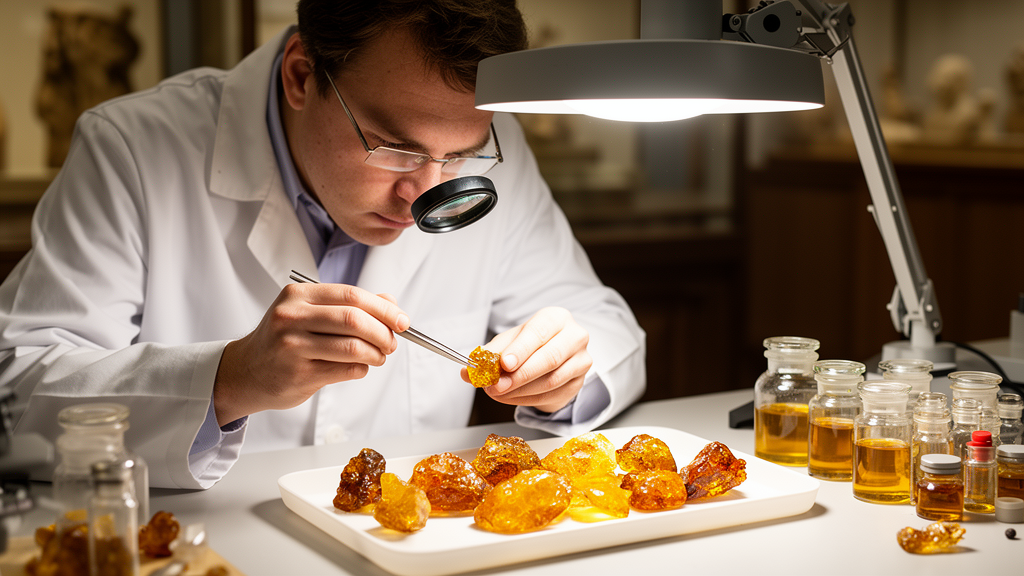
Deep in the attic of the Phyletisches Museum in Jena, Germany, a small collection of amber pieces sat untouched for roughly half a century. When curators cleared storage spaces after the museum’s pandemic closure in 2020, they stumbled upon a forgotten trove of 161 resin pieces, many of them mislabeled, some bearing no labels at all. What followed was a forensic investigation spanning chemistry, history, and high-resolution 3D imaging, and it has now rewritten parts of the fossil record of insects, including the description of two species new to science.
The Phyletisches Museum, founded by the celebrated and controversial zoologist Ernst Hachekel, who laid its cornerstone in 1907, houses some 750,000 specimens. Its paleontological holdings exceed 30,000 objects, and among them were long-known amber pieces containing scientifically precious inclusions such as early strepsipterans. The rediscovered collection, however, was something else entirely: a small, chaotic assemblage whose labels pointed mostly to the Samland Peninsula on the Baltic coast, with a few pieces marked as East African copal and dozens carrying no provenance information whatsoever.
That ambiguity mattered enormously. Amber and copal, a younger, semi-fossilized resin, can look nearly identical to the eye, yet the difference in age can span tens of millions of years. A piece labeled Baltic amber is roughly 40 million years old; East African copal is typically centuries to a few millennia old, and so-called defaunation resin, resin collected from living forests, can be younger than 250 years. If the Jena pieces really were Eocene amber, several ant inclusions would have represented sensational first fossil records of widespread genera such as Dorylus, Crematogaster, Pheidole, and Lepisiota, dramatically extending the evolutionary timelines of entire lineages.
The research team, led by Brendon Boudinot and colleagues, refused to take the labels at face value. They first subjected the pieces to the classic qualitative tests recommended for distinguishing amber from copal: checking whether the material floats in saltwater, examining fluorescence under ultraviolet light, scratching it, and burning tiny samples to observe whether it melts or burns. The results were baffling and contradictory. Every piece floated exactly as its label predicted, yet not a single piece glowed the characteristic blue under ultraviolet light, and the burn tests failed to separate the two resin types cleanly.
The decisive evidence came from quantitative methods. Samples were sent to the International Amber Association in Gdansk, Poland, for Fourier-transformed infrared spectroscopy, a technique that reads the chemical fingerprint of the resin. The results overturned the labels entirely: every pale yellow piece, including those containing the supposedly Eocene ants, turned out to be copal, while the darker, orange pieces were genuine Baltic succinite. Radiocarbon dating sealed the case. A piece containing driver ants of the genus Dorylus yielded an age of roughly 145 years, squarely within defaunation resin, while a piece containing a barklouse dated to about 390 years. Neither was remotely Eocene.
The biological evidence told the same story. Synchrotron-radiation micro-computed tomography, performed at the German Electron Synchrotron facility in Hamburg, allowed the team to reconstruct the trapped insects in exquisite three-dimensional detail. The Dorylus specimens proved identifiable as Dorylus nigricans molestus, an extant subspecies of army ant known from East Africa today, previously recorded from confirmed East African copal. A synincluded platypodine beetle was identified as Doliopygus cf. serratus, another living species restricted to Africa. In contrast, the dark amber pieces yielded genuinely ancient treasures, including the extinct ant Yantaromyrmex geinitzi, a species endemic to Baltic amber.
The investigation also yielded genuine novelties. From a piece of copal dated to roughly 390 years old, the team described Amphientomum knorrei, a new species of scaled barklouse in the family Amphientomidae, named in honor of the museum’s longtime curator and historian Diedrich von Knorre. Because the species is preserved in copal rather than true amber, it may still be alive in East Africa today. To capture this possibility, the authors introduced a novel taxonomic convention: a double dagger symbol to denote species known only from copal or defaunation resin, distinguishing them from the single dagger used for true amber fossils that are certainly extinct.
From a piece of genuine Baltic amber came a second new species, Baltistena nigrispinata, a tumbling flower beetle of the family Mordellidae distinguished by striking black combs of scale-like setae on its hind legs. The team also designated a neotype for the ant Pheidole cordata, a name that has vexed systematists since 1829, anchoring the long-ambiguous species to a radiocarbon-dated copal specimen from the collection. Beyond the new species, the study delivered sweeping taxonomic housekeeping: dozens of poorly preserved ant fossils were transferred out of the genus Camponotus into form genera such as Camponotites and the newly erected Eocamponotus and Incertogaster, precisely so that unreliable names cannot be misused as calibration points in evolutionary analyses.
Historical detective work traced the collection’s likely path into the museum. Handwriting analysis and archival testimony point to Ernst Haeckel’s successor era and, more specifically, to Ernst Uhlmann, a preparator and later director of the museum who kept a small amber collection and bequeathed it to von Knorre, who in turn deposited it in the museum’s holdings. An original invoice from the Prussian mining company operating the amber works in Koenigsberg, dated to the window between 1923 and 1929, anchors at least one purchase to the interwar period, when roughly 500 tons of amber were harvested annually from the Samland Peninsula.
The broader lesson resonates far beyond one German attic. As the authors emphasize, qualitative tests long recommended for identifying amber fail spectacularly when benchmarked against quantitative methods such as infrared spectroscopy, and label data alone can never substitute for chemical and biological verification. With an ever-growing flood of amber fossils, particularly from Cretaceous Burmese amber, feeding into phylogenetic and macroevolutionary studies, mislabeled material can silently distort evolutionary timelines. At the same time, the team argues, the young resins should not be dismissed: copal and defaunation resin preserve snapshots of recent biodiversity and may offer a final, urgent window on ecological communities now being lost to deforestation and climate change. The rediscovered collection, now sorted into defaunation resin, copal, and true Baltic amber, stands as both a scientific resource and a cautionary tale about the quiet power of a museum label.
Subject of Research: Provenance analysis and taxonomic revision of a rediscovered amber and copal collection from the Phyletisches Museum Jena
Article Title: Et latet et lucet : Discoveries from the Phyletisches Museum amber and copal collection in Jena, Germany
Article References: Boudinot, B. E., Bock, B. L., Weingardt, M., Tröger, D., Batelka, J., LI, D., Richter, A., Pohl, H., Moosdorf, O. T. D., Jandausch, K., Hammel, J. U., & Beutel, R. G. (2024). Et latet et lucet: Discoveries from the Phyletisches Museum amber and copal collection in Jena, Germany. Deutsche Entomologische Zeitschrift, 71(1), 111-176. https://doi.org/10.3897/dez.71.112433
Image Credits: AI Generated
Keywords: amber, copal, Phyletisches Museum Jena, fossil insects, infrared spectroscopy, radiocarbon dating, micro-computed tomography, new species, Formicidae, Psocodea, Baltic amber, taxonomic revision
Cite Scienmag News
Gavin Prescott. (October 19, 2026). Lost amber trove rediscovered in Jena museum yields new species and a lesson in fossil skepticism. Scienmag. https://scienmag.com/lost-amber-trove-rediscovered-in-jena-museum-yields-new-species-and-a-lesson-in-fossil-skepticism/
Gavin Prescott. "Lost amber trove rediscovered in Jena museum yields new species and a lesson in fossil skepticism." Scienmag, 19 October 2026, https://scienmag.com/lost-amber-trove-rediscovered-in-jena-museum-yields-new-species-and-a-lesson-in-fossil-skepticism/. Accessed 19 October 2026.
Gavin Prescott. "Lost amber trove rediscovered in Jena museum yields new species and a lesson in fossil skepticism." Scienmag. October 19, 2026. https://scienmag.com/lost-amber-trove-rediscovered-in-jena-museum-yields-new-species-and-a-lesson-in-fossil-skepticism/


