


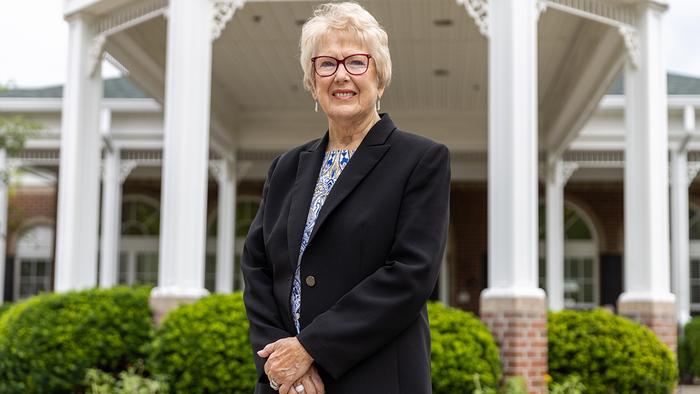
A researcher at the University of Missouri has developed a program that improves the quality of care and reduces avoidable hospitalizations in nursing homes — saving Missouri nursing homes and Medicare millions of dollars and allowing Missouri nursing homes to invest more in retaining their most skilled staff members. The program is so successful that it’s being recommended for use in all 50 states.

Credit: University of Missouri
A researcher at the University of Missouri has developed a program that improves the quality of care and reduces avoidable hospitalizations in nursing homes — saving Missouri nursing homes and Medicare millions of dollars and allowing Missouri nursing homes to invest more in retaining their most skilled staff members. The program is so successful that it’s being recommended for use in all 50 states.
The Quality Improvement Program for Missouri (QIPMO) was created by Marilyn Rantz in 1999 as a partnership between Mizzou’s Sinclair School of Nursing and the Missouri Department of Health and Senior Services.
For the past 25 years, the program has allowed Rantz and her team of experts to meet with the staff and administrators of hundreds of nursing homes throughout Missouri, providing them with strategies to detect illnesses earlier, control the spread of infections and improve all parts of the quality of care they provide.
A new study confirms what Rantz has long known — the QIPMO program works.
The study, which was recently published in the Journal of the American Medical Directors Association, evaluated all 510 Missouri nursing homes that received free services through the QIPMO program from 2020 to 2022. It tracked the number of issues related to various quality measures such as urinary tract infections, high-risk pressure ulcers, antipsychotic use, emergency room visits and hospitalizations, among others.
“The data gets deep into the nitty-gritty details, but the key takeaway is that every single nursing home that received our QIPMO services saw overall improvement,” said Rantz, a Curators’ Distinguished Professor Emerita who has worked in and with the nursing industry for nearly 55 years. “Whether it’s infection control practices, disinfecting procedures in common spaces, education regarding hand-washing or noticing if something seems off with a resident’s behavior, ensuring these evidence-based best practices are being followed around the clock is key. The program has helped improve hundreds — if not thousands — of lives.”
From mid-MO to nationwide
The coronavirus pandemic exposed many issues that U.S. nursing homes have been dealing with for decades, including staffing shortages, underpaid staff and a lack of personalized care. In response, the National Academies of Sciences, Engineering and Medicine selected Rantz to join a committee of nursing home experts nationwide, recognizing her expertise in improving the quality of care in nursing homes.
In 2022, the committee released a national report providing recommendations to the U.S. Congress and nursing home associations for improving the quality of care in nursing homes throughout the country. Among the recommendations is for quality improvement programs that have a proven track record of success — such as QIPMO — to be emulated in all 50 states nationwide.
“Our work at Mizzou and with the Missouri Department of Health and Senior Services has set the standard in terms of raising the bar for nursing home care statewide,” Rantz said. “Now, it is time to get these best practices implemented across the country.”
“Longitudinal evaluation of a statewide quality improvement program for nursing homes,” was published in the Journal of the American Medical Directors Association.
A living legend
Rantz began her nursing career in 1970. By 1981, she became a nursing home administrator in Wisconsin, leading a staff of more than 400 people and overseeing a 300-bed nursing home.
In her more than 30 years working at Mizzou, Rantz has earned $108 million in total grants, authored or co-authored 250 published research studies and was inducted into the National Academy of Medicine in 2012. She is one of the reasons why Mizzou has seen 10 consecutive years of growth in research expenditures.
In 2020, Rantz was honored as a ‘Living Legend’ by the American Academy of Nursing for her dedicated commitment to improving the quality of care in nursing homes.
Journal
Journal of the American Medical Directors Association
Method of Research
Data/statistical analysis
Subject of Research
People
Article Title
Longitudinal Evaluation of a Statewide Quality Improvement Program for Nursing Homes
Article Publication Date
31-May-2024
Cite Scienmag News
Courtney Benton. (June 24, 2024). Leading the way in nursing home care. Scienmag. https://scienmag.com/leading-the-way-in-nursing-home-care/
Courtney Benton. "Leading the way in nursing home care." Scienmag, 24 June 2024, https://scienmag.com/leading-the-way-in-nursing-home-care/. Accessed 6 September 2026.
Courtney Benton. "Leading the way in nursing home care." Scienmag. June 24, 2024. https://scienmag.com/leading-the-way-in-nursing-home-care/

