


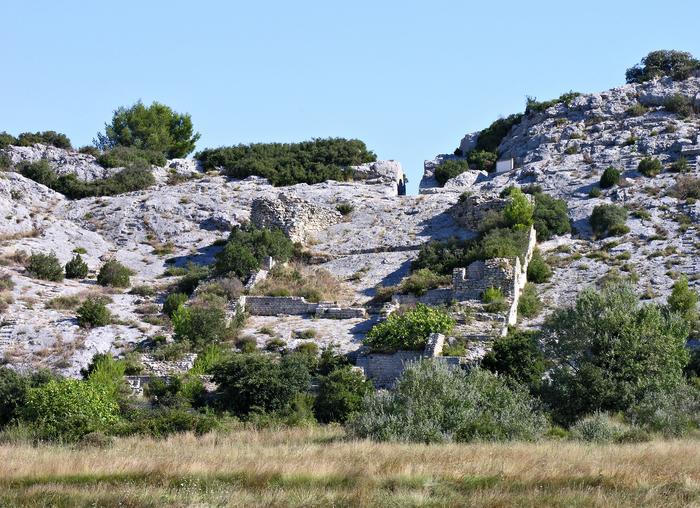
Archaeologists face a major challenge when they intend to acquire information about buildings or facilities of which only ruins remain. This was a particular challenge for the remnants of the Roman water mills in Barbegal in Southern France, dating back to the 2nd century CE. This unique industrial complex consisted of 16 water wheels placed in parallel rows, eight on the east and eight on the west side, which were operated in a waterfall-like arrangement. Little could at first be deduced about the site from these now scant ruins – except that the wheels were supplied by an aqueduct that brought water from the surrounding hills. A coin issued during the reign of the Emperor Trajan discovered in a basin above the mill complex as well as the structural characteristics of the site indicate that the mill was in use for about 100 years. However, the type of mill wheels, their function and how they were employed has remained a mystery until now.

Credit: photo/©: Robert Fabre
Archaeologists face a major challenge when they intend to acquire information about buildings or facilities of which only ruins remain. This was a particular challenge for the remnants of the Roman water mills in Barbegal in Southern France, dating back to the 2nd century CE. This unique industrial complex consisted of 16 water wheels placed in parallel rows, eight on the east and eight on the west side, which were operated in a waterfall-like arrangement. Little could at first be deduced about the site from these now scant ruins – except that the wheels were supplied by an aqueduct that brought water from the surrounding hills. A coin issued during the reign of the Emperor Trajan discovered in a basin above the mill complex as well as the structural characteristics of the site indicate that the mill was in use for about 100 years. However, the type of mill wheels, their function and how they were employed has remained a mystery until now.
Carbonate fragments provide remarkable information
Professor Cees W. Passchier and Dr. Gül Sürmelihindi from Johannes Gutenberg University Mainz (JGU), in collaboration with colleagues from France and Austria, have now unraveled the history of the mill complex using calcium carbonate deposits that are now stored in the Archaeological Museum of Arles. These deposits had formed towards the end of the roughly 100-year operational life of the Barbegal water mills on the sides and base of the wooden supply system that conveyed the water to the wheels. “We show that it is possible to reconstruct to a large extent the history of a water mill on the basis of such carbonate deposits,” stated Passchier, head of the JGU team. First, the researchers had to fit some of the total of 140 stored pieces together like a jigsaw puzzle, then they analyzed the layers using various techniques, including mass spectrometry.
Wooden water wheels and gutters were replaced
The researchers have now published their results in Geoarchaeology. “We were able to show, for example, that wooden water wheels and water channels had to be replaced after three to eight years. In at least one case, an old water wheel was replaced by a larger one,” said Passchier. The researchers drew this conclusion from the unusual shape of the carbonate deposits that had formed in the water channel. While the lower and earlier layers indicate that water levels must have originally been relatively low, upper and later carbonate layers indicate a higher water level. The possibility that there was originally less water flowing through the water channel which was subsequently increased was rejected by the researchers. They established that – for a gently sloping water channel and low water level – the amount of water provided would not have been sufficient to drive a mill wheel. Therefore, the inclination of the water channel must have been altered, from what was at first a steeper angle with a low water level to a shallower slope transporting water at a correspondingly higher level. “The entire structure of this water mill must have been modified,” said Passchier. “If you uplift the water channel alone, the water tends to splatter, losing the power to drive the wheel efficiently. Thus, when you uplift the water channel, you also need a larger water wheel.” In fact, a section of carbonate deposit formed on the water wheel corroborates this conclusion as it does not contain all the carbonate layers but only those of the latter years of operation.
Results of isotope analysis provide evidence of the mill’s service life
Using isotope analysis of the carbonate layers, the researchers were even able to ascertain the operating periods before which parts of the mill required renewal. Carbonate contains oxygen and the relative ratios of oxygen isotopes differ depending on water temperature. Based on the isotope composition in the carbonate layers, the researchers were able to infer water temperatures and thus identify the seasons in which the layers were deposited. They concluded that the carbonate from the samples in the Archaeological Museum in Arles had been deposited in the water channels over a period of seven to eight years. “The uppermost and thus youngest carbonate layer contains mollusk shells and fragments of wood, showing that the mill must have been abandoned by then and was disintegrating. The water continued to flow for a while so that carbonate deposits also continued to form, but maintenance of the water channels ceased,” said Passchier.
The researchers were able to answer yet another question. It was not previously known whether the mills had been run in combination by a single operator or whether the 16 water wheels had been used independently of each other. Judging from the layers of three investigated water channels, which are clearly different from each other, the mills were in operation separately – at least towards the end of their lifetime. Moreover, the western side of the complex was abandoned earlier than the eastern side. Finally, long pieces of carbonate from the water channels were later used as partition screens in a water basin for other industrial purposes after the mills had already been abandoned.
Related links:
Read more:
- – press release “The Aqueduct of Constantinople: Managing the longest water channel of the ancient world” (11 May 2021)
- – press release ” The hydraulics of the world’s first industrial plant: A unique construction in the Barbegal water mills” (13 Nov. 2020)
Journal
Geoarchaeology
Article Title
Operation and decline of the Barbegal mill complex, the largest industrial complex of antiquity
Article Publication Date
13-Jun-2024
Cite Scienmag News
Courtney Benton. (July 1, 2024). Layers of carbonate provide insight into the world of the ancient Romans. Scienmag. https://scienmag.com/layers-of-carbonate-provide-insight-into-the-world-of-the-ancient-romans/
Courtney Benton. "Layers of carbonate provide insight into the world of the ancient Romans." Scienmag, 1 July 2024, https://scienmag.com/layers-of-carbonate-provide-insight-into-the-world-of-the-ancient-romans/. Accessed 4 September 2026.
Courtney Benton. "Layers of carbonate provide insight into the world of the ancient Romans." Scienmag. July 1, 2024. https://scienmag.com/layers-of-carbonate-provide-insight-into-the-world-of-the-ancient-romans/

