

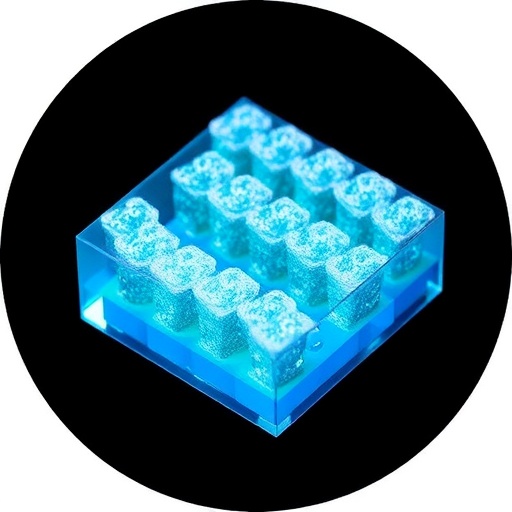
In a groundbreaking study set to revolutionize the field of environmental remediation, researchers have unveiled a novel approach leveraging the unique properties of layered double hydroxides (LDHs) to combat the pervasive issue of toxic heavy metal contamination. The work titled “Spatiotemporally ordered topological transformation in layered double hydroxides enables synergistic mineralization of As^III^/Cd^2+^,” published in Nature Communications in 2026 by Zheng, M., Du, H., Cao, X., and colleagues, details an unprecedented material transformation mechanism that advances mineralization strategies for arsenic and cadmium ions.
Heavy metal pollution, particularly by arsenite (As^III^) and cadmium (Cd^2+^), poses critical environmental and public health risks worldwide. These contaminants infiltrate water sources through industrial discharge, mining activities, and agricultural runoff, demanding efficient methods for removal and stabilization. The challenge has been to design materials capable of not only adsorbing these ions but also converting them into stable mineral forms that mitigate bioavailability and toxicity. This innovative study demonstrates that LDHs, a class of lamellar materials characterized by positively charged hydroxide layers balanced by interlayer anions, can undergo spatiotemporally orchestrated topological transformations to capture and mineralize these contaminants synergistically.
Central to the researchers’ approach is the exploitation of the dynamic structural adaptability of LDHs. Traditionally, LDHs have been employed for ion exchange and adsorption; however, their ability to transform topologically in response to environmental cues introduces a new paradigm in targeted remediation. The study meticulously elucidates how the LDH layers, upon interacting with arsenite and cadmium ions under controlled conditions, rearrange spatially and temporally to integrate these ions within their matrix, facilitating nucleation and growth of mineral phases that effectively sequester the contaminants.
Using an array of advanced characterization techniques, including high-resolution electron microscopy, X-ray diffraction, and synchrotron-based spectroscopy, the team uncovered the mechanistic underpinnings of this transformation. The findings reveal an intricate sequence where initially intercalated ions induce lattice distortions, triggering adjacency layer migration and reassembly. This process culminates in the formation of robust mineral phases analogous to naturally occurring arsenate and cadmium mineral structures. Importantly, this transformation is not random but follows an ordered spatiotemporal pattern that maximizes ion incorporation and mineral stability.
One of the key insights from the study is the synergistic effect arising from the simultaneous presence of As^III^ and Cd^2+^. Instead of competing for adsorption sites, these ions cooperatively influence the LDH transformation pathway, enhancing the efficiency of mineralization. This synergy arises from complementary chemical affinities and the ability of the LDHs to optimize layer spacing and charge distribution dynamically, facilitating co-precipitation phenomena. Such synergistic mineralization could lead to enhanced removal efficiencies in complex contaminated matrices where multiple heavy metals coexist.
The researchers also emphasized the environmental significance of this mechanism in real-world scenarios. By mimicking natural mineralization processes observed in geochemical environments, the LDH transformation advances biomimetic remediation strategies that are more sustainable and effective than conventional approaches reliant on harsh chemical treatments or energy-intensive processes. The material’s ability to self-assemble into mineral phases reduces secondary pollution risks and enables long-term immobilization, an essential attribute for practical applications in water treatment and soil remediation.
A compelling aspect of this study is its demonstration of controllability over the transformation process. By tuning external parameters such as pH, temperature, and ion concentration, the team achieved precise regulation of the LDHs’ morphological and compositional evolution. This customizable control allows for optimization tailored to specific contamination profiles, broadening the versatility of the material system. Moreover, scalability assessments suggest that the approach is amenable to mass production and integration into existing remediation frameworks.
The implications of these findings extend beyond environmental chemistry into the realm of material science and nanotechnology. The concept of spatiotemporally ordered topological transformation could inspire the design of smart materials with programmable reactivity and adaptive functionalities. Applications could range from targeted drug delivery systems to catalysis and sensors, where controlled structural rearrangements enable responsive behavior. This study vividly illustrates the potential of marrying structural dynamics with chemical functionality.
Remarkably, the study also provides insights into the kinetics of the mineralization process. Through time-resolved experiments and computational modeling, the researchers mapped the transformation trajectory, revealing rate-limiting steps and intermediate phases. Understanding these kinetics paves the way for further refinement of the process, potentially enabling rapid remediation in emergency scenarios like industrial spills or natural disasters.
The interdisciplinary nature of this research, integrating materials chemistry, environmental science, spectroscopy, and computational modeling, exemplifies the collaborative effort required to tackle today’s pressing environmental challenges. The authors argue that future research should focus on expanding the range of adaptable LDH compositions, testing performance in field conditions, and exploring the transformation mechanism for other toxic metals and metalloids.
This discovery arrives at a crucial time, as regulatory pressures and public demand for clean water solutions surge globally. The innovation heralds a new era where materials do not merely capture pollutants but actively transform to render them harmless. Given the scalability and environmental compatibility of the proposed LDHs, this technology could emerge as a cornerstone in next-generation heavy metal remediation strategies.
The study concludes with a forward-looking perspective, underscoring the need for pilot-scale implementations and long-term stability assessments to transition this promising technology from the laboratory to real-world applications. The ability to manipulate topological transformations for environmental benefit may ignite a wave of material innovations, positioning layered double hydroxides as central players in global sustainability efforts.
In essence, this pioneering work unravels the untapped potential of LDHs to act as dynamic, adaptive matrices that reconfigure themselves in space and time to neutralize toxic arsenic and cadmium ions synergistically. The spatiotemporal ordering aspect ensures efficient mineralization pathways, setting a new benchmark for the remediation field that could substantially improve environmental health outcomes worldwide.
Such breakthrough research stands as a testament to the power of innovative material design coupled with environmental imperatives. As heavy metal pollution threatens ecosystems and human health, the strategies detailed in this study offer a beacon of hope—materials engineered not only to resist contamination but to transform pollutants into inert, stable forms through intelligent structural evolution.
This novel mechanism of environmental detoxification may inspire a suite of advanced materials, each designed to respond dynamically to specific contaminants, thus propelling environmental remediation into a new scientific frontier. With further exploration and refinement, the spatiotemporally ordered topological transformation demonstrated by Zheng and colleagues has the potential to redefine how society manages the persistent problem of heavy metal pollution.
Subject of Research:
Spatiotemporal topological transformations in layered double hydroxides for synergistic mineralization of arsenite (As^III^) and cadmium (Cd^2+) ions.
Article Title:
Spatiotemporally ordered topological transformation in layered double hydroxides enables synergistic mineralization of As^III^/Cd^2+^
Article References:
Zheng, M., Du, H., Cao, X. et al. Spatiotemporally ordered topological transformation in layered double hydroxides enables synergistic mineralization of As^III^/Cd^2+. Nat Commun (2026). https://doi.org/10.1038/s41467-026-68326-2
Image Credits:
AI Generated


